Desire, Memory, Belonging The shabby door

There was a Korean friend. A Japanese boyfriend. A Filipina love affair that burned hot and short. Several Thai and half-Thai women and men, one of whom has already appeared on this blog. A decade of Grindr, Tinder, Twitter, Snapchat, all of them quietly sorting the world for me, and me letting them, because the sorting matched something I already wanted.
That’s not a story. That’s a catalog.
And a catalog is a worse thing to find in your own life than a story is, because a story has a shape and a reason and a wound at the bottom of it, and a catalog just has a pattern. I fell for the pattern blindly. For years. I want to be precise about that before anything else in this post makes me sound thoughtful: the thinking came after. The wanting came first, and it came with the reliability of a tide.
So. Why?
Why do I look at Southeast Asians – and, in some respects, East Asians – and feel the thing, and look at Central Europeans and feel the opposite of the thing? Not neutral. The opposite. Why does my desire have a map, and why does the map have borders on it that look uncomfortably like borders?
Attraction has a biography, not a biology
Let’s start with the part I expected to be reassuring and wasn’t: The best study on this is a big one – Germine and colleagues, 2015, tens of thousands of people, including identical and fraternal twins. They wanted to know how much of face preference is shared between humans and how much is yours alone. The shared part is real: symmetry, averageness, skin texture, the usual suspects. Everyone likes them a bit. But they’re a minority of what’s going on. Roughly half of what makes a specific face attractive to a specific person is that person’s own private business – and, crucially, it is almost entirely not heritable. Identical twins, same genes, same house, same parents, do not agree about who’s hot.
Which means the answer isn’t in my DNA. It’s in my life. Whatever built this thing in me, I watched it get built and didn’t notice.
The mechanism is boringly mechanical – show a brain enough faces and it computes a running average, and it grades everything new against that average. Change the diet of faces and the average drifts, and attractiveness ratings drift with it – Gillian Rhodes and others have moved people’s taste in a laboratory in under ten minutes. Your eye is not a judge. Your eye is a thermostat. (Standard caveat, and it matters: a lot of the flashier evolutionary-psychology work on beauty – the ovulation stuff, the grand symmetry claims – replicated badly or not at all. Treat the universals as small and soft. Treat anyone who tells you your desire is written in the species with suspicion).
I like this research. It’s also useless to me in the exact place I need it. It explains why individual taste varies wildly and how it gets assembled. It cannot tell me why mine points where it points. For that I have to go back to a village.
A village, 1,500 people, and a boy with a Chinese admiral problem
From when I was six years old on, I grew up in a Bavarian village of about fifteen-hundred people, the child of atheist Munich transplants, speaking Standard German in a place where nobody spoke Standard German, outside the church, outside the clubs, outside the entire operating system the place ran on. I have written before that I say I’m from Munich. That’s not geography. That’s a position.
And what grabbed the outsider kid was, of course, the furthest possible thing from the room he was standing in: Shōgun, the 1980 one, on a television years after it aired. Every early-2000s action movie that contractually had to spend one scene in Hong Kong, wearing its cliches like a rented suit. Emperor: Rise of the Middle Kingdom. Three Kingdoms: Fate of the Dragon. Battle Realms. And historic topics: The rise and fall of the Khmer Empire. The story of the Đại Việt monarchy. The life of Zheng He, who kept me awake at two in the morning on school nights, because in the early 1400s a eunuch admiral took treasure fleets across the Indian Ocean with ships that made European carracks look like bath toys, and then the court decided the sea wasn’t worth it and burned the plans, and world history turned left instead of right. I lay in bed in Upper Bavaria and grieved for a maritime empire that chose not to happen. My mind lived in – East Asia.
Then, in 1999, secondary school, there was a girl from Thailand. She caught my attention, and she caught everybody’s attention, which is a sentence I have to leave standing there and not soften, because she was thirteen too and she did not consent to being anybody’s revelation.
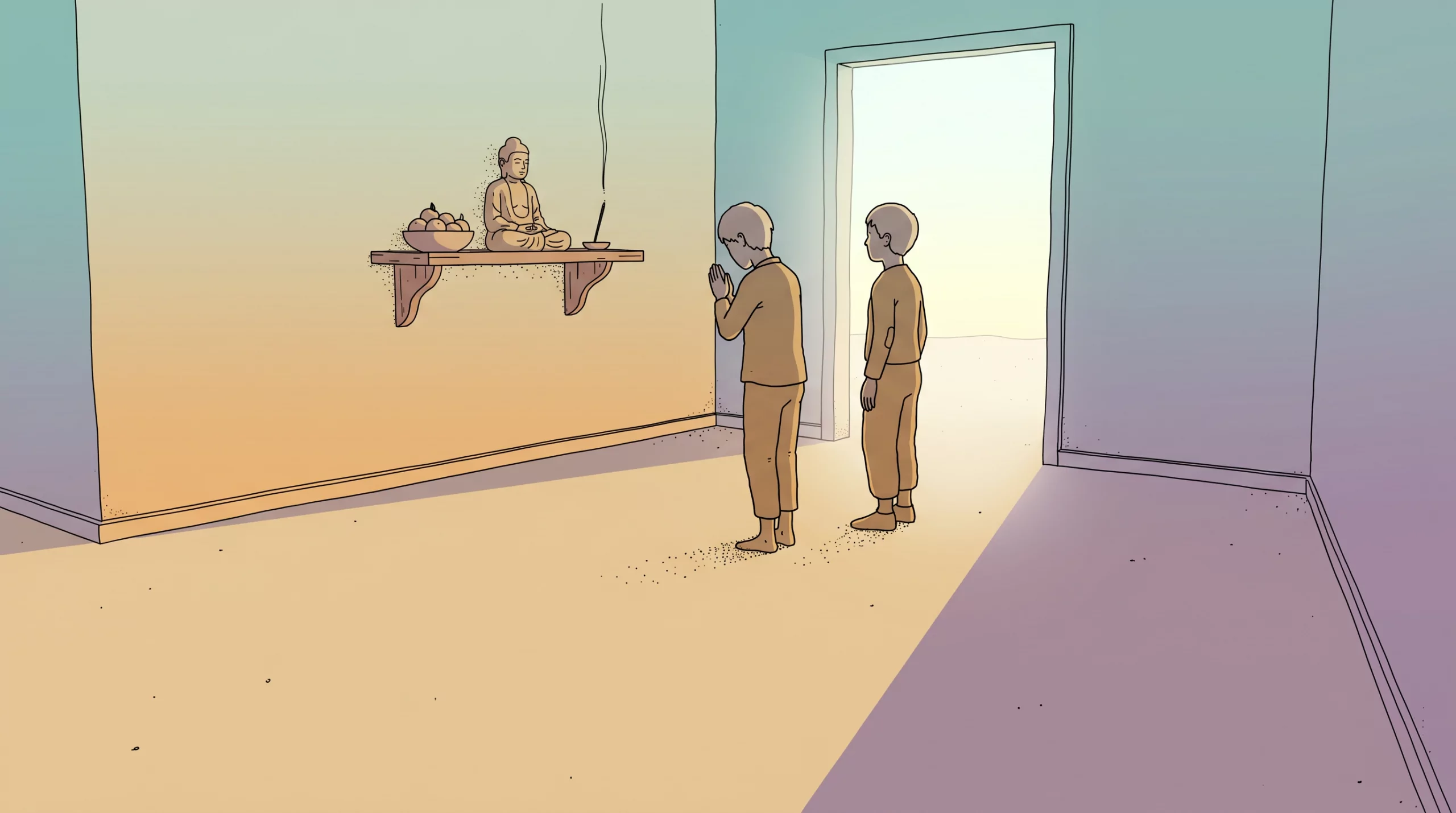
We became friends. I went to her house – for years. And what I kept from that house – I checked, I went looking, this is the honest inventory – is not her face. It’s incense. A small altar with a Buddha on it, and her praying in front of it without a sound. Food that was too hot for me and that I ate anyway. Music I’d never heard. And her speaking to her mother in a language I couldn’t follow, which arrived in my ears as melody, because that’s what a language is when you can’t understand it.
Five channels, no person. I didn’t come out of that house with a girl, even after years. I came out with a world, and I had already been building that world out of books, movies, miniseries, games, and an general interest in East Asian history and culture, including an dead admiral.
She didn’t start it. She gave it an address.
The word for this is not romantic
Orientalism sounds like a Renaissance painting movement, all silk and lamplight, and I think a lot of people hear the word and picture something in a gilt frame. It isn’t that. Edward Said‘s argument, stripped to the bone, is that the West assembled an imaginary East – serene, sensual, ancient, available, slightly unreal – and then used the picture instead of the place. And the picture didn’t stay in academia. It went into the movies, into the games, into the pornography, into the folk wisdom about who is soft and who is fierce, into an entire vocabulary of preference that circulates in gay male spaces under names I’m not going to be coy about because I’ve heard them applied to me.
So when a German teenager in a village of fifteen-hundred assembles an entire civilization out of Hollywood, Koei and a paperback, and then grows up wanting to sleep with it, the honest name for that is not an unusual sensitivity to Asian aesthetics. The honest name is that the rails were laid before I got there and I rode them at speed.
I can hear the defense forming, because I’ve made it before. It wasn’t only that. There was real interest, real history, real reading, real friendships. Sure. All true. And a preference that runs on rails doesn’t stop being on rails because the passenger enjoyed the view.
The tell I can’t argue with: Until recently I’d have told you, sincerely, that there was a kind of beauty here in Vietnam that was general – a deeper elegance, a purity, visible in almost everyone, regardless of gender or age. Read that sentence cold. Purity. Elegance. Serenity. That’s not an observation about a hundred million people. That’s the trope, reciting itself in my voice, and it went unexamined in my head for twenty-five years.
A preference that can’t tell its objects apart isn’t a preference for people. It’s a preference for an image.
The shabby door
Now the part where the essay would like to stay noble, and doesn’t get to: In 2017 my company started building an engineering team in Vietnam. Colleagues flew out before I did, and they came back with stories, and not all of the stories were about the office, the people, and the culture. Some of them were about the apps. They were good stories. I listened to them with an interest I would describe, generously, as professional.
I moved in 2018. I told myself, and other people, a set of reasons: the work, the city, the cost of living, the adventure, the escape velocity from a German life I’d stopped wanting. All of that was true. And also, in the mix, somewhere between the visa paperwork and the flight, was a man in his early thirties who had been running the same pattern uninterrupted for over a decade and who had just been told the dating in Sài Gòn was excellent.
It was Tinder and Grindr. I enjoyed it.
That’s the door I came through. Not the admiral. Not the altar. Not the weight of history. A shabby little door with an app icon on it, and a colleague’s anecdote for a doorbell.
I keep that in the text on purpose, right here, up front, before the serious part – because the serious part is coming and I refuse to let it pretend it arrived on its own. A man can carry a real grief about a war that isn’t his and also move countries partly because his friends said the swiping was good. Both of those were true on the same Monday. They were true on a lot of Mondays.
Eight years of losing the image
Something happened that I did not plan and could not have engineered, and it’s the only cure I’ve found: I’m attracted to fewer Vietnamese people now than I was in 2018. Substantially fewer.
That sounds like a loss – but it’s the opposite. What’s actually happening is that I got good at seeing faces here – the way you’re good at seeing faces from your own place, where nobody is a German man, they’re this specific irritating German man with the eyebrows. Psychologists call the flipside of this the other-race effect, and it’s not a moral failing, it’s a perceptual deficit: unfamiliar faces collapse into a type because you haven’t got the resolution yet. The type is what I was attracted to. Once the resolution arrives, the type dissolves, and there’s nobody there to want. Just people. Some of whom I want, most of whom I don’t, exactly as it works everywhere else in the world.
The image lost to the humans. Slowly, without my involvement, and mostly because I stayed.
The war that isn’t mine
And then there’s the thing I can’t explain, which I have to write carefully or it’ll turn into astrology: Whenever the American War comes up – and here it comes up, it lives in this country the way weather lives in a country – something in my chest goes down like a lift with a cut cable. Sadness that arrives with no permission slip. A sense of unfinished business, of looking for something. Other conflicts move me. This one moves me personally, and I have no right to that, and I know I have no right to it, and it happens anyway.
For years I had no account of it and I would occasionally, privately, flirt with an explanation that I find embarrassing in daylight and will not print here. But here’s the account I actually believe now, and it has the advantage of being boring:
I’m German.
I grew up inside the most elaborate machinery of inherited responsibility any country has ever built. Erinnerungskultur – state schools, memorials, the class trip, the whole apparatus, and I’m aware the term is under heavy fire right now and that nie wieder has been pulled in opposite directions by people who both think they’re the ones honoring it. I’m not entering that fight in this post. I’m telling you what it did to a kid: it installed a duty. Never again, as a life’s work handed to me by the accident of which side of a map’s line I was born on.
And here’s the mechanism: A German cannot grieve a German war cleanly. It arrives pre-loaded – with guilt, with the classroom, with the reflex to say the correct thing in the correct tone, with the knowledge that your family was somewhere in it and you’d better find out where. There is no channel where the feeling gets through unfiltered.
Vietnam handed me a war where I have no ancestor, no side, no guilt and nothing to defend. So the grief that has nowhere to go in its own house went there instead. At full volume. And because it arrived with no return address, my brain reached for the only label lying around – this feels like it’s from somewhere else, from another life – which is what brains do when the feeling is loud and the cause is missing. The feeling is data. The story was a guess made in the dark.
It’s not from another lifetime. It’s from this one. It’s just about the wrong war.
The thing I can’t stop looking at
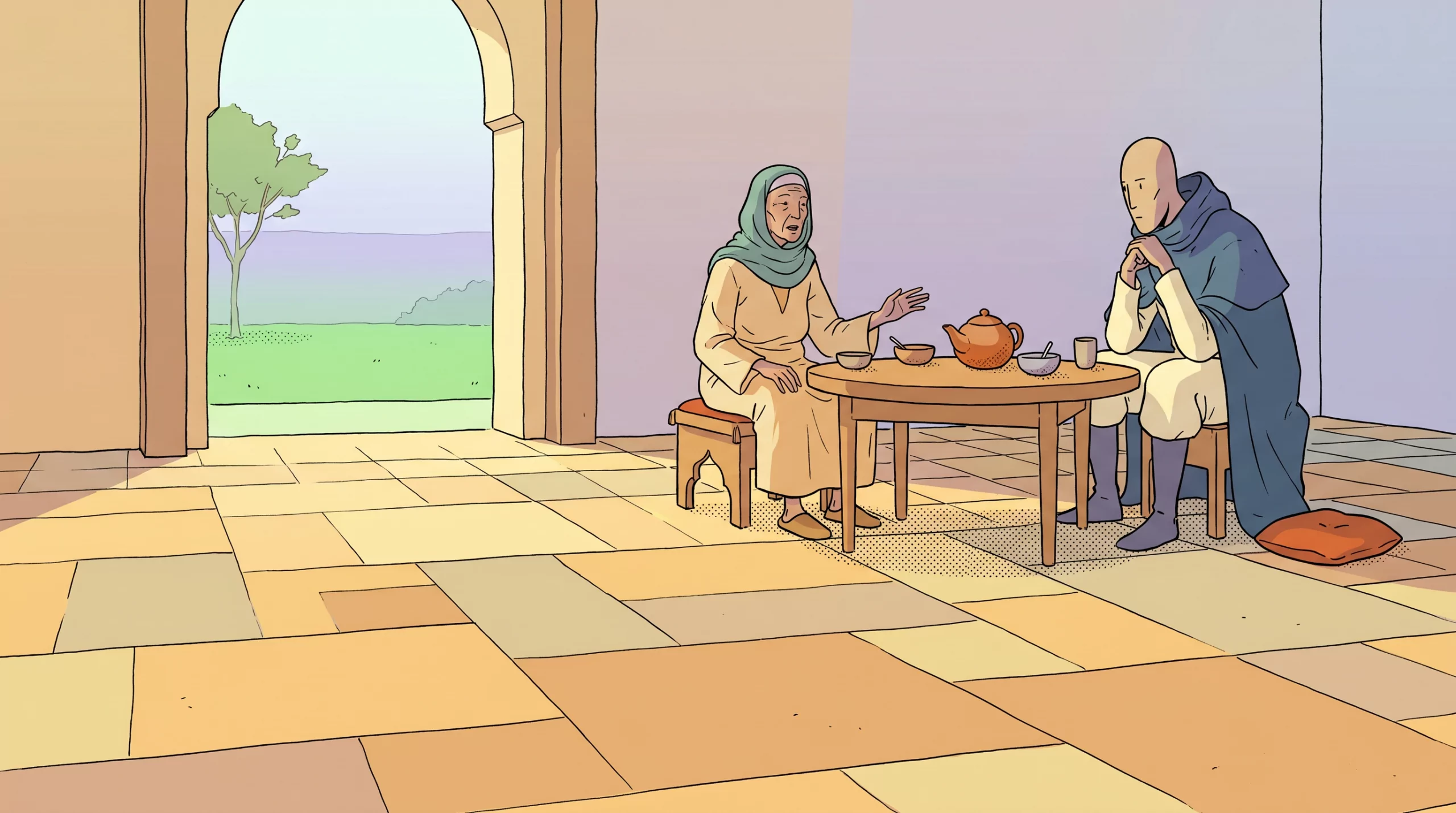
An old woman tells you, over food, in a matter-of-fact register that would break you if you let it, that her village was burned. That people she loved were killed in ways that don’t fit in a sentence. That some of them were never found. She tells you this the way you’d tell someone about a bad winter.
And then she is fine with the Americans.
Not performing forgiveness. Not gritting her teeth. The Americans come here on holiday and she’d pour them tea, and this country, broadly, has laid the whole thing down and walked on, and it is one of the most extraordinary things I have ever been close to.
I look at that and I feel pride, and respect, and I have said as much for years. But there’s a third word under those two and it took me until this month to write it down:
Envy.
Because I’m from the country that never managed it. Where the war is never over. Where laying it down would itself be the crime. I have spent the past year in archives reconstructing my own family’s Silesian ancestry, and let me tell you what a German finds when he does that, and the answer is: exactly what he was afraid of. So I sit in a kitchen with a grandmother who suffered incomparably more than my family ever did, and who is at peace, and I am not, and never will be, and my whole culture has built a cathedral out of not being.
And I feel my hand starting to reach for the measuring tape. Where is the memorial culture here. Where is the vow. Where is the never again. I’ve had that thought in this country more than once – standing at a historic site, in a museum, in a conversation – looking at a peace that got made without the apparatus I was raised to believe the peace requires, and thinking: what happens when the last grandmother dies?
I stop my hand. I want to be very clear that I stop it, and that stopping it is not the same as never having reached.
Because the comparison is broken at the root. German remembrance was built by the perpetrators, about a genocide, for the descendants of the people who did it. It is a machine for handling guilt. What happened here was done to these people, and what a survivor owes the future is not the same debt as what a perpetrator’s grandson owes it. Measuring theirs against mine and finding it short is not moral seriousness. It’s a German walking into someone else’s house and inspecting the furniture (which is meta because that’s what Germany actually love to do).
Both things stay true and I’m not going to reconcile them for you. Their peace is real and it is better than anything my country achieved. My duty is real and I don’t get to put it down. And I live in a region where the next one is not unthinkable – I won’t say more than that, in print, from here, and you’ll understand why – and the sentence I was raised on has never been said out loud in this part of the world, and I don’t know what to do with that except notice it and be afraid in a low, background way, the way you’re aware of weather.
Knowing doesn’t fix it
So here’s where I am.
I know what the pattern is. I know roughly how it was built – the village, the screens, the altar, the apps, the rails that were laid before I was born and the enthusiasm with which I rode them. I know the word for it and I know the word isn’t flattering. I’ve stopped saying purity out loud, which is a start, and a small one, and about twenty-five years late.
Does knowing change what I want?
Not yet. Maybe never fully – desire is not a democracy and it does not take instruction from the parts of me that read footnotes. What knowing does is give me somewhere to stand. Months of walks and thinking and quiet retrospectives, from a position that isn’t a lie. Whether that eventually moves the wanting itself, I genuinely can’t tell you. Ask me in a few years.
But this is the part that surprised me most, and it’s why I could write all of the above without it curdling:
The reasons I’m still here have nothing to do with any of it.
I stayed because of a life. Because of the man I’m marrying, who is a person and not an instance of anything, and whose family in the Mekong Delta fed me and teased me and put a baby in my arms and made a category error out of my entire adolescence. Because of a city that never stops rewriting itself and lets me rewrite too. Because of work that means something. Because of eight years of small mornings that don’t photograph well.
The door I came through was shabby. I’ve stopped pretending otherwise. It just turned out to open onto a room the size of a life.
Past-Luit would not believe how present-Luit loves, lives, and thrives. Past-Luit was busy with something else.

