A Loanword Rebuilt The trapboy takes the stairs four at a time

April 2024, one of those late-night threads where nothing is really being said. I told Jayden I was addicted to him. He wrote back:
I hope you’re not a trap boy honey
Then, a beat later, softening it: or if it’s you, hmmmm, it’s okay, I see it as a sweet trap.
I had no idea what he meant. So I asked. And what came back, thirty seconds later, was a screenshot of an Urban Dictionary entry from August 2017 defining a trap boi as a boy who dresses as a girl, with a homophobic kicker attached about what falling for one supposedly makes you.
Then, in the very next message, in his own words: a trap boy is a guy who knows how to charm and seduce and attract, who makes someone fall in love and then plays with their feelings. It’s a term in Việt Nam, he added. And the same for girls.
And the same, he meant, as the screenshot. Both definitions. Both live.
That’s the entire subject of this post, delivered in about forty seconds by someone who has never spent a minute thinking about it. Same same but different. Two words sharing a spelling and nothing else, held in one hand, with no sense that this might require sorting out – because for a Vietnamese speaker it doesn’t. English keeps its meanings. Việt Nam has its own. Nobody has to arbitrate.
I told him I doubted I had any ability to charm anyone, and that in my experience I’m usually the one who falls first. He said that’s exactly what a trap boy would say. Later in that same thread I tried on a counter-label: maybe I’m a freedom boi but no trap boi. Some months after that, running on four hours of sleep: no trap boy here, bb, just a zombie boy.
Hold onto those. They come back.
Two words, one spelling
In American English, a trap boy sells drugs. The oldest Urban Dictionary entries for it are from 2008 and 2011 and they all say roughly the same thing: a kid moving product out of a trap house. Trap girl, on the same terms, is either a woman doing the same work or the woman attached to someone who does.
The other English sense is the one Jayden’s phone reached for. Trap, in the anime and forum usage that peaked in the 2010s, meant a boy who reads as a girl, and the framing was always deception – you thought you were getting one thing, surprise, you weren’t. That’s a slur. It fed the idea of trans people as liars-by-existing, which is a trope that has cost actual human beings actual safety, and it has largely been shoved out of polite English use for exactly that reason. It has not fully gone anywhere: an entry submitted in April 2022 still spells it out as a trap set for people looking for a woman.
Both of those senses locate the trap inside the person: what he sells. What his body is. He is the trap.
The Vietnamese word does something else entirely, and it got there by a route I find genuinely delightful.
Vietnamese speakers borrowed the word twice. The anime sense came first and was the dominant reading on Vietnamese forums for years. Then, some time in the first half of 2021, it flipped. Kenh14 was running the romantic definition as a gen Z dictionary entry by May of that year; by October, Znews was reporting that young people had layered a new meaning on top through English wordplay, and dated the change to the previous few months.
The wordplay is: open the dictionary. Trap means bẫy. A snare.
So the new sense was not imported. Nobody looked at an American rapper and thought, ah, romance. Vietnamese speakers took a word they already had in circulation for one thing, threw out both English meanings, went to the entry for the literal noun, and built a third sense from scratch. That is folk etymology doing a full teardown and rebuild, and the finished product has no equivalent anywhere in the language it came from.
Worth noting who does the disambiguation, too. A consumer electronics chain’s explainer page stops halfway through to clarify that the anime trap is about appearance and is not the same thing as gender identity. That’s Thegioididong. They sell smartphones and fridges. English-language internet culture spent a decade not managing that sentence.
The slot was already open
A thing you notice fast once you live here: Vietnamese youth speech runs an X-boy and X-girl frame constantly, and it will accept almost any input. Bad sleep and a face like a corpse makes you a zombie boy. Skipped lunch, hungry girl. There’s gym boy, horny boy, rich girl, bro boy – yes, I have heard bro boy – plus the imports that arrived pre-assembled, pick me boy and pick me girl, good girl and bad girl.
Trap didn’t have to invent a shape. It fell into one that was standing there empty, gender-symmetric by default, two syllables, ready for a hashtag.
This is also, I think, why trapgirl exists at all. English never really produced a female fuckboy – the attempts all sound like translations – because English doesn’t have this frame running hot. Vietglish does. Worth noting: I’ve seen this explained as a Vietnamese grammatical instinct and I don’t think that’s right. Vietnamese puts the modifier after the noun: trai đẹp, gái xinh. Boy-handsome. Zombie boy is English word order. So the frame is borrowed and the productivity is local, which is a more interesting claim than the other one. It’s also a claim I’d want an actual linguist to check before anyone quotes me on it.
The other reason trap landed: the metaphor slot was occupied too. Vietnamese already had thả thính for flirting. Casting bait. Trap is the snare at the end of a line that was already in the water.
The staircase
On 19 July, a Vietnamese illustration account called sleepwalkers.illustration posted a single panel with a four-word caption: chỉ muốn nhanh. Just want it fast. Smiley face.
The drawing is a staircase seen from behind. A young man in a red cap, one hand on the rail, faceless, generic, could be anyone in this city. A small label points at him: TRAPBOI. It’s not a name. It’s a diagram callout, the way you’d label a part in a manual.
The steps have writing on them. From the bottom:
- làm quen
getting acquainted - gặp gỡ, chia sẻ
meeting up, opening up - tìm hiểu kỹ
getting to know each other properly - xác định mqh
defining the relationship - ra mắt bạn bè
being introduced to the friends
And at the top, on the landing, in the panel’s only speech box: rủ đi ksan. Asking you to a hotel.
He’s standing on the first step. His other leg is extended in an anatomically deranged stride, four steps of air underneath it, and his shoe has already landed on the top.
Look at what that joke requires: it requires every single person scrolling past to already agree that the staircase exists, that it has five steps, that they come in that order, and that the hotel is at the top and not somewhere off to the side. The artist doesn’t explain any of it. Nine hundred people liked it and not one commenter asked what the steps were.
You cannot draw this comic in English. Not because Anglophone dating has no norms, but because it has no agreed sequence, so there’s nothing to skip and no shape to violate. Try labelling the steps for an American audience and watch the argument start on step two.
Which gives you the thing this whole word turns on – trapboy names a position in a procedure. The offense is where he stops. He isn’t a villain in the comic – he’s speedrunning, and the drawing is a route map with a skip in it.
And the comments confirm it, which is the part I didn’t expect. People reached, unprompted, for process vocabulary. One says he’s đốt công đoạn – burning through the production stages, and công đoạn is factory language, the stations on an assembly line. Another argues that actually all the steps are there, the leap just belongs to a different category of thing. And the best comment in the thread, which I have thought about more than is reasonable:
may mình chân ngắn nên đúng quy trình
lucky I have short legs, so I follow proper procedure
Quy trình. Procedure. Protocol compliance reframed as a limb-length limitation. He’s not virtuous, he’s just physically unable to reach.
The thread does other things too. A running argument, four separate people deep, that this is fuckboy behavior and trapboy is the wrong word – one of them writing phắc boi through nói lái, the syllable-swapping trick, to get it past the filters. Coining, contesting, and censorship-dodging in a single comment section. Someone complaining that he always breaks at the xác định mqh step and gets branded a trapboi anyway, vì style, because of how he dresses; the label detaching from conduct and sticking to a haircut. And the moral verdict of the thread, overwhelmingly, is not condemnation. It’s đi cho lẹ. Go on then, be quick.
Then about eight people start openly soliciting in the replies. DM me. Anyone inbox? Hotel or no? Looking for a girl to get coffee and see a film.
Under a cartoon diagnosing exactly that. Nobody in there finds this ironic. I love it here.
Go follow sleepwalkers.illustration, by the way, and not just for the staircase. The account draws explicit, funny, unembarrassed comics in Vietnamese about sex, relationships, situationships, contraception, pregnancy, kinks, queer life, and the entire category of thing that goes wrong in bed and never makes it into a textbook. It’s sex education by other means, aimed at young Vietnamese readers in their own language, and it stays frank without ever sliding into leering or into the six-red-flags panic mode that every other Vietnamese-language source on this subject runs by default. The staircase is one of the tame ones.
The neighbors all built fish farms
Việt Nam is not alone in needing a word for this. East Asia converged on aquaculture more or less independently, and once you see it you can’t stop seeing it.
Korea got there first with 어장관리, from the Sino-Korean for fishery management. You keep several people close, approach and withdraw, never let anyone off the hook and never let anyone go. People were already asking what it meant on Korean Q&A boards in 2009. Note that it works in both directions – women say it about men, men say it about women – and someone running the operation at scale gets called a 해수욕장, an entire swimming beach.
China arrived around 2020 with 海王, Sea King, which is also just the Chinese title of Aquaman. The operating manual is explicit: cast a wide net, catch many fish. Your pool of prospects is a 鱼塘, a fish pond. Maintaining it is 养鱼, fish farming. The line that made it go viral is a woman realizing she thought she’d swum into his heart and had in fact swum into his pond. There’s a female form, 海后. Adjacent vocabulary includes 备胎, spare tire, for the backup you keep in the boot, and 中央空调, central air conditioning, for the man who is warm to absolutely everybody.
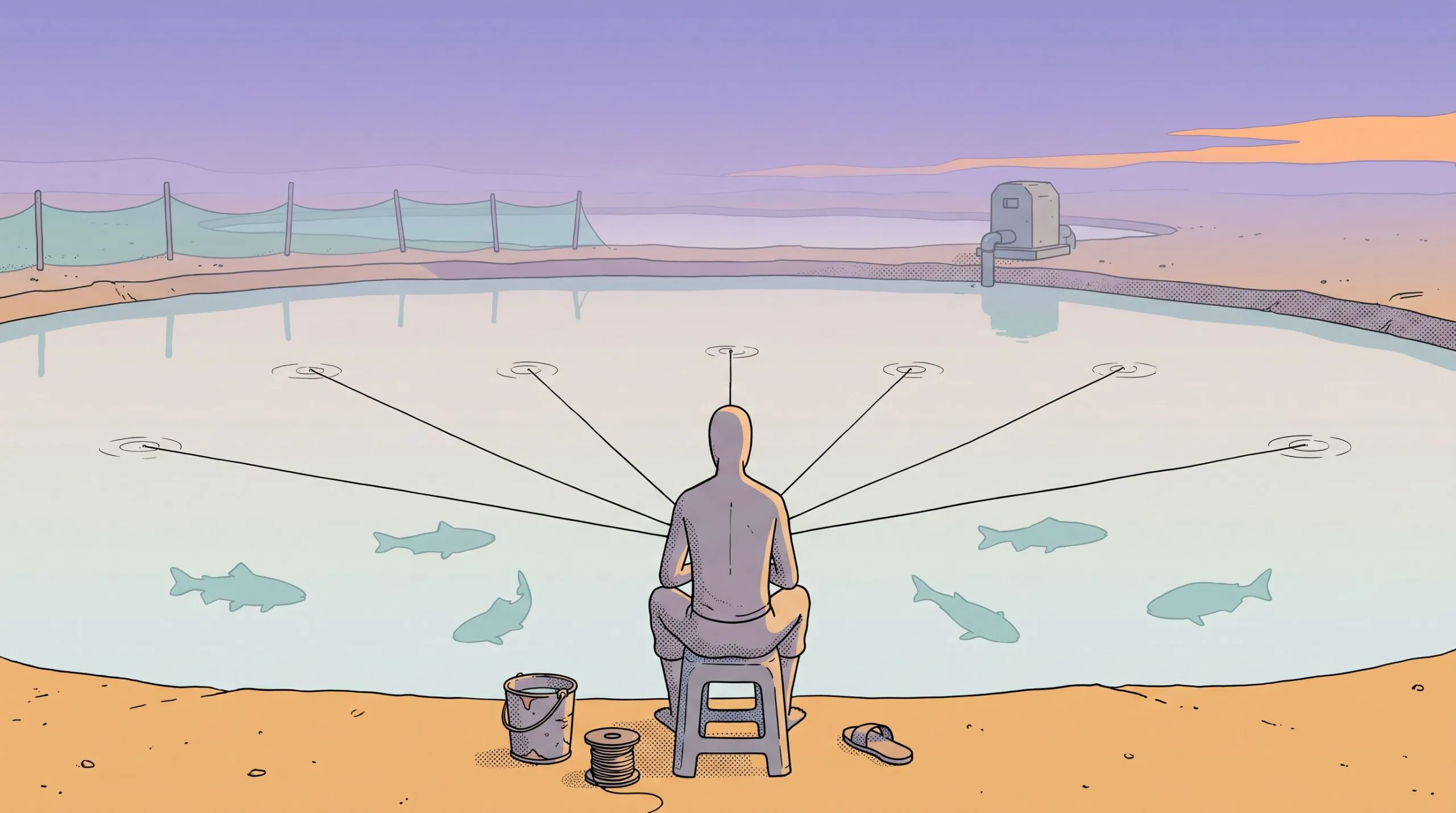
The transmission is documented, incidentally – Taiwanese explainers define 海王 using 漁場管理, the Korean term. Korea to Taiwan to the mainland, roughly 2009 to 2020.
Maritime Southeast Asia went somewhere else. Indonesia says PHP, short for Pemberi Harapan Palsu, giver of false hope, which conjugates: you got di-PHP-in. The Philippines has paasa, one who makes you hope, big enough that Yeng Constantino charted with a song about it. The Philippines also has chickboy, which is the closest structural cousin trapboy has anywhere on earth – English parts, local compound, does not exist in English.
Thailand, as far as I could get, never lexicalized it. The workhorse is still เจ้าชู้, the old word for a flirt. Either Thai genuinely didn’t need a new one or I’m not looking in the right places, and I’d rather say that than guess. Japan I couldn’t confirm at all.
Line them up and the pattern is hard to miss. Fuckboy is a verdict on a man’s character – what he is, appetite-first. Every one of the Asian terms describes a system he’s operating. A farm he manages. A hope he manufactures. A staircase he skips. The Vietnamese one is the only one that specifies exactly which step.
Which is, by the way, the step that makes the standard complaint legible. Ra mắt bạn bè, the public-ratification step, being introduced to the friends. That’s why the universal accusation everywhere is he never posts you, he never introduces you to anyone. Everyone knows which stair he stopped on.
The national anthem, and the other song
November 2024, Trúc Nhân released Không Ra Gì, written by Mew Amazing, MV shot through with Chợ Lớn. It went to number one and people started calling it the quốc ca trap boy – the trapboy national anthem. Mew Amazing has been asked about this and his answer is better than the joke: he picked the subject deliberately, he isn’t endorsing anything, he wanted to know what’s actually going on inside a trapboy’s head.
So the song is written from inside it. First person, and the man in it is not defending himself. He runs from the word love because he knows what he is, and he says so in a chorus that repeats ích kỷ, selfish, three times like a diagnosis.
But the detail I keep coming back to is the fishing: There’s a line where he tells her that love made her forget the rod hanging over her head. Thả thính, made completely literal, in a number one pop song. The etymology is sitting right there in the chorus where anyone can hear it.
And then, later, she’s fishing too. There’s a line about her wanting to angle some sincerity out of him – the same verb, câu, aimed the other way. Both people in the song are holding a rod. That’s a considerably sharper piece of writing than the trapboy anthem framing gives it credit for.
Trúc Nhân – Không Ra Gì
Now the part that makes the whole semantic story concrete: three months before that, on 16 August 2024, Def Jam Recordings Vietnam put out a track by 24k.Right with Mason Nguyễn and Hipz. It is called Trap Boy.
It’s about the trap house. Party, product, dân chơi, American sense start to finish, no romance anywhere in it.
One country, one year, two songs with identical titles, twelve weeks apart, meaning completely different things. Vietnamese rap kept Atlanta’s word. Vietnamese pop kept the dictionary’s. The split isn’t a theory I’m proposing, it’s a discography.
TikTok, meanwhile, has gone back through the archive and started reclassifying. Mây Trắng’s Chắc anh có yêu em, from 2007, now gets called trapboi đời đầu của Vpop – first-generation trapboy. A word from 2021 issued retroactively to a ballad that predates it by fourteen years. That’s how you know a category has really landed – it starts eating history.
What actually happens on the apps
Everything above is published, sourced, checkable. This next part is my memory of my own chat logs and I want to mark it as that, because I’m not going to reproduce anyone’s messages here. I was on Tinder and Grindr in this city for years, looking exclusively for Vietnamese men and women, in English and in Vietglish. Here’s what I noticed.
The word came at me constantly, and my profiles never contained it. They said, plainly and in the first line, that I wasn’t looking for a relationship of any kind. I supplied the definition. Other people supplied the noun.
Which is surprising. Being honest about where you stop does not get you out of the category. It makes you a well-behaved instance of it. Trapboy doesn’t mean person who lies about his intentions. It means person who stops early, and disclosure doesn’t move you up the staircase, it just tells everyone which step you’re standing on. That’s what separates it cleanly from PHP and paasa, both of which need actual deception to apply, and from fuckboy, which is about appetite rather than position.
The register split by gender, and it split hard.
Men, on Grindr especially but on Tinder too, used it as a game. Almost always an indirect question wrapped in a joke – I’d love to meet you but I hope you’re not a trap boy haha, or you can trap me anytime. An icebreaker with a trapdoor in it. Most of them were also, transparently, not looking for a relationship, which is precisely what let the word be fun. Nobody was accusing anybody of anything.
Women, on Tinder, used it to find something out. Same word, occasionally the same joke wrapping, but the joke was load-bearing: are you just here for fun, and is fun the thing that traps me? It was a probe, and it expected an answer.
And here’s the bit that reverses the whole word: say a term literally means concealed intent. Then watch people use it to declare intent. On an app, a trap that announces itself is a road sign. When I half-ironically confirmed the label, several guys got more interested, not less – and what that responds to isn’t this man is a liar, it’s this man is legible. On a hookup app legibility is the rarest thing there is.
One caveat I have to put in, because leaving it out would make me a worse writer and a more flattering one: I’m a Western man in Sài Gòn, a foreigner. There’s a script here about foreigners that predates me by decades: the contract ends, the visa runs out, he goes home eventually. Some unknown share of the trapboy reads I collected were people sorting me by category rather than responding to anything I’d done. Trapboy as a description of my behavior and trapboy as an assumption about my passport would look absolutely identical in a chat log and mean nothing like the same thing. My fiancé and my ex are the control group, in a manner of speaking: they had years of evidence. Strangers had a nationality.
The gap nobody has written down
Every source I found for this piece frames the word as heterosexual – the songs, the comic, the explainers, the entire Vietnamese-language coverage of the term. Boy traps girl. Girl traps boy.
My Grindr archive has it running man to man, as a joke and as a sincere question, from Vietnamese men, repeatedly.
So what happens to the diagnostic? The standard test for a trapboy is he never introduces you to his friends and he never posts you. In a Vietnamese queer context that behavior is baseline for an enormous number of people, and for reasons that have nothing whatsoever to do with intent. Ra mắt bạn bè, the load-bearing step, the one the whole comic hangs on, is the step a lot of men here cannot take and would not survive taking. Apply the test unchanged and it returns a positive on nearly everyone. What’s an accusation worth when it convicts the entire room?
Two things can happen to a word in that position – it re-anchors onto different evidence, or it stops working as an accusation and drifts into being a joke and an opener. My inbox is a sample size of one man’s recent dating life, so take it as a hypothesis rather than a finding – but everything in mine points at the second one.
Trapgirl among women here, I have nothing on at all. WLW slang in Việt Nam is documented essentially nowhere. If you know, write it down. At least somebody should.
The trapgirl who isn’t one
A friend of ours is saved in several phones under the name Trapgirl. She’s fine with this being told; I’m keeping her name and the details out.
The story is that a guy a year younger flirted with her for months. They texted constantly, played games together, went on a beach trip with a group of friends. He was, by her account, unmistakably pursuing her, and it worked – she fell for him.
He also had a girlfriend. They’d been on a break and had quietly got back together. The girlfriend went through his phone, found the conversations, and then used his phone and his Facebook account to block our friend, and unfriended her in the game for good measure. Then messaged her directly to announce that they were together and to stop talking to him.
That’s how she found out.
But look at what the girlfriend actually did there: ra mắt bạn bè is the step he was skipping – the public declaration, the making-it-real in front of other people. She performed it for him. By force, from his own account, with his own login. The staircase got completed by somebody who wasn’t even on it.
Then our friend told the story to the group, everyone gossiped, and everyone agreed the guy was a trapboy. And then, talking about the future, they told her that instead of getting trapped she should go be a real trapgirl. The revenge of the trapgirl, so to say.
The nickname stuck. It’s still her name in my phone.
Which means it isn’t an accusation and it never was. Nobody thinks she does this to people. The name was issued forward, as advice, as armor, as a joke about a thing she might become. And that lines up exactly with what the apps do – men declaring the label as an opener, a friend group prescribing it as a defense. Same direction of travel, opposite ends of the gender spectrum, and neither one is a charge.
The comfortable trap
Last week I met an ex. Long conversation, the good kind, the one where you get to go through the past and the present and the future in order and nobody flinches. We got to how our relationship ended, and she laughed and told me that looking back, she thinks I was a trapboy – one who built a very comfortable and very complex trap.
Half joking. Not entirely.
And she’s right, and it breaks the model, which is why I’m putting it last instead of leaving it out: the staircase says a trapboy is a man who skips steps. I didn’t skip any. I climbed all five, slowly, thoroughly, over months. Trapboy deluxe. The comic can’t diagnose that, because the comic diagnoses stride length, and mine was fine.
So the protocol theory has a hole in it, right in the middle, and I don’t think it’s a small one. It might even explain the drift – if the label can’t catch the version of the thing that follows every rule, then it slides off conduct entirely and starts attaching to whatever’s nearby. To a haircut. To a passport. Vì style.
We’re friends now, by the way. Friendship without the plus. Just friendship.
24.923/25/CBMP-HN
Every public explainer article about this word is written in warning mode: spot the signs! Six red flags! Protect yourself! And most of them are hosted by companies that sell phones or air conditioners.
Because – the word is also merchandise. Stickers, cups, t-shirts. Days ago I pulled up behind a student at a red light in Quận 7, almost forty degrees, exhaust shimmering off the asphalt, and his black tee read Trapboi but fun with an arrow underneath pointing straight down to his ass. Both English senses and the Vietnamese one, stacked on a single shirt, in traffic. I have thought about that arrow considerably longer than he can possibly have intended.
Meanwhile, in Hà Nội, somebody filed paperwork.
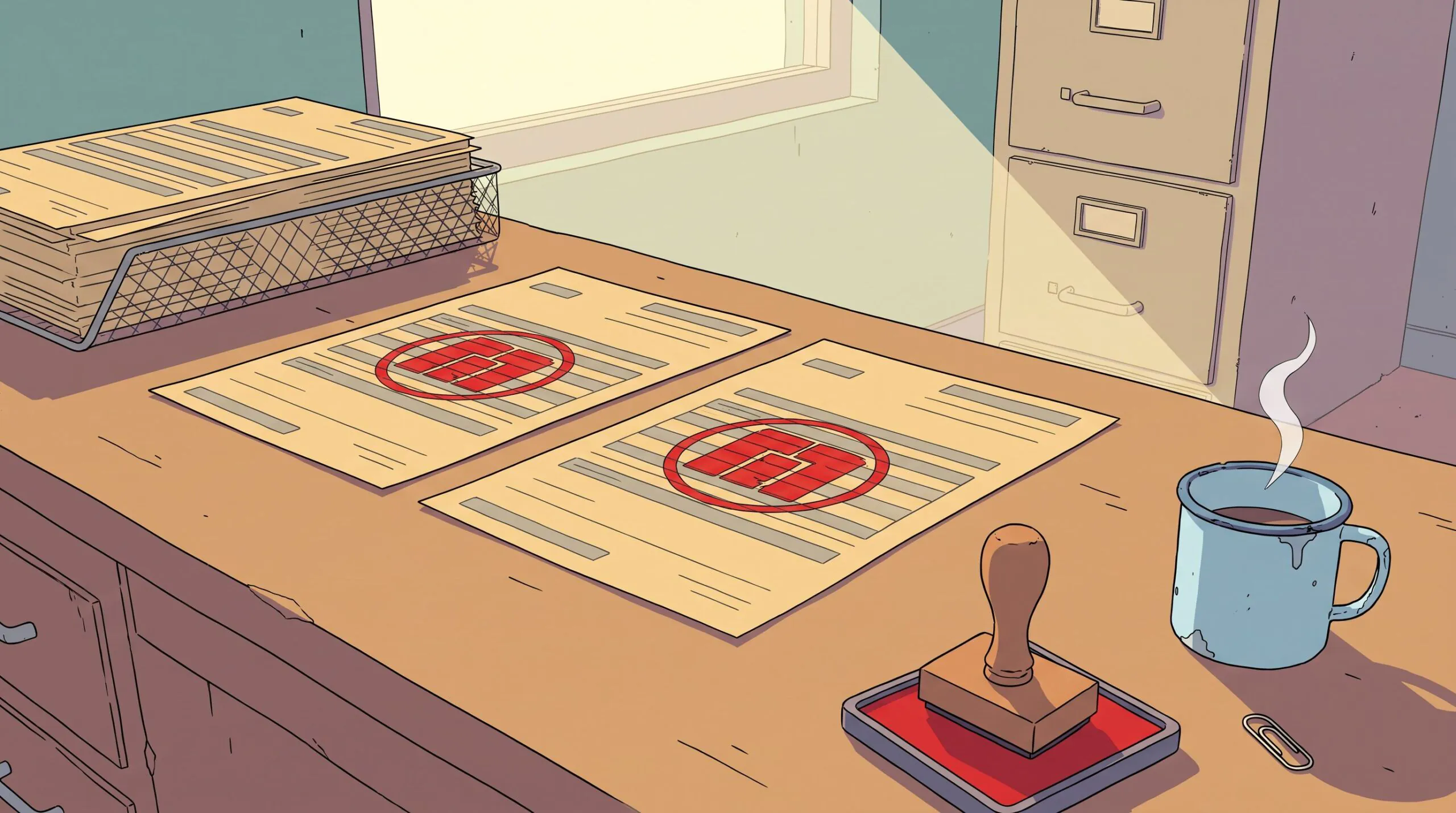
I’ve found two Phiếu công bố sản phẩm mỹ phẩm – the mandatory cosmetic product notification forms you submit before anything can legally be sold as a cosmetic in Việt Nam. Both filed with the Sở Y Tế Hà Nội in 2025. Both under the brand A:MOURES. Signed by Tô Hoài Nam, head of the pharmaceutical practice division, by authorization of the Director. Stamped. Valid five years.
The product names are TRAP BOY and TRAP GIRL.
Three things about those forms: the receipt numbers are 24.923/25/CBMP-HN and 24.915/25/CBMP-HN – eight apart, same acknowledgment date, which means they went in together as a matched pair. The gendered symmetry walked into a government office as a set and the state received it without comment. The red stamp indicates a hộ kinh doanh, a household business: this isn’t a corporation doing trend arbitrage, it’s somebody small. And to be precise, because the difference matters: a notification is not an endorsement. The department acknowledges a filing, it doesn’t bless a name. But names do get bounced for being misleading or unsuitable, so clearing the filing is still a signal. They cleared it.
Twenty years and change from a bait-and-switch joke on an English-speaking forum, through a fishing metaphor, through a cartoon staircase, to a perfume with a receipt number, valid until roughly 2030.
No trap
There’s a convenience store on the ground floor of our building. We go most evenings, somewhere between eight in the evening and three in the morning, for whatever we forgot or crave for.
One of the (cute) staff there is gender-fluid, knows us, always says hello. A while back we came in holding hands and there was a Vietnamese pop song playing over the speakers, one of the ones about a trapboy, and they looked up and grinned and said:
you two are lucky boy! no trap, look so happy always, haha!
Viet grammar. Perfect sentence. Two languages, one loanword, three genders in the room, and a word that started life as a snare being used to bless somebody.
I hope you’re not a trap boy honey.
Turns out I’m not. Took a village and a government form to establish it, but there you go.

