Five Nights In Đà Nẵng The one who sang into the ocean

I had just started the dating game again – actual dating, on actual difficulty levels, the thing I’d let go quiet for years – and somewhere in the middle of that I reinstalled Tinder. Not looking for anything. Or looking for everything, which is the same thing with the pressure switched off. Men, women, between, beyond, whoever. A conversation that went somewhere, a drink, a new friend, or nothing at all. Zero expectations. Just the swipe.
And the swipe gives what it gives, which is mostly nothing – a hundred matches become ten conversations become one that survives past hey how are you. If sex is the only line on the list, the honest move is Grindr, where the menu is at least printed on the wall. Tinder is for people who want to pretend the menu isn’t there – and I was pretending. So I swiped.
Until I came across – her profile.
Damn. Picture the face of Ian Alexander, who played Gray Tal in Star Trek Discovery. Androgynous, neither loudly male nor loudly female, parked in the good uncertain space between the two. Short black hair, a couple of earrings, a snub nose that had no business being that cute, dark brown eyes, a round face, and a smile that reached out through the screen and grabbed something behind my ribs. Her name was Vỹ. Reseller in a sim-card shop, lived up the coast in Đà Nẵng, one year younger than me, and – of course – a singer (every detail here is already scrambled, btw. Different name, different job, different face in the ways that count. She gets her privacy. Everything underneath it is true).
We matched. We talked.
The first day was the standard choreography – where you from, what you do, the polite little customs check every match starts with. And already then, it stopped being standard. We stepped over the small talk like two people stepping over a puddle – Vietnamese humor versus Western humor and why neither one survives the border. The films we made each other swear to watch. Her music, my music. Even, somehow, God. Ethics. What a person owes the world and what the world owes back – the kind of talk that in Vietnam is as normal as asking whether you’ve eaten yet, and that back in Germany would empty a dinner table by dessert.
She argued with me. Not to win – to check whether I meant it. I’d float some half-baked opinion and she’d poke it until it either stood up on its own or fell over, and then she’d laugh at me either way. Proud, quick, a little dangerous in the way only very awake people are. Not the average anything. Which tracked, because she was everything except average.
Hours became days, days became weeks. And under all of it, running quiet the whole time: want. Never said out loud. Said in everything else. A comment held one beat too long, a joke that leaned in a single degree too far, a goodnight that took twenty minutes to actually become goodnight. It was a game. A chess game. Patient and elegant and nothing like the blunt one-item grammar of the apps built for exactly that one item. Slower. Better. The good kind of unbearable.
The night she sang
Around day twelve we abandoned Tinder like a sinking boat and moved the whole thing to another app, the way people do when a conversation outgrows the room it started in. It felt like a small promotion. Off the marketplace, onto something quieter. Fewer eyes. And – voice messages & video calls.
Text is a costume. It lets me edit myself into whoever I’d like to be, delete the ugly half-sentence, arrive fully composed. A voice can’t do that. A voice leaks. Hers came through with all the seams showing; high-pitched, cheeky, soft – the laugh that cracked at the top, the little pause where she reached for an English word and caught it half a beat late, the way she’d start a thought over when the first run at it embarrassed her. I’d lie in the dark in Sài Gòn and press play and listen to a person hundreds of kilometers up the coast be accidentally, helplessly herself.
And suddenly, one night, she sent one that was just her singing.
No warning, no here’s a thing I do. A minute and a half of a Vietnamese ballad I didn’t know, her voice unaccompanied and a little unsure and completely unguarded, going up into notes she wasn’t certain she’d land and landing them anyway. I could hear a fan turning somewhere in her room. I could hear her breathe between the lines. When it ended she typed, fast, like she wanted to bury it before I could react: ok delete from your memory, embarrassing, bye.
I did not delete it. I played it four more times.
Honestly, I understood the size of that gift only later, on the rocks, when she told me about singing into the ocean. She’d handed me the same thing she gave the sea. The private version. The one nobody was supposed to hear. She’d done it over a phone line to a foreigner she hadn’t met, at eleven at night, and then tried to laugh it back into the box.
So I sent one back. Me, singing, badly, probably even terrible; some German thing my mom used to hum – and I mean badly, it came out thin and off and human. Fair was fair. If she was going to show me the unedited version, she wasn’t going to do it alone.
She didn’t reply for a full minute. Then: trời ơi. ok. now we are in trouble, I think.
We were. We absolutely were. And the worst part, the part I’d have paid money to not know yet, was that I was already glad about it.
So we decided to meet.
The flight
Vỹ had plans. God, she had plans. She’d put me on the back of her motorbike and show me her city, her coast, her landmarks, the good coffee and the better stuff. She’d take me to where she worked and where she lived, so I could see the real shape of her days. Road trips. Nature. The whole tour. And – she said this straight out, which floored me – she wanted to see me and feel me, because she’d built a warm little architecture of curiosity around the German who’d wandered into her country and stayed. Cultural exchange, she called it. On several levels, I thought, and didn’t say.
I prepped like a teenager with a theory: barbershop – cut, color. Then home, where I, let’s say, extended the grooming into territory the barber doesn’t handle, on the general principle of being ready for anything and for nothing. Good shirts, good shorts, folded with intent. I felt brave. I felt like nothing could go wrong, mostly because I’d quietly redefined “wrong” out of existence: whatever happened, I’d learn something – about her, about the country, about me. You can’t lose a bet rigged like that.
Then Tân Sơn Nhất airport, and the news: three-hour delay. VietJet, the Deutsche Bahn of Vietnam. I texted Vỹ that she had more time before the airport run, bought a cà phê đen đá strong enough to hear colors with, and sat down on the terminal floor like a local. When she heard how calmly I’d taken it, she fired back two words: haha you’re Vietnamese! Best compliment I got all year.
After that, and I’m still thankful the universe didn’t press its luck – no additional delay. A little later I walked out into her city with my orange backpack, and there she was, at the edge of the motorbike lot, waiting.
First time in the flesh. Beautiful, elegant, and – it needs saying – devastating. Not the long-haired postcard the algorithm keeps trying to sell as the default Vietnamese woman. Something wilder, watchful, an animal deciding whether to trust you. Which is exactly what she was doing. It was her first time seeing me in the flesh too.
We said hi. We laughed about the shared VietJet suffering, still the fastest way to bond two strangers in this country. A quick hug. And then, before I’d even finished being nervous, she was ordering me onto the bike – out of the airport, toward somewhere she wouldn’t name.
I sat behind her and kept my hands to myself, still shy, a full head taller so I could see clean over her and take my first look at the place. Her perfume came back at me on the wind. And her, underneath the perfume. Both were a problem.

Where she sang to the sea
She drove out of the city, past the last of it, to a rocky stretch of coast going empty and gold in the late light. We stopped at a roadside stall, grabbed some snacks and drinks off a dusty rack, and climbed down onto the rocks. Found a spot nobody could see. Sat down side by side, facing the water, facing each other, whichever one felt right from second to second.
And here, the real work started – the good work, the ice-breaking. Jokes that died on the runway. She tried to land a filthy Vietnamese pun and lost the whole thing in translation; I tried to explain a German joke and watched it collapse under the weight of its own setup. So we gave up and just laughed at how badly the two of us had failed. Then she asked, a little shy about it, if I’d hold her. Yes. Oh boy, obviously yes! She folded back into me, in between my legs, all the way inside my arms, and she was warm – feverish almost – and so was I. I kept my hands honest and gentle, and it was, simply, good.
V-pop drifted off her phone, all melody and longing, and she translated the saddest ones for me. The Vietnamese soul, she said, is always aching toward love, and you can hear it in every song. I tried to be funny by describing the concept of German Schlager in return – the syrup, the cheese, the crimes committed against the human ear – and we agreed, solemnly, that in this particular moment on these particular rocks, her music won.
Until she turned around and sat in my lap and looked at me. One arm still around her, I ran my hand through her short hair, slow. She said she’d figured I’d be shorter. She said the smile was exactly the one from the photos and short clips. And then she told me the thing that undid me a little: this spot, these rocks, this was hers. Where she came alone, before any of this, to sit with her own story – her past, her mess, her dreams – and sing out into the ocean where nobody could hear her.
She hadn’t brought me somewhere beautiful. She’d brought me somewhere private. Her lonely place. There is a difference, and I felt it land.
It got dark the way it does here, all at once, no negotiation. I was sweaty and oily from a day of airports and wind – obvious, unmentioned, completely normal in this heat – and we agreed it was time to check me in.
hai, ba, dzô
So we rode back in, stopped to grab one or two bottles of Đà Lạt white – cheap, not good, secretly loved by both of us – and got to the hotel. Took separate routes up to the room, some shared instinct for discretion neither of us discussed. Nice room. Two spaces, a king bed built for bad decisions, a bathroom with a big glass shower, a vase of orchids doing their soft orchid thing off to the side. There was even a view, but I had not booked the room for the view.
She used the bathroom first; I unpacked. Then my turn, while she stayed out there cueing up the sad love songs again and working the cork out of the Đà Lạt. When I came back she’d kicked off her shoes and was sitting on the bed with two glasses already poured. For arriving. For us. I said hai, ba, dzô like I’d earned it (cringe-moment), and we drank, and we talked, and the room got warm in a way the AC took personally and then lost.
Shoulders touching. Then hands. Silly stories, small compliments – her voice, her nerve, the way she’d blown past every low expectation the app had trained into me. We agreed Tinder was mostly a swamp, worse for her, obviously, running that gauntlet as a woman. She said she’d always wanted to meet foreigner, because the Vietnamese men before me had been unkind in the specific way small places are unkind to anyone who won’t sit still inside the template. They’d cheated. They’d mocked her for the short hair, the androgynous face, the small breasts – for not performing the traditional woman they’d ordered off some mental menu. And here sat this German who liked her nose and her skin and asked nothing of her shape.
Vỹ asked if I was white everywhere, and then slapped a hand over her own mouth, dissolving into laughing before the sentence had even finished. She’d said it. She knew she’d said it. That was the whole joke and she was delighted with herself.
More wine. She climbed back into my lap, face to my face, V-pop still bleeding softly out of the phone, the air doing something specific and undeniable. She hugged me, I hugged her, I felt her against my chest, and we kept talking, kept joking, kept pretending the conversation was still the point while both of us drifted closer without once admitting to steering. The wine, probably. Or maybe it was just the shape the evening had always been going to take.
What I wanted, sitting there with her weight on me and her breath on my neck, did not need choreography to explain. I wanted her. Stupidly, completely, the whole animal and the whole idiot heart firing at once. Tenderness and appetite balled up in the same fist. I wanted the closeness and I wanted the mess and I wanted to still be talking to her afterward. That kind of wanting.
So – I kissed her. No warning, mid-sentence, gently. And she went still. Looked at me for one second that stretched out long and strange – and then she kissed me back, and the wine was forgotten and the music was forgotten and that carefully arranged little view was forgotten, and somewhere in there a small astonished oh my god, what is happening got breathed into the space between us.
I asked her to shower with me. A gamble; yet she said yes, because both of us were still ridiculous from the heat of the day, and because by then the gamble wasn’t really a gamble anymore. I put on the original score from The Sims: Hot Date, the only thing my brain coughed up in the moment, a private joke I didn’t bother explaining and she didn’t need explained. The bathroom door closed. Memory goes to steam and warm tile and the specific weight of another person after two weeks of only a voice, and then it goes generous and vague, the way the good ones do, and keeps the rest for itself.
What stays sharp is the after. Two people who’d spent two weeks circling and one whole evening pretending, finally done pretending. We became one – Vietnamese and German, with each other and inside each other, wired together at every level a person comes with. Not once. Not twice. Who counts. And when the hunger finally went quiet and we were lying there wrecked and tangled up, two whispers landed in the dark at more or less the same moment, hers and mine: I love you, and trời ơi, what just happened. Both true. Neither one a lie.
She fell asleep first – and I didn’t. Of course I didn’t – my body was a whole symphony of satisfaction and my brain, the traitor, kept the lights on out of pure habit. Insomnia does not care that you just had the best night of your recent life. I lay there holding her, listening to her breathe, watching the window go black to grey to gold, and only when the sun was fully up did my eyes finally agree to close.
The morning we had to talk
I woke to a warm empty dent in the bed and Vỹ already back from a food run – phở bò, cà phê đen đá, orange juice, a whole late breakfast laid out like an offering. Before any of it we hit the shower again, just kissing this time, nothing more, both of us moving slow through the fog of too little sleep and a little too much cheap wine.
Because we had to talk, and we both knew it. The night sat between us like a relationship map with half the tiles still under fog of war, and we were trying to read it through tired eyes and slow heads. The bed behind us was a piece of abstract art – pillows, blanket, a towel, underwear, a whole choppy sea of folds and creases and the frank evidence of what two human bodies get up to when left alone. And the room had that smell. Wine and sweat and heat and the honest animal musk of it. We needed air, and the bed needed, frankly, professional help. Our bed. Not mine. Ours. Her words.
So she put me back on the bike and we did, at last, a thin slice of her grand plan. A fancy mall. A salted coffee. A Buddhist temple, incense and quiet. Sticky rice. The beach again, under a rented umbrella, watching the sea and the people and talking about every single thing except the one thing. Until she suddenly said that she had to go home for a few hours – be a daughter, show her face to her parents, help out – and she kissed me (secretly) and laughed and rode off, and just like that I was alone.
Alone on a beach in a city I’d known for exactly one day, with the first real quiet I’d had since the plane, and nothing left to do but feel it.
It felt unreal. Like a dream somebody else was having. This was supposed to be the careful part – the getting-to-know-you, the trust built one honest conversation at a time over weeks, maybe months, before anything like last night. Or, far more likely, nothing at all. A digital spark that fizzles the second it hits real air. A pleasant few days, a friend gained, a story to bring home. Instead we’d gone off like two struck matches. No shyness, no shame, no brakes, no plan, and – the part that should have scared me more than it did – no real precautions either, with everything that word can drag behind it. And still, sitting there with the sun dropping onto the water, I couldn’t make myself regret a single second. It felt right. Raw and hungry and reckless, sure. Also warm. And, somehow, correct, in a way I couldn’t argue with and didn’t want to. We’d built something in one night that ran deeper than anything our bodies had done – and our bodies had done plenty.
I walked back to the hotel confused in the nicest way a person can be confused, and I waited.
The daughter
Years later I still try to build those hours from her side, the ones where she left me on the beach and rode home to be somebody’s kid again. This is my best reconstruction; tt is probably wrong in the details and probably right in the shape:
She rides home with him still on her skin. That’s the first problem. She showers at her parents’ place, fast, in the concrete stall with the plastic scoop and the water that never quite gets warm, and it doesn’t help, because the thing on her skin isn’t sweat.
Her mother is in the kitchen doing three things at once and asks, without looking up, why she’s smiling like that. She isn’t smiling – she checks. She is. She rearranges her face into the neutral one her mother’s kitchen requires and helps with the herbs and answers the ordinary questions with the ordinary answers – work is fine, the shop is fine, no, nobody special, why do you always ask that.
Because here is the arithmetic she’s already done, days ago, the arithmetic the German hasn’t even started yet. She knows what he is: a visitor. A door left open on purpose, a man who moved to the far end of the country so that nobody could hold him, who will get on a VietJet flight in a few days and take the whole warm impossible thing back to Sài Gòn with him. At the same time, she knows what she is: A daughter in a house full of relatives, in a city she was born in and will be buried near, expected to marry, expected to produce the grandchildren currently being hinted at over the herbs. Grounded. Rooted. Heavy in the good way and heavy in the other way too.
Two systems that don’t map. She worked that out before she ever helped me book the hotel, and she chose the nights anyway, with her eyes fully open, because she is braver than me and always was. What she is doing in that kitchen is not confusion. It is grief, taken in advance, in small private installments, so that when the bill comes due at the airport she’ll have already paid most of it.
She tells her mother she’s meeting a friend later and stays overnight. Which is true, in the way that the worst lies are always technically true.
And she stayed. And we repeated the intimate ritual of the previous night.
The house we didn’t enter
On the third morning she wanted to take me home. To the actual house. Meet the parents, meet the relatives, sit on the floor and be fed things and be inspected. She was half-serious and fully mischievous about it, and somewhere in the pitch she landed the line that has followed me around this country ever since:
But no privacy there, she said, entirely deadpan. Three generation, one house, grandma hear everything. We cannot make a baby.
Make a baby. I have heard that phrase a thousand times since, from taxi drivers and colleagues and friends of friends who barely know me, always with the same cheerful frankness, always meaning the thing Western English wraps in three euphemisms and a dimmed light. Vietnam does not wrap it. Vietnam calls it what it produces and moves on. She said we cannot make a baby there the way another person might say the wifi is bad, and I laughed so hard I had to sit down.
Then, helmet already in her hand, she stopped.
I watched her reconsider the whole thing in real time. Actually, she said, slower now, maybe not good idea. And she laid it out, plainly, the way she laid everything out. A foreigner turning up at the house is a question with no good answer. And worse – she gestured at my face, at her own – look at us. Look your eyes. My eyes. Everybody see something already happen. In my family, this, and she waved a hand at the invisible thing between us, the glow, the wreckage of three nights of not sleeping, this is not normal yet. With a foreigner, extra not normal.
She wasn’t ashamed. I want to be clear about that, because it would be easy to read shame into it and there wasn’t any. It was closer to weather forecasting. She knew exactly what a traditional house would see when it looked at the two of us, and she declined to walk us both into it for no reason. So we did the thing we were best at anyway. We went back to the sea.
And on the sand, under the same kind of rented umbrella, we had the longest conversation of the whole five nights, and almost none of it was about us. It was about everyone else. It was the two of us as amateur anthropologists, comparing field notes on the strange societies that made us.
Her Vietnam: where you do not, generally, announce sex, where premarital everything is officially disapproved of and unofficially universal, where the workaround is an entire economy of nhà nghỉ – the by-the-hour guesthouses on every second corner, existing precisely because three generations share a house and grandma does hear everything. Privacy here is not a right you’re born with. It’s a room you rent. Love happens in the gaps the architecture leaves, and the architecture leaves very few, so people get inventive and discreet and sometimes also a little sad about it. She talked about cousins in marriages arranged in everything but name, about the pressure that starts at twenty-five and becomes a siren by thirty, about how a face like hers – the short hair, the in-between – reads as a malfunction to people who need everyone sorted into one box or the other before lunch.
My Germany, in return, sounded to her like science fiction: you move out at nineteen, or earlier. You have your own door, your own key, your own silence. Sex is not a scandal, it’s a Tuesday. People live together for a decade and never marry and nobody’s grandmother stages an intervention. You can be as in-between as you like on a Berlin street and the worst you’ll get is indifference. She kept stopping me to check I wasn’t exaggerating, and I kept telling her I wasn’t. She found the freedom beautiful and, I think, a little lonely either – all those separate doors, all that silence nobody’s required to fill.
We mapped it for an hour. Two entire civilizations’ worth of rules about who gets to touch whom and where and when and who’s allowed to know. It was curious and warm and genuinely funny in places, and it never once got clinical, because we weren’t cataloging acts. We were cataloging loneliness, and its opposite, and all the different machines cultures build to manage the distance between people.
And underneath the whole cheerful comparative-sociology of it ran the thing neither of us said. We could talk this fluently about how the world arranges love because it kept us safely off the subject of how we were going to arrange ours. Every culture on earth, mapped and discussed and gently mocked. Except the tiny two-person one we’d accidentally founded on a rock three nights ago, which had no rules at all, and no architecture, and a demolition date already stamped on it.
The mountain of caves
The next day she took me to the marble mountains – Ngũ Hành Sơn, five limestone hills the old people named after the five elements, standing up out of the flat coast like something dropped there by a god with a sense of drama. Stone stairs worn slick and shallow by a few hundred years of feet. Caves hollowed into the rock, and inside the caves, pagodas, and inside the pagodas, Buddhas sitting in the dark being patient about everything.
She climbed like she was born on the stairs, because more or less she was. I climbed like a tall German carrying a tall German’s center of gravity, and she waited for me at each landing with a look that was equal parts affection and mockery, which by then was my favorite of her looks.
In the biggest cave there’s an opening in the roof, high up, where the mountain lets a single column of daylight down into the dark. It falls on the stone and the incense smoke turns solid in it, a slow grey river hanging in the air. People stood under it not talking. She took my hand – out where her city could see, the first time she’d done that – and we stood in the smoke and the falling light and didn’t talk either.
One of my grandmas came here to pray for husbands for her daughters, she said, eventually, quiet. All got married. So, it works. A beat. Maybe too good.
I laughed. She didn’t, quite.
Because there it was again, the thing we kept walking up to and stepping around: her whole life was standing in that cave, carved into it – the grandmother, the daughters, the marriages that worked, the long unbroken rope of people staying and belonging and being buried within a morning’s drive of where they were born. This was her element. Earth, one of the five. And I was the guy with the return flight, whose entire adult religion was the door left open, who’d chosen a city hundreds of kilometers south precisely because nobody there had any claim on him.
Same beam of light. Different ground. Both of us smart enough to feel the floor.
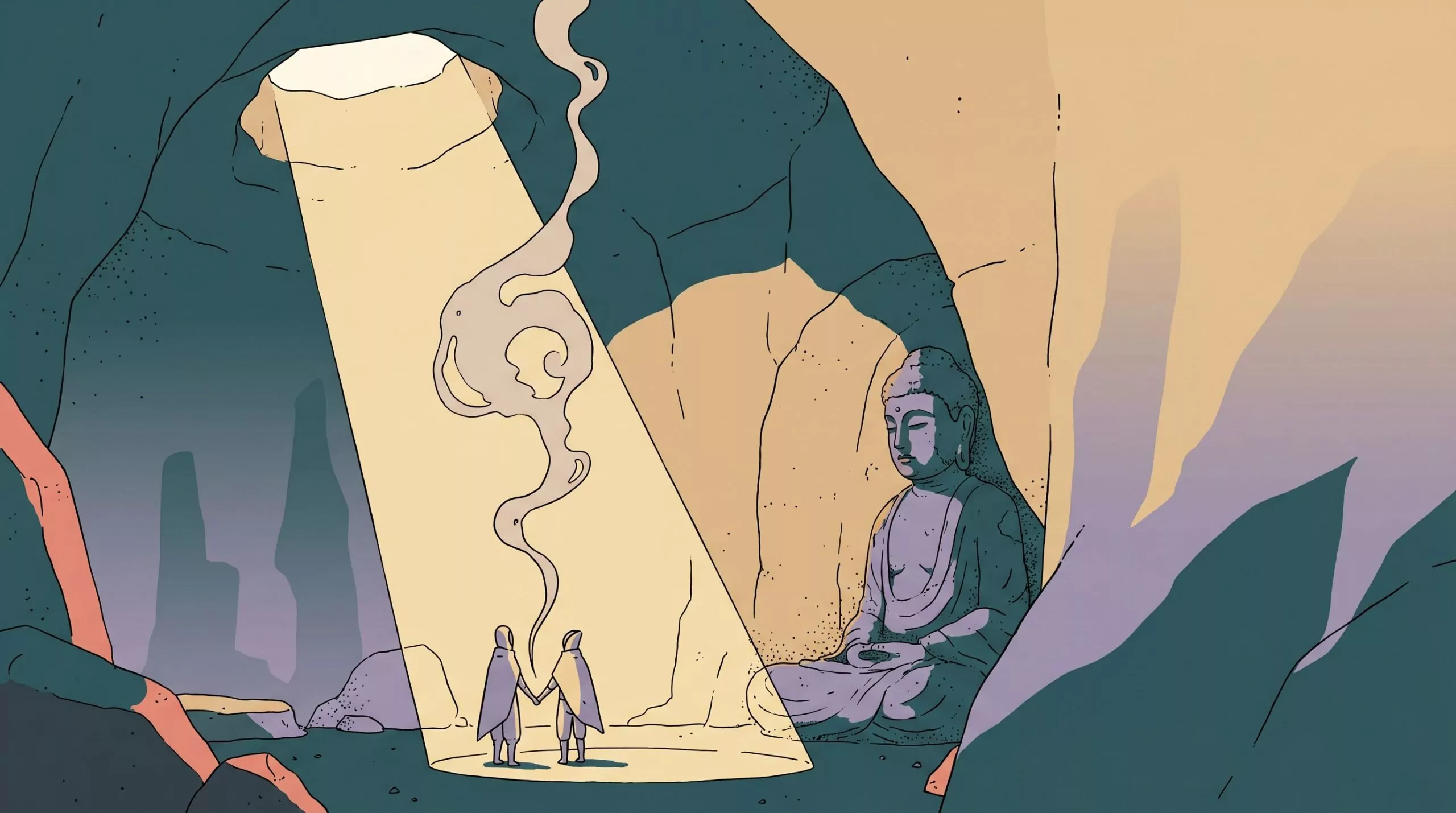
She squeezed my hand once, hard, like she’d heard the whole thought. Then she pulled me back toward the exit and the heat and the marble-carving stalls, and bought me a tiny stone turtle from a man who called her by a name I didn’t catch, and the moment folded itself up and went back in the drawer where we kept the things we weren’t saying.
I still have the turtle.
The word neither of us said
It happened on the fourth night, and it happened because I got greedy.
We were in the dark, after, in that loose warm wreckage where people tell the truth because they’re too tired to build anything else. She was drawing something on my chest with one finger, a character maybe, a word she didn’t translate. And I – full of wine and tenderness and the specific arrogance of a man who thinks a good night entitles him to a straight answer – I asked her. What this was about. What we were doing. About us.
Well – her finger stopped.
And the room got very quiet, the kind of quiet that has a sound. Outside, a motorbike went past, then another, then the city’s endless idle hum resumed. She didn’t move off me. She didn’t tense up and pull away, which somehow would have been easier. She just went still and let the question sit there in the dark between us, growing, filling the space until it was the only thing in the room.
And she started to come apart a little, in the way that counts. She said that THIS had never happened to her – not the sex, the whole of it, the speed and the depth of it at once. She was overwhelmed. She had feelings she couldn’t name yet, and she was honest enough to say so out loud: strong affection, a liking that might be a lot more than liking, maybe even the big word, but everything had moved so fast that she needed time to find the true shape of her own heart. She asked me to give her that time.
There was the whole tragedy, delivered by the braver of the two people in the bed: she wasn’t avoiding the truth; she’d swallowed it whole, days ago, and chosen the nights anyway, with her eyes open, knowing the exact size of the bill. I was the one still pretending there might be a version where nobody paid.
So the last part of that night we didn’t do anything at all. Just held each other, bodies clearly filing formal objections and getting overruled, and it was better than any of the nights we did. That surprised me – it shouldn’t have.
The same parking lot
Vỹ dropped me at the airport on the fifth morning, at the same motorbike lot where she’d picked me up, which felt like a cruelty the universe had arranged on purpose. Same cracked concrete. Same smell of hot dust and two-stroke exhaust. Five days earlier I’d walked out of that terminal a nervous stranger with an orange backpack and no idea what was coming. Now I knew exactly what was coming, and it was a departure gate.
She didn’t cut the engine – that told me everything. Killing the engine would have made it a goodbye with weight, a thing with a duration, and she’d decided – I watched her decide it – that we were going to do this fast or not survive it.
I got off the bike, put the backpack on, and then we looked at each other in the ugly flat morning light, no golden hour to hide behind now, just two tired people and a running motorbike and a hundred meters of terminal between me and the rest of my life.
Text me when you land, she said. Normal words. The words you say to anyone.
I would.
And don’t – she stopped. Started again. Don’t be weird. Ok? People get weird after. Don’t.
I won’t be weird.
But I was going to be so weird. We both knew it.
I leaned down and kissed her, once, and it was not like the other kisses, it was a full stop where all the others had been commas. Then she smiled the mocking-affectionate smile, the fourth-landing smile, the one I’d have flown back for on its own, and she said go, you’ll miss it, VietJet won’t wait – which was a joke, because VietJet waits for everyone, VietJet is the inventor of waiting – and I laughed, and the laugh saved both of us from the alternative.
I walked to the terminal. At the doors I turned around, which never helps, which I did anyway.
She was already pulling out of the lot. Not looking back. Threading into the traffic, one more helmet in a river of them, that short black hair vanishing into the current of her own city where she belonged and I did not. She hadn’t looked back on purpose. I understood that. Looking back is for people who haven’t already done the math.
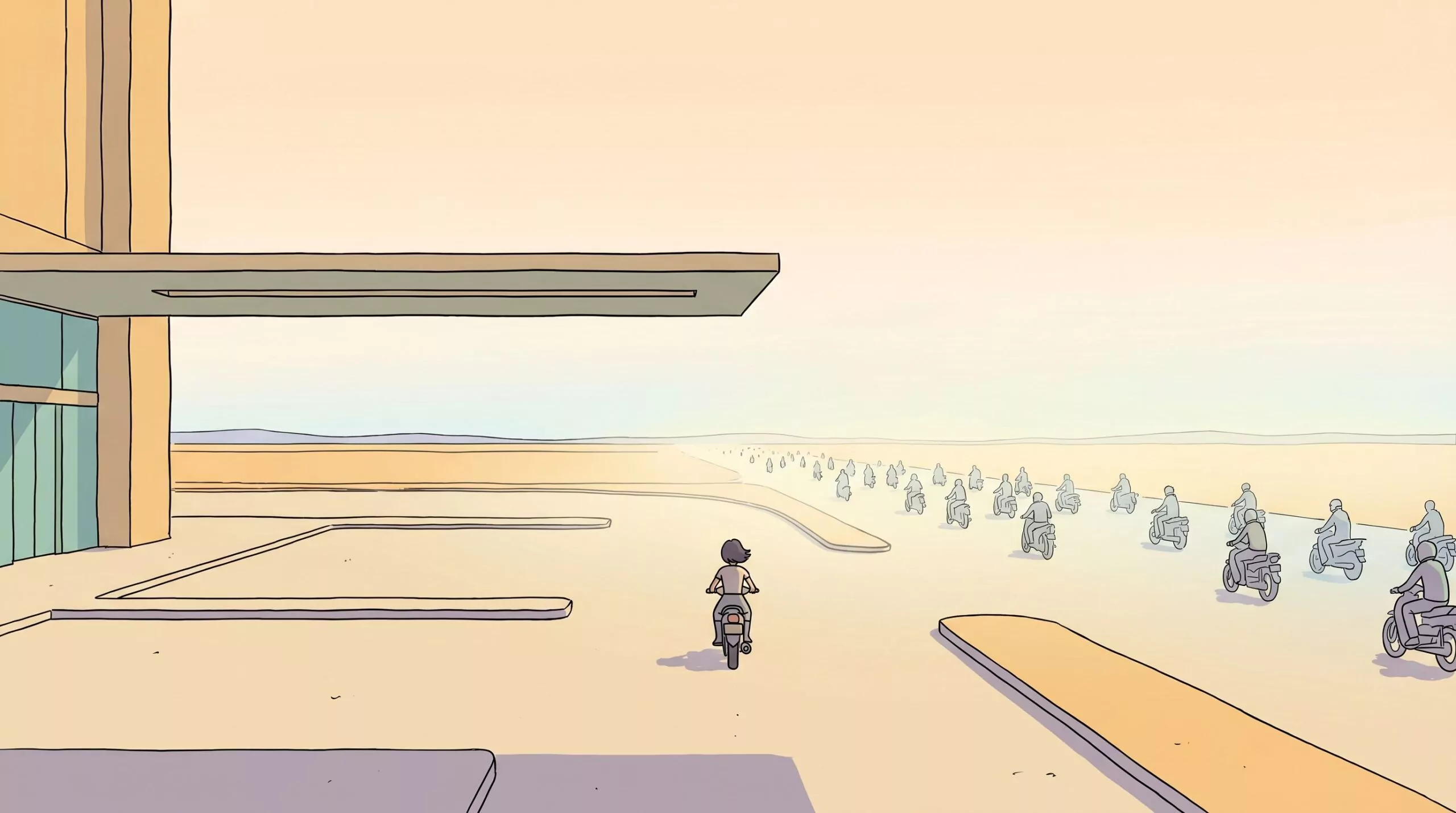
I went inside and found my gate and sat down on the floor, like a local, and waited for a plane that was, as usual, delayed. Just one hour – VietJet showing rare mercy.
Just a swipe
I flew back to Sài Gòn – and we kept texting, all day and all night, until we finally spent a few short sentences on the thing we’d spent five nights not saying.
The heat gone, the hunger quiet, we could finally see the arithmetic in daylight. Vỹ wanted a life near her hometown – a real relationship pointed at marriage, at least two kids, wrapped in family and relatives and old friends, no big adventures, no moving cities, and gosh no, no moving abroad. Love, stability, safety, continuity. A rooted life. She’d earned the right to want exactly that, and to want it out loud.
And me; I wanted the opposite of a plan. Freedom, motion, escalation, the door left standing open. Nothing fixed, everything still possible. A long-term anything wasn’t on the table, and children weren’t even in the building. All that beautiful recklessness, and in the end it billed us nothing – no consequences, just the memory. Two people can fit together perfectly for five nights and still be built for completely different lives. Nobody was wrong. That’s the part that stings – there was no villain to pin it on, just two honest shapes that wouldn’t tile.
The messages thinned out over the following weeks, the way a fire you stop feeding does. Then one day she told me she was falling into something new, with someone new. She said she’d loved every minute with me. She said – and I believe she meant it, I’ll always believe she meant it – You are always in my heart. She said she’d kept some of the photos. Just for her. Just to remember.
I stayed scrambled for a while. Longer than I’d like to admit. Eventually I fell into something new too, with yet another man – which is its own story, and maybe it never gets told. This wasn’t the first casual catch-up in my life to detonate into something much bigger than the small thing it promised. Not the second either. Or third. But this one carried a particular intensity, a particular naivety, and it cracked open questions about gender and desire and my own wiring that I hadn’t planned on carrying home in the orange backpack. Those questions stayed. They still drop by.
Do I miss her? God, yes. She wanders through my head every now and then, even now, and every time I land on the same thought: there was nobody else like her. Do I need her? No. Clean, easy no. I moved on a long time ago, and I’m not the guy who booked that flight anymore – and she, wherever she is, is surely not the same either. We haven’t spoken in over two years. Somewhere up that coast there are still rocks she sits on alone and sings her story into the water, and I hope the newer verses are kind ones.
In the end, it was just a Tinder swipe. But at the same time, it was so much more.


