The Language Of Neither The neutral pronoun Vietnamese never had (so the community grew one)

You cannot greet a stranger in Vietnamese without first deciding their gender. Not “would rather not” – cannot. The grammar reaches into the sentence before you’ve finished thinking and makes the call for you.
Here’s the mechanic: When you talk to someone in Vietnamese, you don’t reach for a neutral “you”. You pick a kinship word and use that: anh for a man a bit older than you, chị for a woman a bit older, em for anyone younger, and a whole ladder of aunts, uncles, and grandparents past that. The word does double duty – it’s how you address them and how you refer to yourself in the same breath. So the second you open your mouth, you’ve filed the person into a slot, and at least half those slots are gendered right down to the bone.
I’ve lived in Sài Gòn since 2018 and I still stall on it. Not the grammar – the read. Older or younger than me? By enough to matter? And the part nobody warns you about: what do you do when the honest answer to “man or woman” is “neither, actually”?
That question is where this gets interesting, because it turns out I was asking it wrong. I came at it like a German would – the language has he and she, now it needs a they, so where’s the third pronoun? But Vietnamese never had that binary in the first place. It doesn’t really do pronouns the way European languages do. It does relationships. And the main axis isn’t gender at all – it’s age, and how close you are.
The system runs on relatives, not genders
Once you see that, the whole problem rotates ninety degrees.
Because a good chunk of everyday Vietnamese address is already gender-blind. Em doesn’t specify a gender – it’s just “the younger one”. Neither does bạn (friend, peer), or mình (an intimate, soft “you”/”we”), or tôi (the flat, neutral “I” you’d use in an email). Third person has họ, “they”, sitting right there. There are pile of casual peer terms – cậu, tớ, bồ – that carry no gender flag whatsoever. If Vietnamese were as rigid as people assume, none of these would exist.
So the shortage isn’t neutral words. The shortage is one specific rung on the ladder.
The trap is anh and chị – the older-peer terms, the ones you reach for constantly with adults roughly your own age or a little above, in exactly the register where you’re being polite to someone you don’t know well. There’s no established neutral sibling to those two. You want to be warm and respectful to an adult stranger, and the only two tools the reflex hands you are stamped M and F. That’s the whole non-binary address problem in Vietnamese, compressed: not a missing pronoun, a missing rung.
Chanh, cam, and just asking
The community that actually lives inside this problem built its own patches.
The neat one: to dodge the anh/chị fork, some Vietnamese non-binary folks use chanh – a blend that mashes chị and anh into one word. Say it out loud and it also happens to be the word for “lime”. Its little sibling in the wild is cam, “orange”. That’s not an accident, that’s the joke – the terms rhyme into a fruit bowl, they’re playful and in-group and slightly winking, and outside queer circles almost nobody would clock what you meant. As linguistic innovation goes, that’s about the whole of it. No worked-out case system, no third-person machinery, no institution blessing it. Two fruits and a good instinct.
The blunter patch is to drop address terms entirely. Use the person’s name. Restructure the sentence so the slot never comes up. Vietnamese lets you do this more gracefully than English does, because dropping the subject is normal here anyway.
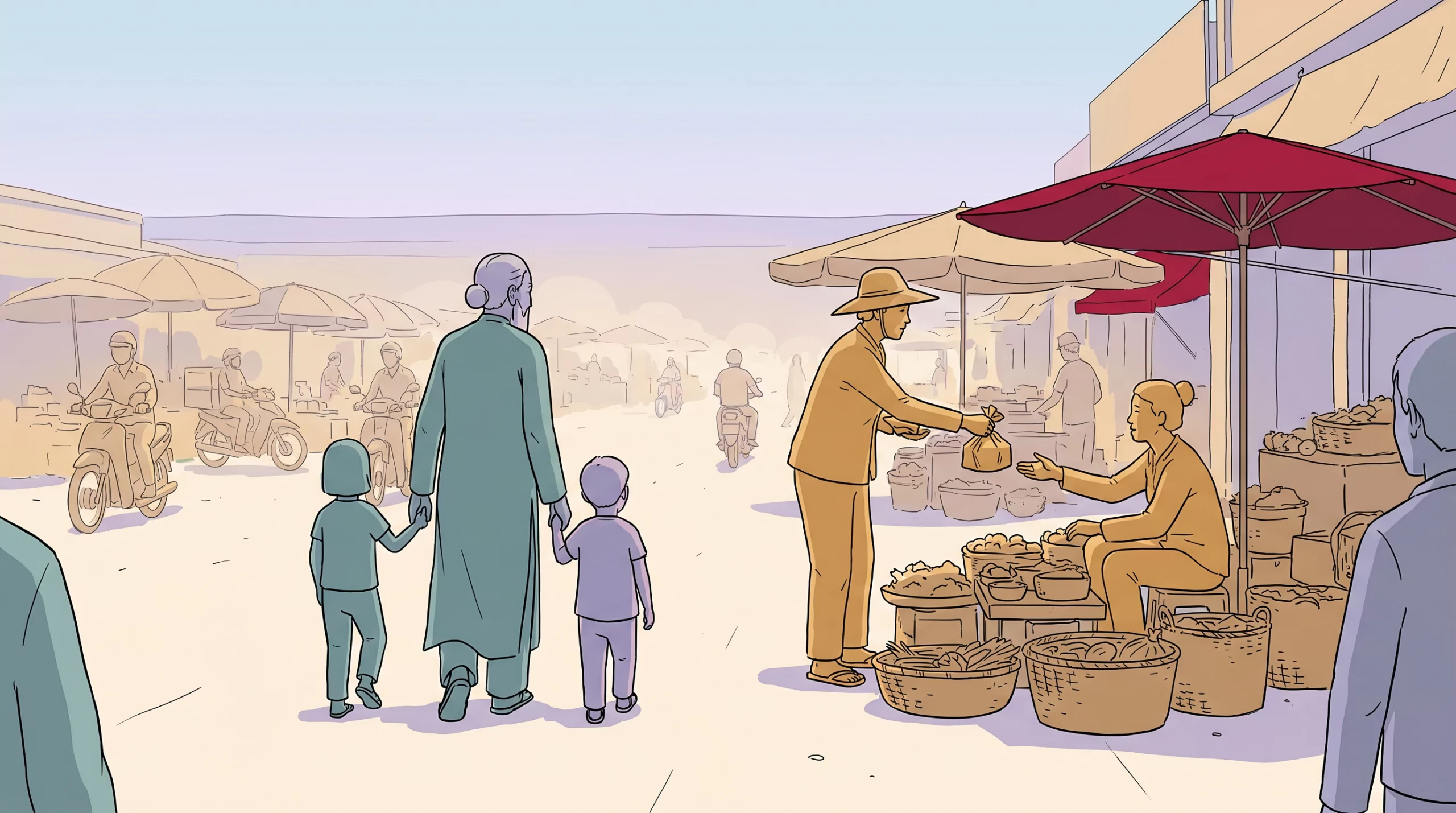
And then there’s the move that surprised me most, because it works so smoothly in Vietnamese and would land so weird in German: you just ask. Vietnamese-language guides on this say it plainly – politely ask what someone wants to be called, and don’t go digging for their birth name or their assigned gender. In a German-speaking context, walking up and asking “wie soll ich dich nennen?” carries a strange intimacy, like you’ve skipped three social steps. In Vietnamese it barely registers as a request.
Here’s why, and it’s the genuinely lovely part: Vietnamese address is already negotiated, every single time, for everybody – not just for queer people. Because the term encodes relationship and relative age, everyone is constantly running the same tiny calculation: are they an anh to me or an em? Do I chị them or bạn them? People hedge, self-correct, and settle it out loud all day long – gọi em là được rồi, “just call me em”. So when a non-binary person states the term they want, they aren’t bolting a strange new demand onto a neutral system. They’re filling in a variable the grammar was always going to make somebody fill in. The ask carries almost no weight, because asking is the ambient mode.
Compare that to German or English, where your pronoun is fixed, third-person, and decided about you largely behind your back. Stating it there feels like correcting the public record – an intervention against a default. Vietnamese address is first- and second-person and chosen in the moment, so declaring a preference feels less like a correction and more like just… taking your turn. That’s the disanalogy that trips up Europeans importing the fight: they arrive treating “your pronoun” as a fixed fact about a person, into a language where address was never a fixed fact to begin with.
The words that exist already – including the ugly ones
For the clinical vocabulary, Vietnamese mostly borrows and calques. Non-binary is phi nhị nguyên giới, often shortened to phi nhị giới – literally “outside the two-part gender system”. A trans person is người chuyển giới. The community lifted the English honorific “Mx.” too, though almost nobody outside the scene would parse it.
Then there’s the older, uglier layer, and it’s worth knowing if only so you recognize it: The big slur is bê đê (also pê-đê), which came into Vietnamese from the French pédérastie during the colonial period and long ago detached from any precise meaning – now it’s a general playground insult flung at gay and trans people alike. Kids get “bê đê” thrown at them from primary school. There’s a whole family around bóng – bóng lộ (“visible/out”), bóng kín (“closeted”) – mostly contemptuous, aimed at feminine men. Ô môi does the same work aimed at lesbians.
One of those words has a deeper root, and it points somewhere unexpected: Đồng cô originally meant a man who wore women’s clothing inside ritual – specifically the spirit-medium ceremonies of lên đồng, where a medium is possessed by a deity and dresses the part. Which means Vietnam did have a sanctioned space for crossing gender lines. It just lived inside religion and performance, as a role you stepped into for the rite, not an identity you carried down the street. That distinction – crossing as ritual versus crossing as self – is going to come back.
Quick correction while we’re in the terminology, because I made this mistake myself: kathoey is Thai, not Vietnamese. It drifts around the Mekong region culturally, but it’s not a Vietnamese word, and using it for a Vietnamese person reads as slightly imported and exoticizing. The local vocabulary is its own thing.
What visibility actually looks like here
If you only watched Vietnamese entertainment, you’d conclude the country was remarkably at ease with all of this. And in one narrow lane, it is.
The single biggest data point is Hương Giang – a trans woman who won Miss International Queen in 2018 (the big international trans pageant, held in Pattaya) and went on to represent Vietnam at Miss Universe. The press calls her “Nữ hoàng LGBT”, the LGBT queen, and she’s genuinely A-list: singer, TV host, reality-show fixture, and the producer running the domestic trans pageant that feeds the international one. She’s not alone in it either – Lâm Khánh Chi, Lynk Lee, Đỗ Nhật Hà, a steady rotation of trans contestants who’ve been a recurring “reveal” beat on Vietnamese talent TV since about 2012. Per capita, that’s arguably more sustained trans-femme visibility than a lot of Western media manages.
But look at the shape of it – the story the culture knows how to tell, and sell, is a specific one: born a boy, transitions, becomes a beautiful woman, wins a crown. Femme, binary, passing, pageant-shaped. It has a destination, and the destination is the other box.
Which means the people who don’t fit that arc stay off-camera. Trans men have almost no equivalent famous faces. And non-binary people – phi nhị giới – have essentially zero mainstream visibility, because a pageant frame structurally requires a binary finish line, and “neither” has nowhere to land in it. This is the đồng cô pattern again, centuries later: the culture has a well-worn slot for crossing from one box to the other, especially beautifully and especially on a stage. It has no slot for standing outside the boxes.
The law is one step behind the stage
The legal picture rhymes with the cultural one, and it’s worth stating carefully rather than dramatically.
On paper, Vietnam recognized a right to gender change back in the 2015 Civil Code – Article 37 – which made it, at the time, one of the first countries in Asia to do so. The catch is that eleven years on there’s still no implementing law spelling out how. It’s a right with no procedure attached.
A dedicated gender-reassignment bill was drafted to fix that, and was expected to pass around May 2025. In September 2024 it was pulled from the National Assembly agenda and postponed with no new date. And even that bill only ever contemplated a binary outcome – being legally recognized as male or female, gated behind medical transition. Non-binary isn’t in the text at all.
The most recent movement, as of this writing in mid-2026, came during debate over the amended Civil Status law in April 2026. On the floor, delegates raised the fact that Vietnamese law can’t properly record the children of trans people or same-sex couples on a birth certificate, and argued a child’s parents should be listed by legal relationship rather than gender. It got discussed. When the law passed later that month, none of it made the final text – the version that went through is an administrative modernization, letting people register births and marriages at any local office regardless of where they live. The identity questions were raised and shelved.
So the pattern holds across the whole legal layer: real discussion, visible sympathy, and then a final text that lands on “not yet”. And non-binary recognition sits a full tier below a fight that itself keeps stalling.
School teaches almost none of this
You’d think the gap would be filled in the classroom. It mostly isn’t.
Sex education in Vietnam isn’t even its own subject – it’s folded into biology, civics, ethics, and life-skills, thin and scattered, landing mostly in a couple of lessons in grades 5 and 8. Grade-8 biology handles “gender” as reproductive anatomy. The Ministry of Education’s own review years ago admitted the coverage was limited. Set that beside the Dutch or Swedish model – mandatory, integrated, covering relationships and attitudes and consent, running since the 1950s in Sweden’s case – and the distance is obvious.
On identity specifically, the paperwork looks better than the practice. The Ministry approved a comprehensive sexuality-education guidance package in 2019, updated it in 2024, and it does name sexual orientation and gender identity as things students should learn about. But that whole track is built and funded largely by UN agencies – UNFPA, UNESCO, UNICEF – and it lives in guidance documents, pilots, and teacher trainings, not in embedded, mandatory curriculum. International institutions, documenting the classroom reality, found the topic routinely avoided as “sensitive”, teachers untrained, and lessons that still quietly carry the old myth that being gay is a curable illness. One study put the risk of school violence for LGBT students as high as seventy percent.
So who actually does the educating? Not the state. NGOs smuggle “rainbow school” workshops into a few sympathetic classrooms. And then – this is the part that stuck with me – a lot of the plain-language “what does phi nhị giới mean” explaining gets done by commerce. A condom brand runs Pride livestreams. A sex-toy shop auto-generates a glossary of gender terms to catch search traffic. That’s who’s defining these words for the average Vietnamese teenager typing a question into their phone at one in the morning. A marketing team.
And even there, in the commercial layer, non-binary is the thin part. The brand content skews toward gay men’s sexual health; the shop’s glossary skews toward orientation and kink. Phi nhị giới gets a stub entry and nothing lived.
The box that isn’t drawn yet
Line the layers up and they all say the same thing in different accents. The grammar makes room for two rungs and improvises a third out of fruit. The stage celebrates crossing from one box to the other and has no frame for stepping off. The law recognizes a binary switch it can’t yet process, and hasn’t reached “neither”. The schools are still arguing whether the first letter of the acronym is a disease.
At every level, non-binary isn’t under-served. It’s pre-conversation. The country is still working through a question a lot of places settled decades ago, which means the “neither” box isn’t empty – it hasn’t been drawn on the form.
So if you want the practical answer to the question I started with – how do you address a non-binary person in Vietnamese – it’s smaller and stranger than a rule. You ask. You use their name. Maybe they hand you chanh, maybe cam, maybe just em. You improvise, inside a system that was already improvising before you got there.
And that improvisation, it turns out, isn’t the workaround. It’s the whole thing. In a language that makes you choose a box every time you speak, the people with no box have quietly made the choosing itself the point. Everyone else just hasn’t noticed they’ve been doing it all along.


