Desire, Legally Speaking Sex is everywhere in Sài Gòn, and officially nowhere

Five minutes from my apartment there’s a building painted the exact red of a fire alarm. Three floors of it. Across the top, in white block capitals with a rainbow fist thrown in, it says LOVE IS LOVE. Below that, GUN SHOP. Below that, in case the gun didn’t land, the words SEX SHOP run down the corner in letters as tall as a person. And bolted to the wall, blinking, a green LED arrow that just says BAO CAO SU – condoms – pointing you at the door like an airport gate. Rainbow flags. A little cartoon shield with a heart in it. And “Yêu an toàn” – love safely.
You cannot miss this place. That is the entire architectural intent.
And yet the last time I actually bought something from a shop like it, I never went inside, never saw a face, and the whole thing had the choreography of a small shady deal. You place the order online. A while later a stranger messages your Zalo to ask, politely, whether it was really you who ordered. You say yes. They send bank details. You transfer the money. And then, at some point that day, a random delivery guy on a random motorbike pulls up to your door and hands you a package wrapped to look like absolutely nothing – the most aggressively unremarkable parcel you have ever held, engineered to be boring, a shoebox with stage fright.
Billboard on the street. Cloak and dagger at the register. Same product, same city, same afternoon. That gap – between how loud the shop is and how quiet the sale is – is the thing I’ve been trying to understand, and it turns out you can’t understand it without leaving the country. Specifically, without going back to the one I came from.
Because Germany has the opposite problem.
I grew up in a country where Beate Uhse is a household name – a former Luftwaffe pilot who opened what most people count as the world’s first sex shop in Flensburg in 1962, and turned a nation of blushing postwar Lutherans into a mail-order erotica market. By the time I was a teenager, Orion and Beate Uhse were just brands, the way Aldi is a brand. Ads on late-night TV. Billboards on the Autobahn. eis.de, dildoking, the whole roster, omnipresent on web, radio and in print and occasionally in a shop window on a perfectly normal shopping street where you were also buying shoes. Sex, in the German public sphere, is not exactly celebrated. It’s just there, unbothered, in the middle distance, like weather – and Germans love to discuss weather.
So here are two countries with the same appetite and two completely inverted ways of handling it. And the difference isn’t really about how horny anyone is. It’s about where each state decided to draw its one line, and how hard it drew it.
Germany drew a small, sharp line and stacked everything on it: protect minors. Age-verify the porn, keep the hardcore behind a checkable wall, and past that, the default is open. Visible. Advertised. The restriction is surgical – a scalpel around one specific thing – and everything the scalpel doesn’t touch gets to exist in daylight.
Vietnam drew one enormous soft line and left it deliberately blurry. The line is called thuần phong mỹ tục – “fine customs and traditions” – and its entire power comes from the fact that nobody will tell you exactly where it is.
The fog has a name
Here’s the strange part: selling sex toys in Vietnam is not illegal. Lawyers get asked this constantly, and the answer is always some flavor of “technically, yes, go ahead”. The Investment Law’s list of banned trades doesn’t mention them. The Constitution says you’re free to do business in anything the law doesn’t forbid. So on paper, you’re fine.
What hangs over you is that phrase. Decree 98/2020 threatens fines of 30 to 50 million VNĐ (roughly 1,000 to 1,700 euros) for displaying or marketing goods in a way that runs against “the historical, cultural, moral, and fine traditions of Vietnam”. Nobody has ever defined what that means for a vibrator. So the enforcement is vibes-based, and the vibe you’re managing is a bureaucrat’s mood on a given Tuesday. You don’t get shut down for selling the thing. You get shut down for how you showed it.
The result is a market that self-censors from the inside. Not because a law forced it into hiding – because the law is a fog, and people are careful in fog.
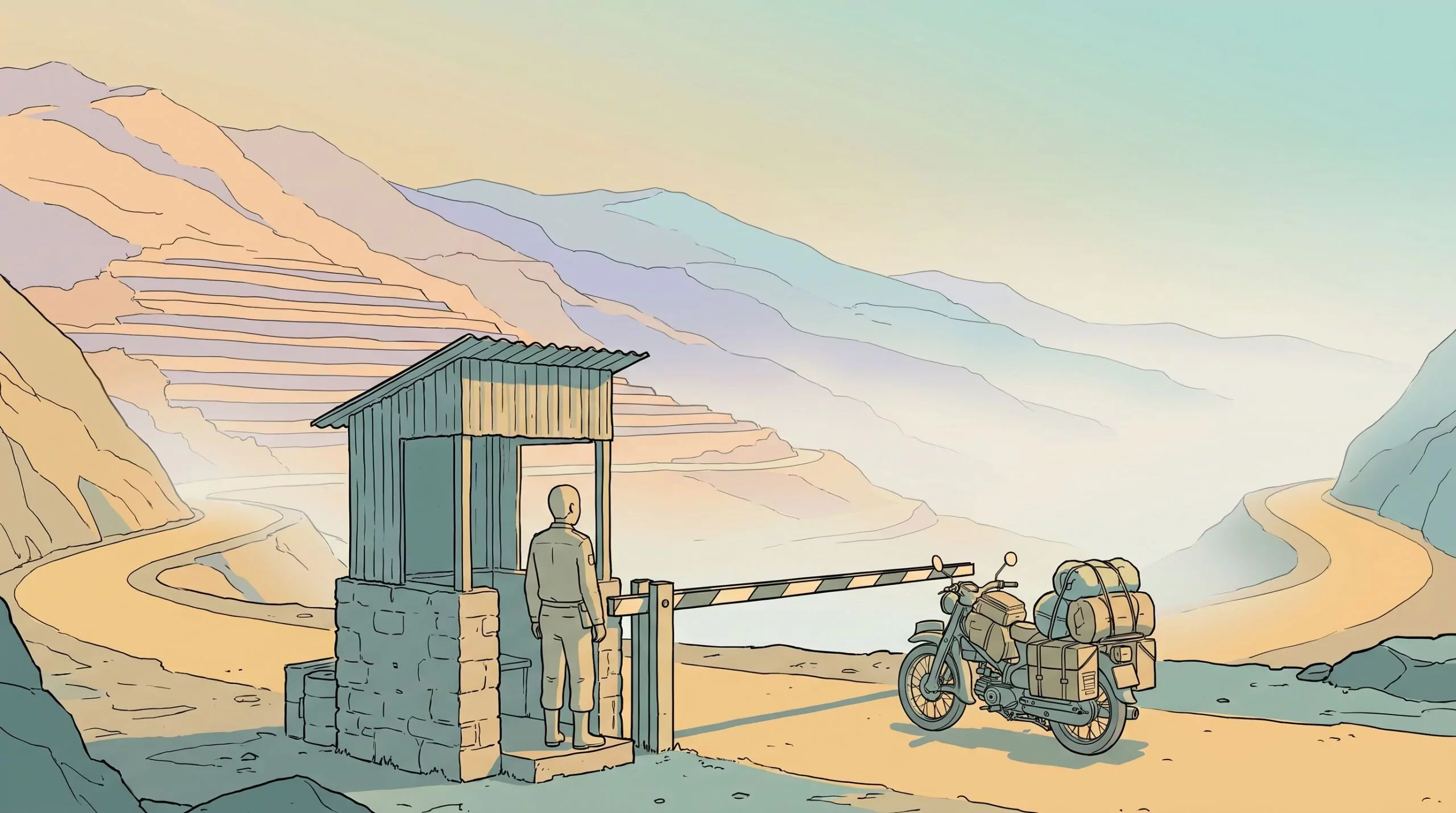
And then there’s the border, which is the one place in this whole story where the rules stop being vague and get very specific very fast. Formal import of sex toys is, functionally, blocked. Customs directive 4891/TCHQ-GSQL, back in 2011, told border officers not to clear them – and the tell is how they justified it, by filing sex toys under “dangerous toys harmful to children”. Adult products, reclassified as a threat to kids, because that was the only box on the shelf that fit. If they caught a parcel, it got held, and if you didn’t re-export it, destroyed.
That was fiveteen years ago, and you’d think something would have changed. In May 2025 a logistics company wrote to customs and asked, plainly, how one might legally import sex toys for a business. The official reply didn’t say yes and didn’t say no. It pointed them at four different general decrees and let them drown. The fog, preserved on purpose.
So how are the shelves full?
Good question, because they absolutely are. Walk into one of these shops and it’s floor-to-ceiling stock – Chinese, Japanese, Korean, Taiwanese, a wall of silicone and gel and packaging in four languages.
None of it came through the front door. It came over the northern land border as informal small-trader freight – đường tiểu ngạch, the grey channel that has fed this entire retail sector for as long as it’s existed. Shop owners have said as much, on the record, for over a decade: the stock comes in by motorbike and mule across the frontier, not by declared container through a port.
Which sets up the single most Vietnamese detail in the whole affair: In 2021, market-control officers in Sài Gòn raided a distributor in District 12 and seized 33,481 items – dolls, gels, vibrators, the lot. And read what they got them on: not obscenity, not “fine customs”, not morality. They got them on missing invoices and no proof of origin. The owner couldn’t produce his paperwork.
That’s the whole system in one raid – the state doesn’t police the act. It polices the receipt. Smart move.
The words are camouflage
Once you see it, you can’t unsee it. “Gun shop”. “Condom shop”. Shop người lớn – adult shop. Those aren’t cute brand names, they’re evasive maneuvers. Say the actual word for the actual object and your Shopee listing gets nuked, because the platform bans the real terms outright. So you rename the thing. There’s a whole subgenre of shops that market themselves around a euphemism for the banana-shaped object without ever quite naming it – fake bananas, love bananas, joy bananas everywhere. Camouflage as a business model.
The rainbow out front is doing the same job, one level up: That LOVE IS LOVE facade near my place isn’t only about being queer-friendly, though it is that too. Draping the shop in pride flags and human-rights language performs a quiet reframe: this isn’t a den of indulgence (indulgence is what the morality clause eats), this is an inclusive wellness space, a matter of identity and health and self-expression. It moves the whole business from a category the state is suspicious of into one the state has, lately, decided to tolerate. Smart, honestly. Cynical, maybe. But smart.
And the shops themselves aren’t hiding in alleys: GunShop runs something like 27 physical stores. ShopKiss holds down prime addresses in District 1. Big buildings, main roads, tinted glass, wellness-coded signage. Loud and coy at the same time, which is a difficult thing to pull off and they manage it daily.
Though it’s louder down here than up north. Hanoi does all of this in a whisper – Confucian gravity, the weight of family face, shops kept discreet and low. Sài Gòn, a trade port with colonial and maritime everything in its blood, does it in neon. The bold rainbow storefronts are a southern phenomenon, and that tracks with everything else about this city.
Meanwhile, the people already moved
Here’s what makes the fog feel so out of step: the objects are still stuck in legal limbo, but the people walked off years ago.
Vietcetera, the youth-culture platform, runs a podcast with Durex called Cởi Mở – “unzipped”, roughly, though it also just means “open”. On it, young Vietnamese talk on the record about female pleasure, mismatched libidos, masturbation, BDSM, orientation – the entire menu that state TV would faint over. Durex added Vietnam to its global sex survey for the first time in 2024. Premarital sex, urban and young, stopped being a scandal a while ago. There’s a clear generational seam running through all of it: Gen Z talks, their parents keep the old silence, and everyone politely pretends the two things aren’t happening in the same apartment.
None of this came from the top. Print and broadcast still hold a hard line on nudity – you will not see on Vietnamese TV what German TV airs after 11pm – so the opening-up wasn’t handed down by media. It grew sideways, peer to peer, in podcasts and group chats and the kind of conversation that only happens once someone’s brave enough to start it.
The state even loosened one knot itself, quietly. For years, condom and sanitary-pad ads were banned from TV and radio during the 6pm to 8pm dinner window, to spare families the awkwardness over rice. That ban got dropped in 2021. Durex can run a primetime spot now. But – and this is the tell – ads for actual arousal products, the toys themselves, are still forbidden. The safe-sex half got waved through into the living room – but the pleasure half stayed in the fog. Even the loosening kept the line exactly where it always was.
And then there’s the part I can only give you as an unscientific field note, so take it as one: Nearly everyone I’ve ended up talking to about this – openly, the kind of late conversation where people stop performing – turned out to own one. Or several. Women, men, folks across and beyond the whole spectrum. It’s a laughably biased sample, obviously; the people who’ll discuss sex toys with a curious German are pre-selected to be the people who own sex toys. But the shape of it stuck with me anyway. Invisible on the shelf. Ubiquitous in the drawer.
The one door in the city that locks
If the sex toy is the thing Vietnam can’t quite bring itself to legalize cleanly, the love hotel is the thing it legalized without blinking.
They’re everywhere. Hundreds of them, and they do not whisper – neon signs, themed rooms, listings sitting right there on Booking.com and MoMo next to normal hotels. Nghỉ theo giờ, “rest by the hour”, is a formal, recognized category of hospitality business under Decree 96/2016, with its own rules for registration and security, sitting in the lawbook beside every regular hotel. No euphemism required. No fog. A clean legal box.
The densest cluster near me is Trung Sơn, technically just over the line in Bình Chánh but pressed right up against District 7, a short ride from the university. Themed suites – one hotel does a birdcage room in red and black, hanging bed and open bathtub; others go full pink for the student budget – ceiling mirrors, round beds, the occasional tantra chair listed openly as an amenity. Rates start around 50.000 VNĐ an hour, about 1,70 EUR. You could not design a business more transparently about sex if you tried, and it operates in complete daylight.
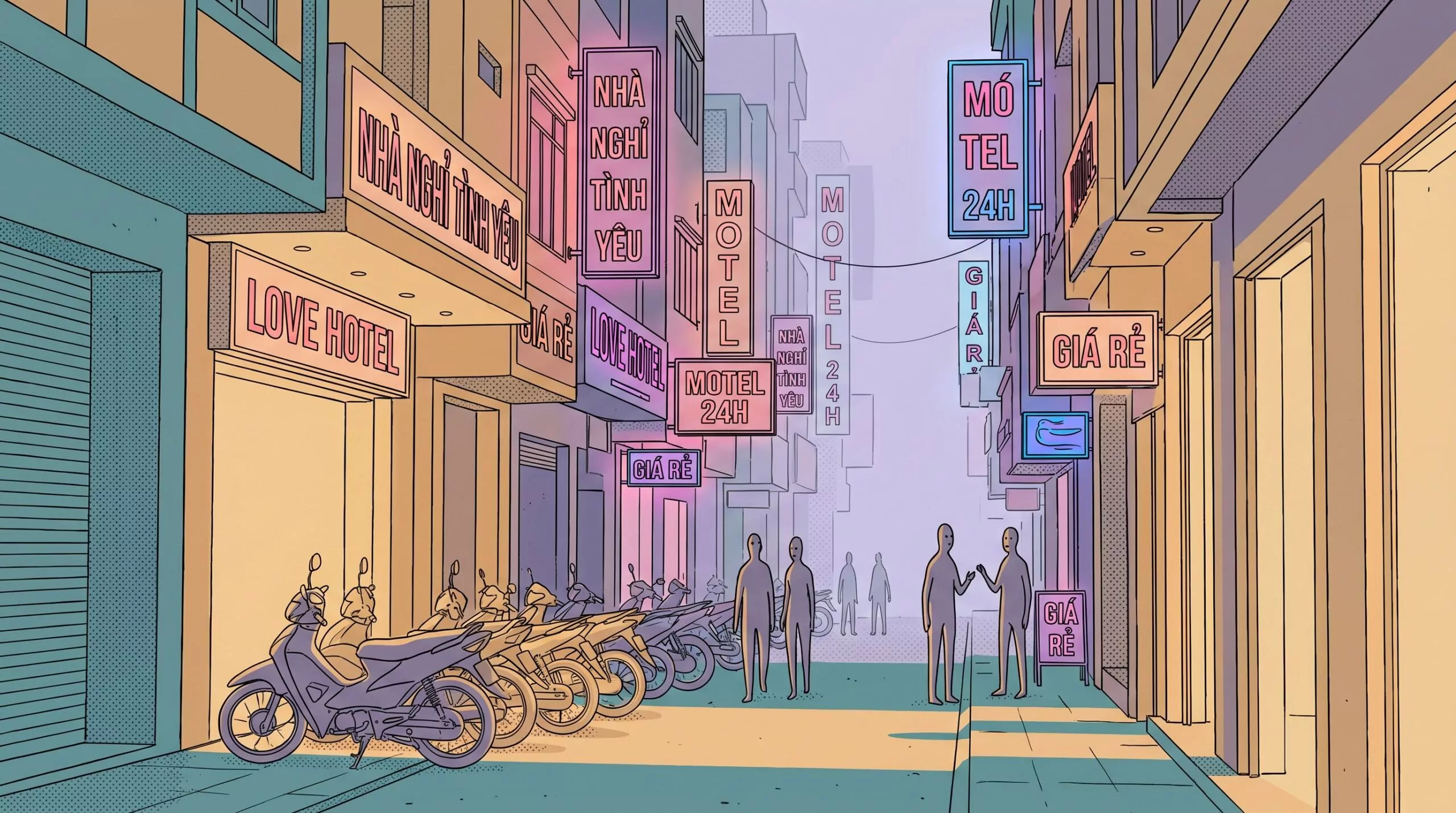
So, it isn’t secrecy – Vietnamese law has never required a couple to be married to share a room – that’s a myth so sticky that lawyers spend their afternoons debunking it. The real engine is real estate. Young people here live with their parents deep into their twenties, sometimes right up to marriage; students share crowded rooms; privacy at home is close to zero. The hourly hotel is, for a huge slice of the dating population, the only door in the entire city that locks behind two people and stays that way for an hour.
So look at the contradiction dead on. The state made the space fully legitimate – licensed, taxed, advertised, on the map – while keeping the object stuck at the border in a fog it refuses to clear. Legitimacy of place over legitimacy of thing. Vietnam is entirely comfortable with sex happening. It’s the little machines it can’t figure out how to file.
Openness didn’t save the pioneer
Before this turns into a tidy fable about the free liberal West and the uptight East, though – Germany’s version doesn’t end in triumph either.
Beate Uhse, the actual pioneer, the world’s-first, the woman who dragged German sexuality out of the drawer and onto the high street – the company is dead as a chain. It filed for insolvency in 2017 over a bond it couldn’t restructure, went under again in 2019, and cratered from around 500 staff to fewer than 70. The physical stores got liquidated. What survived – the website, the customer list, the brand – got absorbed by a Dutch operation and now lives on as an e-commerce footnote.
What killed it wasn’t a morality clause or a customs officer. It was free online porn and a swarm of nimble, digital-native shops – eis.de, Amorelie – the exact kind of business Beate Uhse’s own openness made possible in the first place. The visible, legal, advertise-anywhere German market guarantees you the right to operate. It guarantees you nothing about surviving. The open market grew up and ate its own founder.
Two systems, two ways to lose. In Vietnam the fog strangles the formal business and hands the whole trade to a grey border channel. In Germany the sunlight invites in competition so fierce it buries the company that invented the category. Nobody’s winning cleanly here. They’re just failing in different directions.
None of this is new, by the way
One last thing, because the “fine traditions” framing leans on a quiet lie – that Vietnam was always demure, and all this openness is some recent Western import corroding the culture.
Meet Hồ Xuân Hương, born around 1772, writing in the vernacular Chữ Nôm script under the full weight of Confucian rule. She wrote poems about jackfruit and snails and mountain passes that are, if you tilt your head half a degree, absolutely filthy – double entendres about bodies and desire and female appetite, aimed like a blade at the hypocrisy of the scholars and monks around her. And she isn’t some suppressed marginal figure. She’s canon. Taught in schools. A national treasure.
So the demureness isn’t ancient. It’s a later coat of paint – confucian governance, then a century of ideological tidying – laid over a culture that was, at its root, perfectly capable of writing dirty poems about fruit and getting away with it for 250 years.
The fog is the recent thing. The desire underneath it is the old thing.
Both countries, in the end, drew a line and threw their whole weight against it. Germany drew its line around who is allowed to see. Vietnam drew its around what is allowed to be seen. And on the far side of both lines sits the same ordinary human want, which has never once in recorded history failed to find its way across – through a rainbow storefront, through a boring brown parcel on the back of a motorbike, through a door in Trung Sơn that locks for exactly one hour at a time.
It always gets through. The only real question a society answers is how much it’s going to make people pretend it didn’t.


