Thirty Years Late I finally raided the first tomb – and I did it ugly on purpose

I lost to Tomb Raider 1 when I was a kid. Then I kept losing to it for thirty years, by refusing to go back.
The first part is easy to explain. The first part is tank controls.
Back in 1996, maybe 1997 – I was a small German kid on a PC, so the late-year timing tracks – I watched my older brother and his friends play this thing, and I wanted in. I got in. I got obliterated. Lara moved like a forklift with a ponytail, every jump was a unit of measurement I hadn’t learned yet, and the spike pits were very, very patient. What I didn’t understand back then is that the game was never really testing my reflexes. It was testing whether I’d figured out the grid.
Because Tomb Raider 1 is built on one. The whole world is a lattice of squares, and Lara’s moves cover exact, fixed distances across it: a standing jump clears this much, a running jump clears that much, a running jump with a grab clears just a hair more and saves your life. Miss the read by a frame and she belly-flops into the dark with that little disappointed grunt. As a nine-year-old I thought I was bad at a video game. I was actually just bad at spatial arithmetic wearing a platformer costume.
My brother and his friends had a different relationship to the game, and it was not primarily about grid squares. It was about Lara. The pixel boobs, the wasp waist, the whole polygonal fantasy – it was real, it was documented, and it was, statistically, completely normal. Lara Croft became the first video game character the mainstream openly agreed was a sex symbol. When researchers interviewed players in 1998, people brought up her chest unprompted. So the teenage boys in my living room weren’t outliers. They were a focus group.
But there was more. You’ve heard the story: Toby Gard, Lara’s creator, accidentally cranked her bust up by 150 percent instead of 50, a slip of the mouse, and the team voted to keep it. Great story. Didn’t happen. Gard confirmed in 2021 that it was a flippant joke he made in an early interview, aimed so ludicrously high that nobody would believe it – and then sarcasm died on the page, as sarcasm does, and a myth was born and fed for decades by an April Fool’s article citing a developer who never existed.
The real reason her silhouette looks like that is nerdier and, honestly, better: polygon budget. Her entire body was about 230 polygons. The lead programmer’s own explanation is that Gard spent fewer polygons on her chest so he could spend more on her head and face. The famous pointy geometry is a compression trade-off. She’s not a fantasy. She’s a low-poly optimization. (The braid you remember? Not there. It got cut from TR1 because it thrashed around during acrobatics like an electric eel bolted to her skull, and only came back in the sequel).
Anyway. I bounced off it, hard, and then I did something strange for someone who loved this series. I never finished the first one.
The long way back
I played every PC Tomb Raider that came after. I have thousands of touchpoints with Tomb Raider 2 especially, and with every other entry down the line. But the original stayed a scar, not a save file. The closest I came to finishing it was December 2013, when I put on the Tomb Raider 1 Let’s Retro by Rahmschnitzel – a German Let’s Player out of the Gronkh orbit – and let him raid the tombs while I did other things. I watched the whole run. In the background. Like a podcast about a place I was too scared to visit myself.
Fast-forward to this year. I go digging through my Steam library and find that the Tomb Raider I-III Remastered collection has been sitting there, unplayed, ever since I grabbed it in some sale and forgot about it. Classic move. So in March 2026 I finally installed it, opened the first game, and sat down to finish the tomb I’d been avoiding since primary school – in the exact year the thing turns thirty.
Thirty years to walk back into a cave. That felt about right.
I played the ugly version on purpose
Here’s the twist that surprised even me: The remaster is genuinely lovely. Higher-poly models, more props, sharper textures, reworked lighting, anti-aliasing, anisotropic filtering, the works – built by Saber, published by Aspyr – and Lara herself is finally rendered the way she was always meant to be: round where round was intended, no longer a sharp little pyramid. The polygons Core couldn’t afford in 1996, spent at last.
The remaster glow-up, in motion
And I played most of the game in the original graphics anyway.
You can flip between old and new on the fly with F1, and I flipped constantly – into the remaster to admire it, back into 1996 to actually live there. The classic mode flickers. It’s rough, it’s edgy, it runs at a hard-locked 30 fps that hits like a slap when you’re used to 144-plus. But it shows you what the designers were reaching for through the limits of a 3D engine that could barely hold the thought. The old draw distance chokes the view down to a few meters, drops a wall of black just past Lara’s nose, and that limitation – a technical failure, really, the engine simply couldn’t render further – accidentally becomes the whole mood. The dark ahead of you is not decoration. It is the feeling of being small, alone, and a very long way underground. I’m not the only one who thinks so; go read any thread on the remaster and you’ll find people begging for the old fog back.
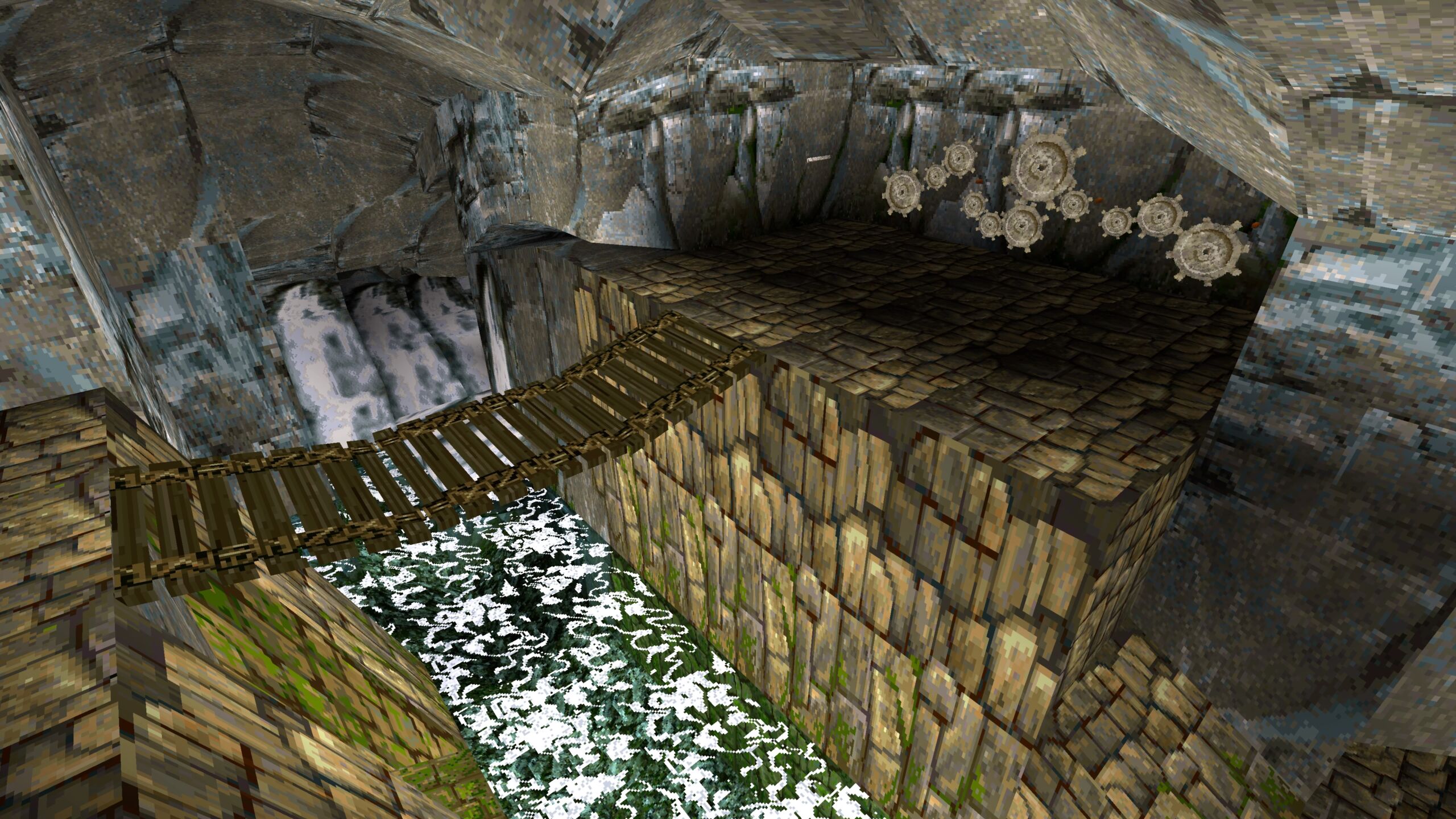
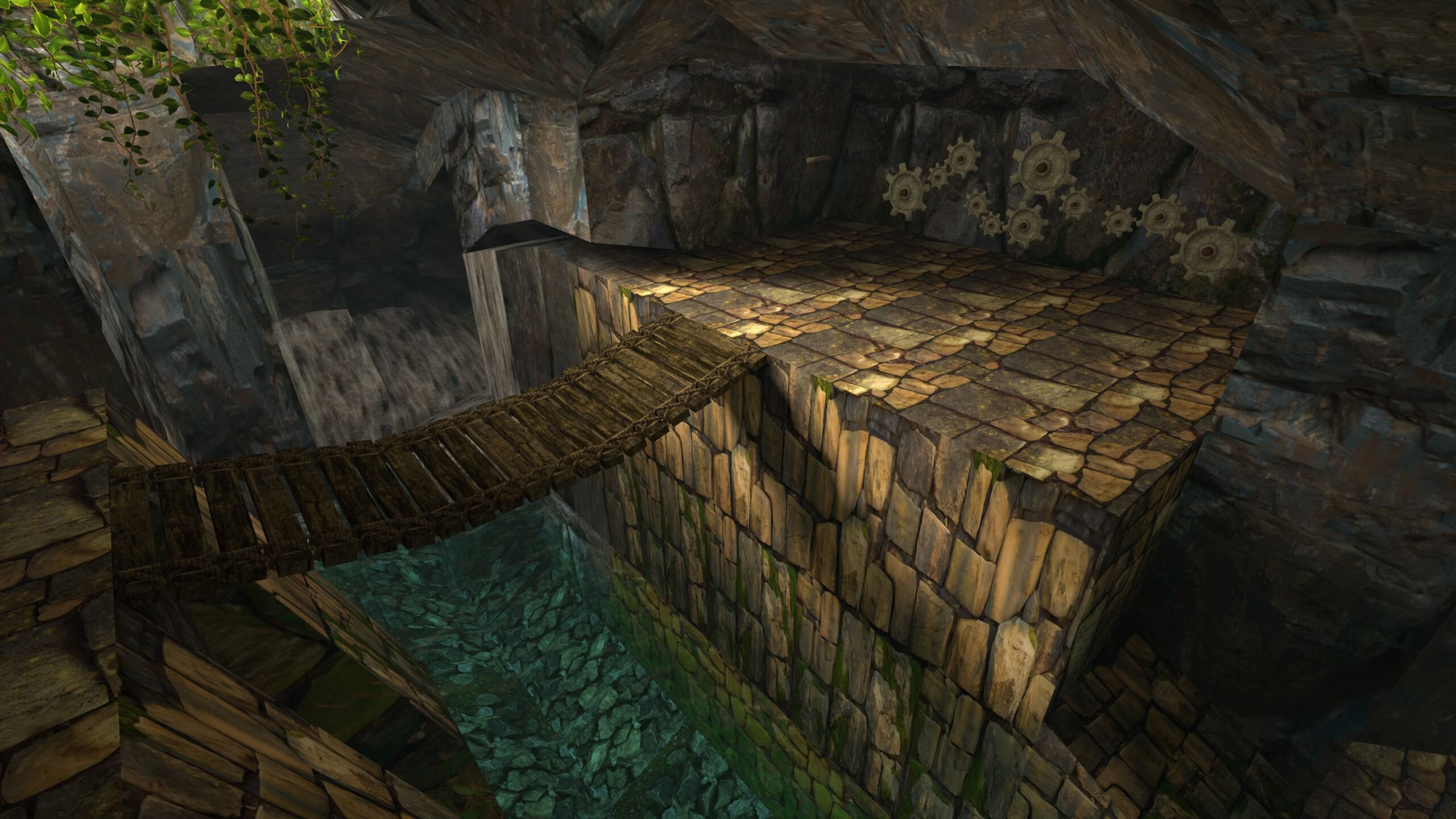
The classic lighting is dimmer too, closer to the intent, dark enough that I had to fire my pistols into a room just to see it for a half-second by muzzle flash. (No, TR1 has no flares. That’s a later-game luxury. In here you light the dark by shooting at it). Toggle the audio side of the remaster on and you can even hear an extra layer of hall and depth wrapped around the old sounds – reverb that makes the caverns feel wetter and bigger. Try it: F1, listen, F1 again. It’s there.
So yes. I chose the flicker. I paid the 30 fps tax on purpose. And I’d do it again.
Four weeks of music and a lot of silence
The game greets you before you’ve done anything at all. That oboe theme in the main menu – you know the one – is a small perfect thing, and it only gets better as the series goes on, mutating and swelling across five games while staying recognizably itself. It’s the sound of the whole franchise announcing that it has taste.
Then you drop into Peru, and the taste turns to awe. The Andes levels are enormous and empty and full of the sense that someone was here before you, a very long time ago, and left the machinery of a dead civilization humming in the dark. Harsh drops. Ancient traps. Wolves and bears in a place nobody has touched in millennia. The design keeps whispering the same contradiction into your ear: you do not belong here, and you are going in anyway. I want to reveal its secrets. I want to understand its architecture. I want to master this environment. I want to raid tombs.
And most of the time, while you feel all of that – nothing plays. That’s the trick.
The score for the first three games is the work of Nathan McCree, a composer who sang in a church choir from the age of six, and you can hear all eighteen of those years the instant a choral swell hits. His cues in TR1 are tiny – many of them run thirty seconds or just about a minute – and they’re bolted to specific rooms and triggers rather than looping under the whole level. You walk through minutes of pure ambient dread, footsteps and dripping water and your own nerves, and then you round a corner into some vast underground hall and a sampled choir comes up out of nowhere and the hair on your arms stands up. That’s not me being poetic. That’s the documented design brief: space over noise, silence over score, awe and isolation as the actual target emotions. McCree wrote the entire thing in four weeks, blind, without ever seeing the levels he was scoring. And the choir giving you goosebumps is a synth patch on a Korg, not a real ensemble – the real orchestra didn’t record his themes until twenty years later, at Abbey Road. Somehow that makes it more impressive, not less.
The choral cue that raises the hair on your arms
The levels that got it right
My favorites, in ascending order of love: the Lost Valley, where a full-size T-Rex comes around a corner and rewrites your heart rate – the single most 1996 holy shit moment in the game. The Tomb of Qualopec. The City of Khamoon, where the Egypt chapter opens up gold and vast. And, above all of them, the Cistern.
The Cistern is peak Tomb Raider 1 for me. It’s a wet, overgrown, vertical labyrinth built around one central switch that floods and drains the whole room, raising and lowering the water to open routes that were sealed a minute ago. You loop through it, in and out, re-reading the same space at two different water levels. The jump sections are hard but readable – the game is being cruel, not unfair. The secrets are woven into the geometry so cleanly that finding one triggers that iconic little chime and a genuine hit of pride. And the crocodiles. So many poor crocodiles (there’s even a cursed bug where a drowned croc floats up with the water and forgets to sink again, so you can park Lara underneath one and let her wear it as a hat. Peak).
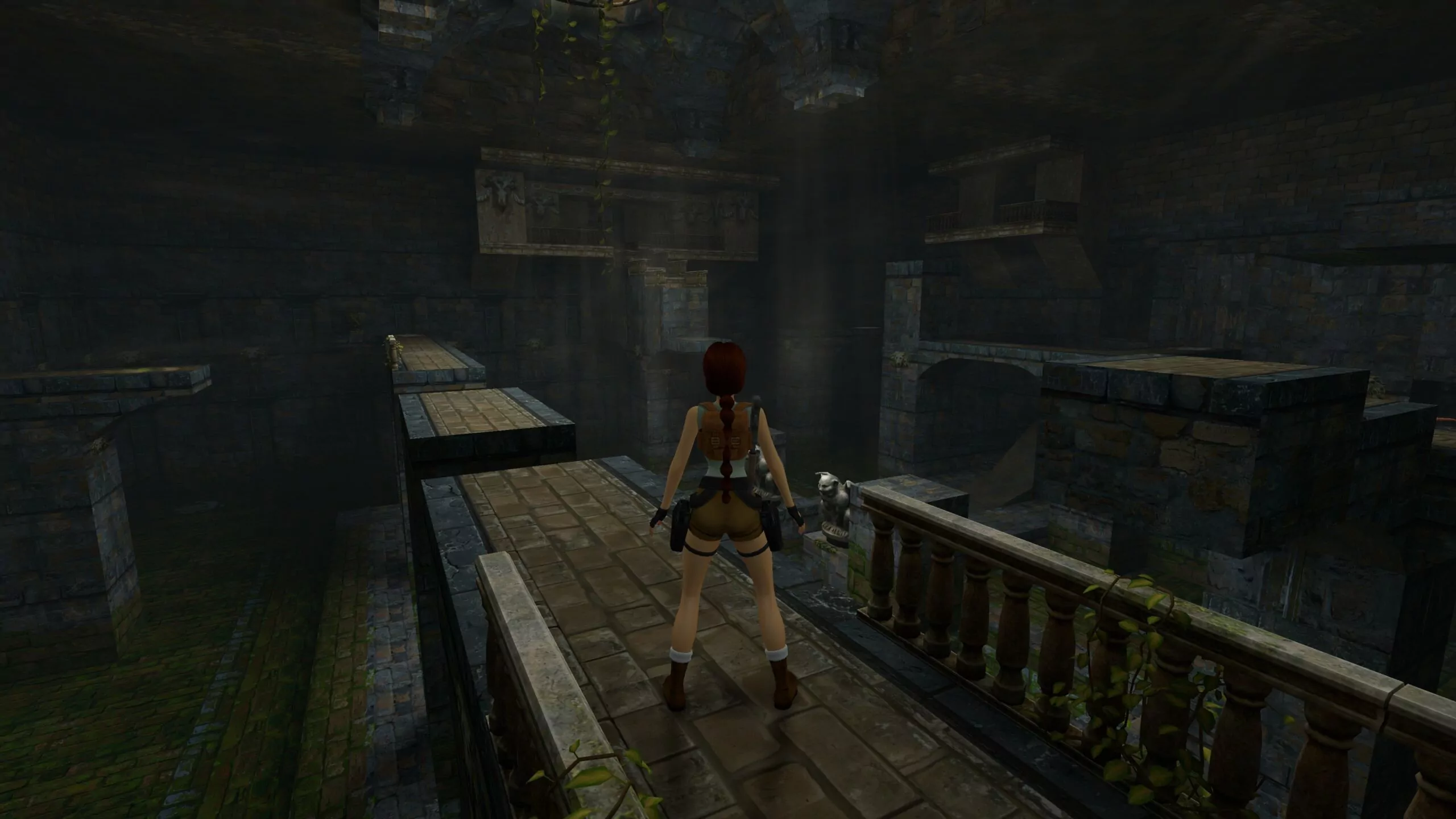
If you want to feel how big these levels actually are, there’s a wonderful thing called Tomb Raider Nostalgia, a browser tool by Alexis Popov that renders every level of TR1 through 4 in interactive 3D. Spin the Cistern around in your browser and the scale hits you – and that scale was the actual selling point in 1996. Big, contiguous, explorable 3D space with real verticality and real solitude, at a moment when almost nothing else offered it. People weren’t blown away by the polygons. They were blown away by the room (if you want the true original texture, you can even play the DOS version straight in your browser via dos.zone or the Internet Archive. Side quest, but a fun one).
Full confession while we’re here: I did not 100 percent this. I’m sitting around half the achievements, I missed a bunch, and I haven’t touched New Game Plus or the remaster’s challenge mode. I came to finish a thirty-year-old grudge, not to platinum it.
Where it lost me
And then there’s Atlantis, which I disliked with my whole chest.
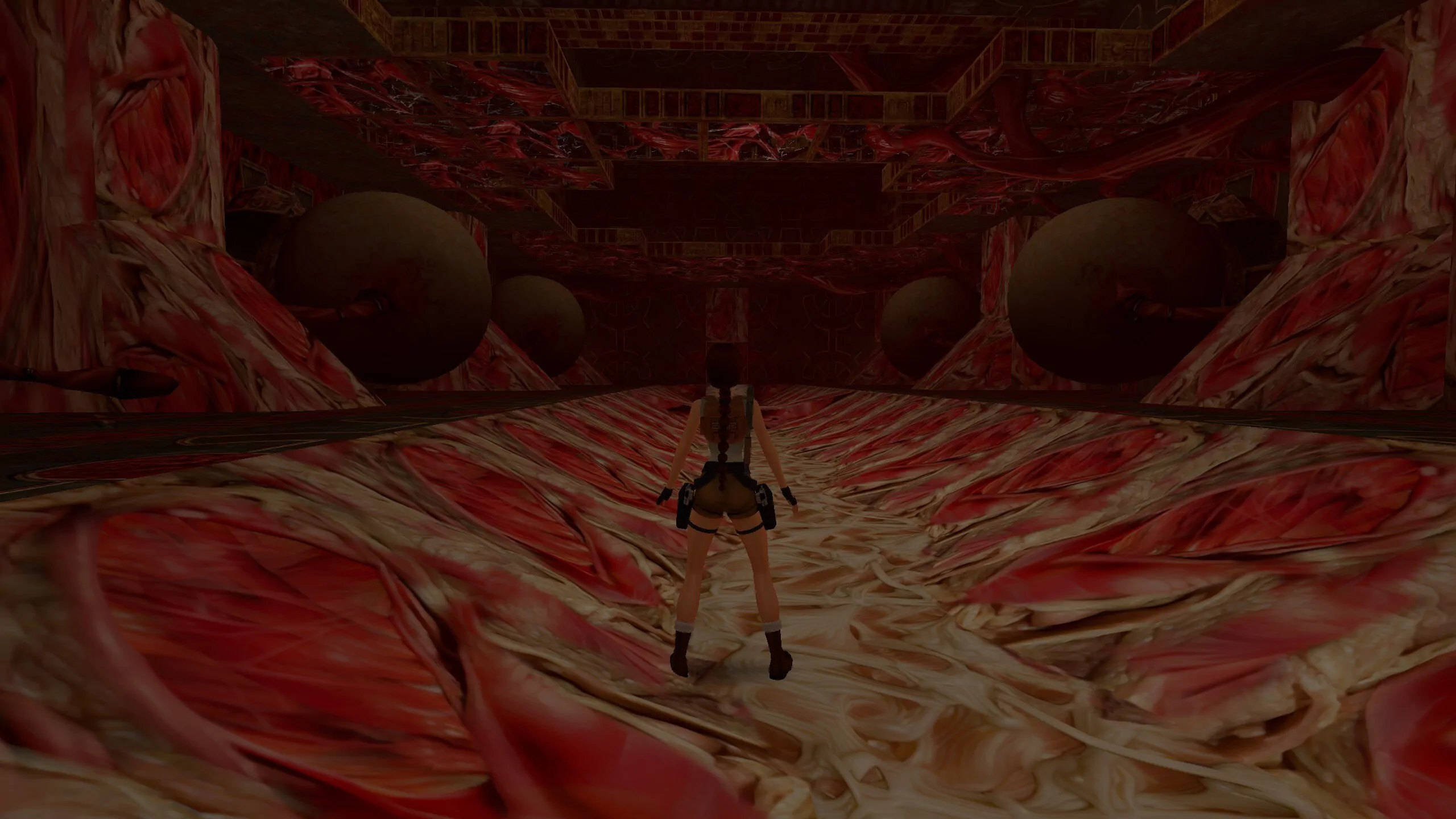
Not the architecture – the level design underneath is fine, sometimes clever. It’s the vibe. The art turns into wet organic body horror, pulsating flesh walls and metal fused with meat, mutants hatching out of eggs mid-jump, a skinless clone of Lara that fans lovingly call Bacon Lara. The difficulty spikes from cruel-but-fair into genuinely unfair, and the enemy design leans on swarms. Even the sound seems built to make you feel unwelcome – long, oppressive, wrong-feeling silences that push you back toward the exit. I finished it. I did not enjoy it. Interesting swing, though, and I want to be fair to it: this is a wildly popular opinion, not a lonely one. Half the internet calls the Atlantis chapter the ugly, exhausting low point of an otherwise gorgeous game, and the ugliness is deliberate – Core wanted you repelled. Mission accomplished, I guess.
The four bonus levels bundled in – everyone calls the whole thing Unfinished Business, though technically that name only covers the two Atlantis levels while the two Egypt ones are the Shadow of the Cat chapter – felt like tacked-on challenge maps, and it turns out there’s a reason for that. They were made by a separate Eidos team in San Francisco, not by Core, released in March 1998 as expert bonus content. No story arc. No standout design. No new mechanics. Just harder, less readable rooms with as many enemies as they could cram in – one reviewer joked they were trying to make Final Doom out of it. If I have to pick a favorite, it’s the Temple of the Cat, with its cat statues that snap into panthers and its multi-story golden Bastet. And of course that’s the one I liked – it’s from the Egypt half. I loved Egypt and bounced off Atlantis right to the very end.
The story, the house, and the verdict
There is a story. Jacqueline Natla hires Lara to recover the Scion, an artifact that turns out to be Atlantean, the ruins turn out to be older and stranger than they look, and the whole thing builds to a reasonably fun bit of pulp with a Texan-accented Atlantean queen. It’s serviceable. It is absolutely not the thing that made this game a landmark. Tomb Raider 1 succeeded on space and dread and movement, not on plot, and it knows it – the story mostly gets out of the way of the raiding.
Lara’s Home, the training villa, is a nice touch and I’m glad it’s here. But it’s bare. It’s the skeleton of the thing it would become – it’s missing the detail, the personality, and above all the beautifully annoying butler Winston who shuffles after you through the sequel’s manor and whom every player eventually locks in the freezer. In TR1 the house is a tutorial. In TR2 it becomes a personality. Here, you can feel the blueprint waiting.
So who’s this for? It’s a clear recommendation – but only if you know what you’re signing up for. Play it if you like a raw, unpolished, slightly hostile experience. Play it if you rank mechanics and atmosphere above graphics and storytelling. Play it if you love trial and error, if you enjoy sitting with a problem, if you can find pleasure in walking from A to B and all the way back again – and here’s the distinction that matters – not as busywork backtracking, but because the walk is how you learn the level, read the space, and earn the solution. If that sounds like tedium to you, skip it and play the remaster’s prettier grandchildren. If it sounds like meditation, you already know.
Tomb Raider 1 at a glance
- Personal rating:
- Developer:
- Core Design
- Publisher:
- Eidos Interactive
- Release date:
- 25 October 1996
- Genre:
- Action-adventure, puzzle-platformer
- Where to buy:
The kid who lost to this game thirty years ago finally beat it. He did it in the flickering, black-fogged, 30 fps version, with the choir coming up out of the dark, firing his pistols at the walls just to see. He did it on purpose.
Turns out I belonged in there after all.


