Notes From The Burner Tray The disc was the network

Nero Burning ROM opened with a picture of the Colosseum on fire. Either the best or the stupidest piece of software branding ever shipped, and not one person I knew ever said a word about it, because we were thirteen and we had things to do. Borrowed disc in the reader. Blank disc in the burner. Four to twelve minutes of whirring, depending on how much you trusted your write speed. And then I owned a game I did not own.
Multiply that by a few hundred and you have my adolescence.
I keep catching myself explaining this to people ten years younger than me, and their faces do a thing. Not disapproval – confusion. The polite, slightly worried look you’d give someone describing a customs procedure from a country that no longer exists.
There were two ways to get a game
The legal one went like this: you took the train to the nearest Media Markt or Saturn, you stood in front of a wall of cardboard boxes the size of hardcover books, and you paid something like 50 euros of money you did not have. The decision itself had been made weeks earlier, on paper. GameStar, PC Games, PC Action, Computer Bild Spiele, Bravo Screenfun – the magazines were the search engine, the review aggregator and the marketing department all at once, and we read them cover to cover including the ads. Everything else came from the schoolyard, or from seeing something unfamiliar running on someone else’s monitor at a LAN party at two in the morning and asking what the hell that was.
The other way was the normal way.
Somebody’s older cousin buys Far Cry. It reaches your friend. Your friend brings the original disc to school in a jewel case with his name in marker on the paper insert, because that disc is going on a journey and everyone knows it. You get it for one evening. You put it in the reader, you put a blank in the burner, and Nero makes a one-to-one copy – or, if the copy protection was doing something clever, CloneCD makes an image straight onto the external hard drive and Daemon Tools mounts it later like a drive that isn’t there. Next morning the original goes to the next guy. The chain keeps moving.
Nobody called it a chain at the time – it was just how software arrived.
Before the discs, the floppies
I’d been doing a smaller version of this since the mid-90s, when the medium was a 3.5-inch floppy and a game was eleven of them in a specific order. Indiana Jones. Full Throttle. Day of the Tentacle. Descent. My older brother was already deep in all of it – the gaming, the swapping, the whole hobby – and nobody ever sat me down and taught me the mechanics. I watched, took it apart in my head, and worked it out. Kids reverse-engineer everything. That’s the entire job description of being seven to nine.
Floppies died constantly. Not corrupted, not unreadable-but-recoverable. Dead. One day SimCity 2000 simply stopped existing, and I remember the specific flavour of that, because it wasn’t a lost save file, it was the whole game, gone because of a dust mote or a magnet or nothing at all. Duke Nukem 2 went the same way. So did Holiday Island. There was no redownload. There was no support ticket. There was a nine-year-old holding a small plastic square that used to be a city.
The disc was the network
To put this part into a proper context: I had no internet at home until 2008.
None. Not slow internet – no internet. Which means that for the entire peak of this thing, roughly 2003 to 2005, I was never downloading anything. I was receiving.
The upstream node was a guy in our circle. Crazy dude – not clinically, just running at an amplitude the rest of us couldn’t match, and living a life outside of gaming that got extreme enough that I quietly stepped back from everything except the games. He had a fat connection and the patience to sit on a torrent for two days. Doom 3. Far Cry. Postal 2. Command & Conquer Generals. Act of War. Uncut imports and indexed titles that never legally reached a German shelf – Painkiller, Doom 3: Resurrection of Evil, Manhunt.
He downloaded, he burned, he handed it over. Not just to me – to the whole group. And then we copied from each other, which meant the bandwidth of my adolescence was a bicycle.
Sneakernet, in other words. The bottleneck was never the connection. The bottleneck was social: you had to know the guy. And I was mostly sitting at the end of the chain, collecting – games, albums, films, and porn, which in offline-2003 in was roughly as difficult to obtain as a firearm and considerably more sought after.
I lost contact with him in 2005 when secondary school ended. No idea what he’s doing now. He was, for five three years, the single most important piece of infrastructure in my life.
Full service, some assembly required
A copied game didn’t just arrive as a game. It arrived as a package, and the package usually had more engineering in it than some of the games.
There was the keygen, which spat out a valid serial on demand. And the keygens – the keygens were art. Chiptune looping in the background, scrolling plasma effects, a greetz list to other crews nobody in my village had ever heard of. Somebody in the demoscene sat down and composed a MOD track for a tool whose entire purpose was defeating a number check. Unpaid, uncredited under any real name, and better produced than half the shareware on the magazine cover discs.
There was the no-CD crack, which let you run the game off the hard drive without feeding the tray. There were patches, sometimes bundled in before the publisher had shipped them.
And then there were the German patches, which is a whole separate thing.
Green blood
Games released in Germany got cut – that’s the short version. The USK and the indexing apparatus behind it meant a shooter could arrive on a German shelf with the blood recoloured, the ragdoll physics disabled so bodies vanished on death instead of falling, and every swastika replaced with something geometrically similar and historically meaningless. Sometimes people were quietly reclassified as robots.
So the scene shipped Blutpatches. Blood patches. A small executable that restored what the German release had removed – red blood, gore, ragdolls, the actual symbols in the actual WW2 game about actual Nazis. And nude patches, for exactly the reason you think, a tradition inherited straight from the 90s.
Installing the blood patch was not a fringe activity. It was a step. You’d get asked whether you’d done it the way you’d get asked whether you’d installed the latest driver. Everyone did it, including – and I want to be precise here, because the received wisdom about German teenagers in 2004 is wrong – the girls. Everyone messed around in Postal 2. Everyone went feral in GTA: San Andreas. It was a violent interpretation of joy and we loved it.
Postal 2 held our group for months, which in retrospect says something about our environment I don’t want to look at too closely.
Far Cry took the entire summer of 2004, and not because of the campaign. It shipped with the CryEngine Sandbox editor, and I spent that summer building single-player and multiplayer maps: environmental storytelling, traps, scripted AI behaviour I’d customised by hand, and – this is the part I’m least proud of and most impressed by – pornography placed in specific sightlines to distract other players during matches. I was a teenager who had independently invented psychological warfare as a level design mechanic. We played those maps for weeks.
The other thing in the package, occasionally, was a virus. The prettier the keygen, sometimes the worse the payload. And when the antivirus lost, there was exactly one remedy: reinstall Windows XP. From a burned copy, obviously. What else.
The IT room had burners
The best joke in this entire story is that the school paid for the infrastructure.
The computer room had machines with CD burners, a connection that made anything at home look like a joke, and system restrictions that took maybe a week to figure out and roughly nine seconds to bypass thereafter. We downloaded there. We burned there. We traded jewel cases and spindles in the hallway like a small commodities market, because blank discs cost real money and nobody had any.
The teachers either didn’t understand what was happening or had made a private decision that this was not their fight. I still don’t know which and I’ve never wanted to find out.
That’s also the answer to a question I get asked a lot: how do I remember eMule, Kazaa, Napster and BitTorrent so vividly when I had no internet at home for the whole period. Because I used them somewhere else. In the computer room. At his place. At whoever’s house had the connection that week.
One CD, eight machines
LAN parties get remembered as the games. But they were not the games, they were the setup.
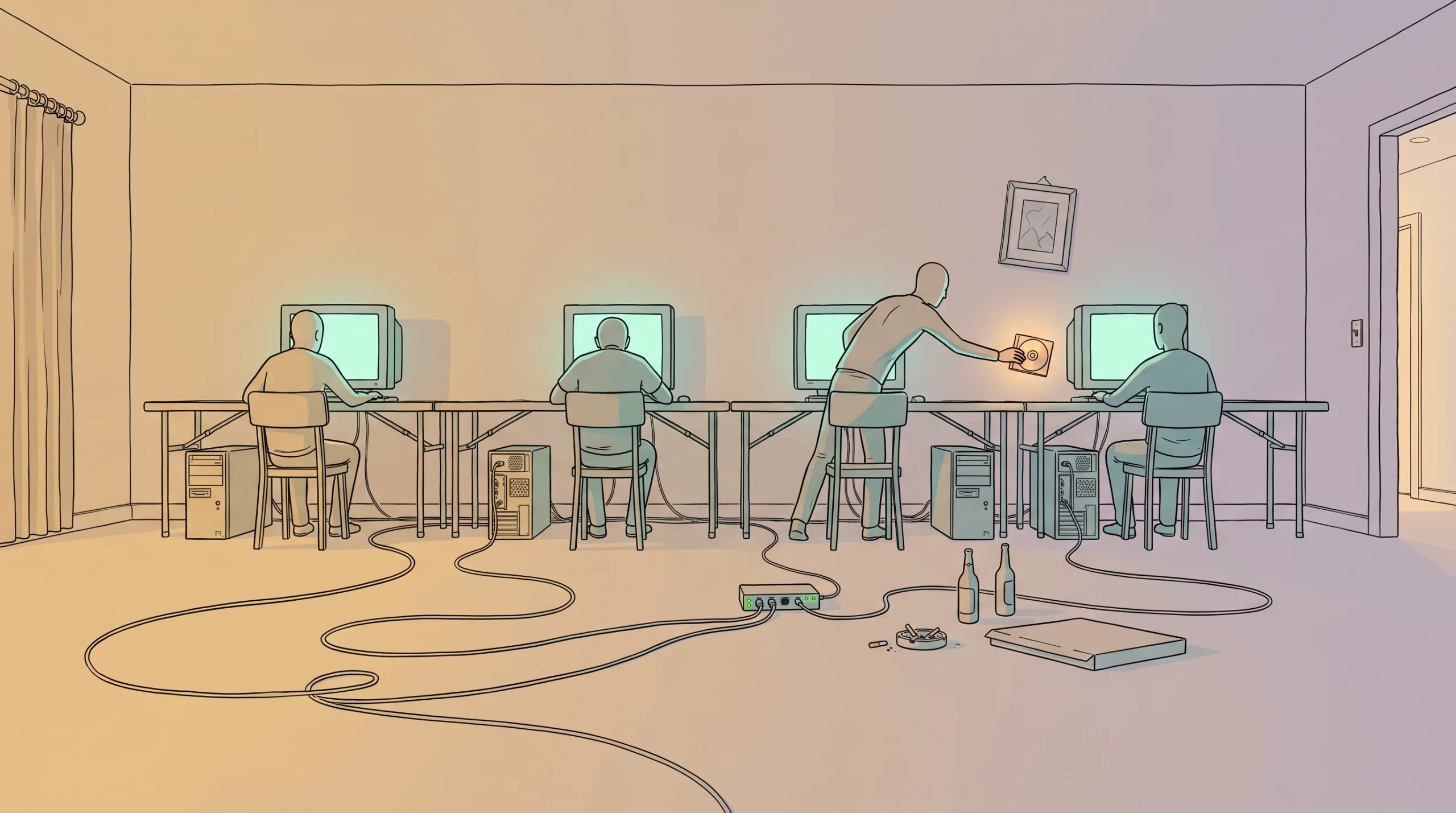
Age of Empires 2: The Conquerors, some Saturday around 2004, eight tower PCs dragged across town in the back of somebody’s mother’s car. Everyone has to be on 1.0c. Not roughly on it – exactly on it, or the map doesn’t load and the session doesn’t happen. We had one CD. One. Which had to do the install, then the serial, then the crack, then the patch, on eight machines in sequence, while the patch itself failed on at least two of them for reasons nobody could reconstruct.
Meanwhile somebody is on the floor behind a desk fighting Windows XP over whether it believes a network exists.
Four hours in, we played. And it was worth it, which is the part that doesn’t translate. The friction was the ritual. You don’t get that from a lobby.
What I actually paid for
I bought games in that era too, plenty of them, and looking at the list now there’s a pattern I never noticed while it was happening.
Pharaoh. Anno 1503 with Schätze, Monster und Piraten. Cultures with Die Rache des Regengottes. Alarmstufe Rot 2 with Yuris Rache. Die Siedler 3 Gold Edition. Later, once I was earning my own money: Gothic 3, Die Sims 2 and 3, Anno 1404, S.T.A.L.K.E.R.: Shadow of Chernobyl, and many more.
Builders. Strategy. The games I would put 200 hours into and still be thinking about on the school bus. Those got my rare, hard-won money and a place on the shelf in a big box with a printed manual I actually read.
The pirated tier was the other kind: shooters, chaos, the disposable and the communal. Fun for a fortnight, played in a room full of people, never once opened again afterwards. I didn’t decide any of this consciously. Thirteen-year-old me had built an entire economic theory of value and would have been unable to explain a single sentence of it.
And no, there was never any guilt. Not a flicker. Everyone I knew copied everything, loudly, in public, in a schoolyard, and the idea that this was theft in any sense that mattered simply had no purchase. Nobody I knew ever got caught either, though this was still a few years before the golden age of the Abmahnanwalt, so maybe somebody did and had the good sense never to mention it.
The last disc
It didn’t end with a decision. It ended with a salary.
From 2005 on the whole thing thinned out – no more schoolyard economy, just the occasional swap at a LAN party. I started earning money. Buying a game stopped being a sacrifice and started being a Tuesday. And then Steam turned up and made the entire apparatus – the borrowing, the burning, the crack, the patch, the spindle, the marker pen – look like an enormous amount of work to avoid a purchase I could now simply make.
The last game I ever burned was, as far as I can reconstruct it, Call of Duty 4: Modern Warfare. I bought Modern Warfare 2 in a box, retail, full price. Same franchise, one instalment apart. The last disc I copied and the first one I didn’t, back to back. You couldn’t script that.
In 2013 I was living in Frankfurt, had been moving between German cities for years, and had gone properly minimalist. I went back to my parents’ house and threw out nearly everything I’d ever owned. Mint-condition big-box games. Music CDs. Hundreds of burned discs with my handwriting on them. All of it, in an afternoon.
I only kept one small box of things with actual emotional weight – it’s still at my parents’ place.
The thing I miss is not the piracy. I’d never go back – I have several thousand legally owned games across Steam, GOG, Uplay, the EA App, Epic, Humble and Itch, I’ve re-bought most of what I copied in the early 2000s, and I haven’t had an optical drive in a laptop for over a decade. Digital, legal, done. If you can’t afford games, I get it, genuinely. The moment you can, pay for them, and not only for the moral hygiene – the money goes to the people who might make the next one.
What I miss is a shelf of GameStar issues from 1998 to 2008, complete, with the premium covers from 2003 onwards when I finally started subscribing. That was an archive and I binned it. The discs were interchangeable, but the magazines weren’t.
Two of the people whose bylines were in those issues, Gunnar Lott and Christian Schmidt, now make Stay Forever, a podcast about old games that I’ve supported for years from an apartment in Sài Gòn.
So the thread held. The Colosseum stopped burning, that’s all.


