Thirteen Years Later The better tomb, and the man who wouldn’t build it

Somewhere in Venice there is a homeowner who cannot open his own front door without first pole-vaulting across his ballroom.
That is not a metaphor. Tomb Raider 2 is full of enormous stone buttons that open doors at the other end of the level, sometimes at the other end of the district, and the game never once acknowledges how insane this is. I complained about it on this blog in 2013, in German, back when I was only watching somebody else play the thing. I have now finished it myself and the complaint survived intact, which either says something about the game or something about me.
I started part 2 the same evening I finished part 1. Then it took months, because life.
And it’s better. Rounder, fuller, more sure of itself. Bigger levels, smarter architecture, slicker movement, a story that is still simple but at least wants something, and a Lara built from visibly more polygons than the 1996 model.
The braid, the ladders and the aha
Start with the polygons, because everybody does, and then leave immediately, because the polygons are the least interesting upgrade in the game.
The braid is better evidence. Tomb Raider 1 shipped without one: Core Design, the studio in Derby that built these games, had animated it and then cut it, because it flailed around like an electric eel every time Lara did anything acrobatic. Part 2 puts it back and it swings correctly, weight and all. A ponytail is a strange thing to call a technical achievement, and it absolutely was one.
But the upgrade that quietly restructures the entire game is ladders.
Tomb Raider 1 has none. Zero. Every vertical connection in that game has to sit within jumping distance of another one, which is why those levels feel compact in hindsight – the architecture was limited by Lara’s legs. Give the designers ladders and suddenly a room can be four stories tall for a reason, a shaft can be a route instead of a wall, and levels start stacking instead of sprawling. You don’t notice them while playing. You assume they were always there. That is how good the addition is.
Then the small stuff, which is where sequels are actually won. The curious, faintly surprised aha when Lara picks something up, a sound I could still hum under anesthesia. More enemies. More weapons, including a harpoon gun, because at some point that design meeting clearly went places. A wider movement palette that makes the platforming read as choreography rather than arithmetic.
None of it is revolutionary. All of it compounds.
The levels that stayed with me
What follows isn’t a walkthrough and it isn’t complete – these are simply the levels still sitting in my head weeks after the credits, in the order the game hands them over – which turns out to be its own kind of story, because Tomb Raider 2 rises, sags badly in the middle, peaks in Tibet, and then quietly falls apart at the end.
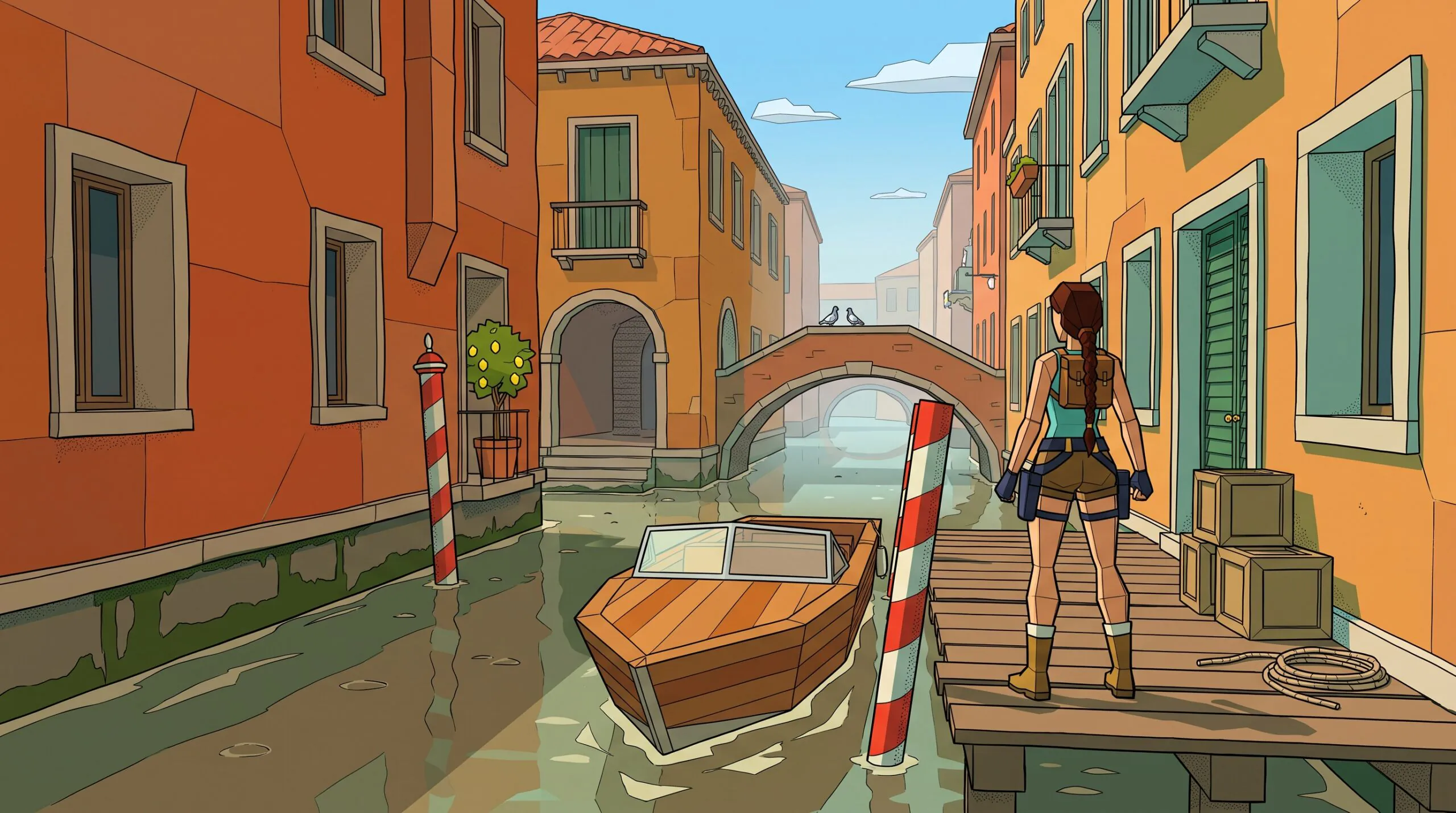
It opens strong. Venice is the one. Obviously it’s the one.
Lemon trees, canals, checkered marble going soft with damp, and Nathan McCree’s Venice Violins laid over the top of it, which is a piece of music that does something physical to anyone who was a kid in 1997. Goosebumps, immediately, every time. Zero counterplay. None available, none attempted.
Bartoli’s Hideout comes next and inverts the whole premise. Lara’s mansion taught you how to move through a home; now you break into somebody else’s, and you learn who Bartoli is from his library and his fireplaces and his rats without a single line of dialogue. It also contains the chandelier hall, a room I have genuine childhood trauma about, because crossing it with tank controls was a small architectural exam I kept failing. Modern controls turned an exam into a stroll, and I felt slightly robbed.
Then the game goes underwater and finds its actual voice. 40 Fathoms is dark, heavy, oppressive, isolated. You can feel the pressure in your ears and smell the mold and the seaweed through a monitor, in 1997 graphics, which should not be possible and is.
And then, right after that high, comes The Deck.
God, The Deck. Enormous, stretched thin, stuffed with backtracking, and full of paths so easy to walk straight past that dozens of minutes evaporate while you jog in circles reopening rooms you already emptied. I hated it as a kid and I hated it again as an adult, with modern controls and functioning spatial reasoning and a map of the place in my head. I’m aware this is a minority position – people genuinely name it their favorite, for the isolation and the open-ended exploring. Well, different players, different habits.
The game climbs out of the water and hands you a snowmobile, which is a bullet point on the back of a box. It was probably a delight in 1997. Today it’s clunky and weightless and it flattens the careful footwork everything else is built on. What survives completely intact is the music: Lara Plays in the Snow, nicknamed Scoosh internally, a track with pure Love Parade energy that has aged approximately zero days. Its middle section quotes the main theme, and it comes back one final time over the end credits, so the best thing about the worst mechanic is also the game’s goodbye.
The track: Lara Plays in the Snow, aka Scoosh
Past Tibet the game gets strange, in the best way. Floating Islands looks like jumping through abstract modern art and I mean that as praise: shards of radioactive green rock hanging over an absolutely black nothing, a moon behind torn cloud, a pagoda and a blossom tree parked on a lump of orange stone, and no explanation offered at any point. Brutal with tank controls, entirely playable with modern ones. I played on default difficulty, so the flying guardians were bullet sponges rather than a wall.
Nobody has ever properly documented where that place is supposed to be. Fans have argued for Agartha, the hollow-earth kingdom of super-elders – a lovely theory, and a French one, invented in Paris in the 1870s and quietly attributed backwards onto Tibet afterward. Which makes the joke better, not worse: a British studio in Derby built a European fantasy of Asia, and a kid in a German village accepted it as documentary. Everyone in that chain is dreaming about somewhere they’ve never been. Me very much included.
And then it ends, and then it keeps going, because I have no self-control and started The Golden Mask the same week. The 1999 expansion is four levels plus a bonus and it is uninspired – it feels like homework somebody else did. Held at knifepoint I’d pick Furnace of the Gods. Not great, not terrible. Huh. Nightmare in Vegas had a genuinely unique premise and an entire world to build in and came out soulless and repetitive and out of ideas by the second room, which stings more than a merely bad level does, because you can see what it could have been.
Barkhang Monastery solves the game’s own problem
I skipped one on purpose, because it doesn’t belong in a list.
Barkhang Monastery is the densest, most satisfying stretch in the entire Tomb Raider 1 and 2 arc, and I say that having just played both back to back. The world building is real. The design balances puzzles, jumping passages, reaction tests, combat and moments of complete silence, and it never sits in any one mode long enough to become a chore. Tibetan Chants underneath all of it. It’s the only level where I stopped wanting the next level.
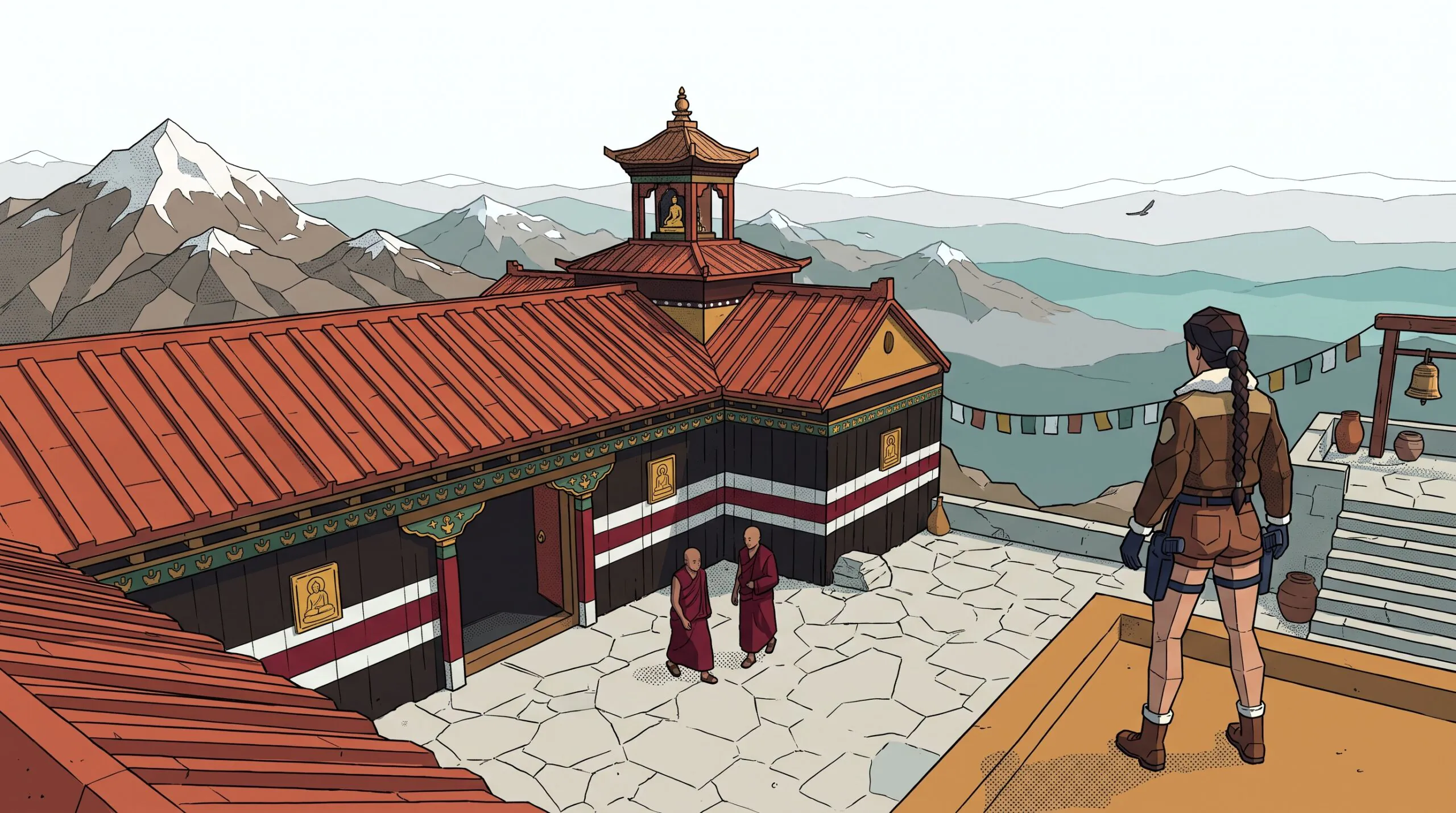
It took me a while to work out why it lands so much harder than everything around it, and the answer is a little uncomfortable for the rest of the game: the monks are a faction. They fight the Fiamma Nera goons on their own, they stay on your side unless you shoot at them (I didn’t), and Core built it that way specifically so Lara wouldn’t spend another forty minutes executing everyone in the building. Barkhang is the one level where Tomb Raider 2 stops being a shooter. My favorite level and my biggest complaint about the game turn out to be the same observation from opposite ends.
I wish there were more of it, and in a sense there is. The fan level-editor scene has been running for twenty-six years and has produced a genuinely absurd amount of Tomb Raider. Just be aware it’s mostly not part 2: the official editor shipped with Chronicles in late 2000 and runs the TR4 engine, so the numbers on trle.net skew hard, with ≈3,225 custom TR4 levels against 152 for Tomb Raider 2. Still. The newest release on that site went up in July 2026. A game from 1997, and people were still building rooms for it this summer.
The gunplay was never the point
Which brings me to the part of Tomb Raider 2 I’d cut:
Shooting has never been a strength of this series. It stands on exploration and adventure – the scenarios, the atmosphere, the complexity of the architecture, the secrets folded into it. Combat is what happens in between. And unless you’re perched somewhere safe plinking away at melee enemies, it’s a fucking pain: floaty, imprecise, unsatisfying. It was worse in part 1 and worse still under tank controls, and part 2 improved plenty around the edges, handed us a wider arsenal, gave us the harpoon, and it still sucked.
The aiming isn’t the real problem. The humans are.
Part 2 has far more fighting than part 1, and most of it is against men with guns whose accuracy and effective range comfortably exceed anything Lara can do back. I understand the intent – more action, more pressure, a harder edge for a sequel that had to be bigger than a phenomenon. It was one of this game’s actual selling points. It’s also the first thing I’d remove. Fewer humanoids, more animals, more environmental hazards, and Tomb Raider 2 is a better game. Floating Islands proves it in the negative: gorgeous non-linear platforming, wrecked by arena waves the engine was never built to run.
That’s an opinion, not a fact. But I did just play the whole thing, so.
Back at the mansion
The game starts and finishes in Lara’s home, and that bookend is doing more work than it gets credit for.
Going back in is nostalgia, undiluted. The little secret buried in the hedge labyrinth. The dark attic, which I still swear has a hidden button somewhere and definitively does not. The basement with its treasure room. And Winston, the butler, trailing after generations of players making small polite noises until each of us, independently, arrives at the same solution: lure him into the cold storage and shut the door. I did it again this time. It was easier than it used to be, because – here we are again – modern controls. Take that, butler.
Sorry, Winston.
There’s also a button on the ballroom wall that switches Venice Violins on. In the original game it plays exactly once per visit, so generations of people pressed it a second time, got silence, and assumed their copy was broken. The workaround the community landed on isn’t clever, it’s stupid in the best way: go trip the assault-course reset, let Lara sigh oh dear, back to the start, and the button re-arms. In the remaster you can toggle it as often as you like, which is more convenient and slightly less romantic.
Then the game sends you home for real. Home Sweet Home exists because Tomb Raider 2 animator Stuart Atkinson and the team thought finishing on a boss fight felt anticlimactic, so they took the training level, made it night, and let armed men break into it. Your shotgun is hidden behind the locked door you couldn’t open during the tutorial. The door that taunted you at the start is the door that arms you at the end.
And the remaster adds one more knot on top: there’s now an achievement for killing every enemy in the ballroom while the music is playing. The nostalgia button – the one I pressed as a child purely to hear the song – is a combat objective. Press it, then shoot people to Vivaldi. THAT is a remaster.
The year Lara stopped being a game
All of which is the small story. The large one is that part 2 is where Lara Croft escaped the medium entirely:
Tomb Raider 2 sold ≈6,800,000 [6.8 million] copies. Fine, big, whatever – sales don’t carry it. What carries it is that in 1998 Die Ärzte put a digital Lara Croft into the video for Männer sind Schweine, officially licensed from Eidos Interactive, and it became the band’s first number one single in Germany. Not a gaming crossover. One of the biggest German rock bands of the decade got their first chart-topper with a video game character in the clip, and it ran on VIVA and MTV on a loop, and I watched it there.
The video: Die Ärzte, Männer sind Schweine
She sold Lucozade. She sold SEAT cars. Eidos had Rhona Mitra record an entire album in character with Dave Stewart of the Eurythmics. In August 1999 Playboy ran a nude shoot of a former official Lara model on its cover without asking Core Design, and Core sued – on behalf of the reputation of a woman who does not exist – and won, and the court barred Playboy from putting her name on the cover or the Tomb Raider logo anywhere near the model.
And in my house there was a magazine.
Lara Croft Magazin, Ausgabe 1/99, DM 9,80. A hundred and forty pages about a fictional woman: how cult figures get made, a trip to Eidos, a feature on artificial intelligence, a twelve-page photo spread of the official Lara model, and a quantity of 3D renderings in which Lara wears, let’s say, a suggestion of clothing. It was a secretly shared treasure between me and my friends, passed around the way things were passed around in a village before broadband. As far as I can tell there was never an issue 2.
That magazine is now a footnote in German media theory. The philosopher Astrid Deuber-Mankowsky cites Lara Croft Magazin 1/99 as a primary source in her work on Lara as model, medium and cyber-heroine. We thought we were hiding something embarrassing. We were curating a research object.
The man who wouldn’t make it
Toby Gard designed Lara Croft. He also refused to work on Tomb Raider 2.
Core wanted to market her sex appeal. They asked him to build a nude code into the first game and he said no. His vision for her was cool, collected, in control, and he was blunt that she was never supposed to be a page-three girl in hiking boots. When Tomb Raider became a global hit the creative freedom evaporated, and he was offered a choice: port part 1 to the Nintendo 64, or work on Core’s vision for part 2.
He took neither. He walked in 1997, together with Paul Douglas, who had written the code for the first game. That is integrity, and it cost him the most valuable character in European gaming.
So the game that turned Lara into an omnipresent commercial object – the magazine, the music video, the sports drink, the Playboy lawsuit, all of it downstream of this hype cycle – is precisely the game her creator refused to build.
And I was the target demographic. I was exactly who that machine was aimed at, it worked completely, and I would not hand back a single one of those afternoons. Both of those things are true and neither cancels the other. Gard was right about what they were doing to her. He just wasn’t right about me, because I was a kid and the marketing worked.
Tomb Raider 2 at a glance
- Personal rating:
- Developer:
- Core Design
- Publisher:
- Eidos Interactive
- Release date:
- 21 November 1997
- Genre:
- Action-adventure, puzzle-platformer
- Where to buy:
It’s the better Tomb Raider. Bigger levels, smarter architecture, more polish, better music, and one monastery in Tibet I’d rank above anything in part 1. It also shoots too much and puzzles too little, and I’d trade three gunfights for one more room like Barkhang without thinking about it.
If you want a properly thorough level-by-level read afterward, there’s a good one over at Backrooms Gaming that disagrees with me about half of this, which is roughly the correct amount.
Part 3 is already running. It’s harder, meaner and far more elaborate, and it will take me months.
And somewhere in it there will be a switch that opens a door at the other end of the world, and I will complain about it, and in thirteen years I will complain about it again.


