A Prophecy In Paint Thôi nôi, and the paint on the wall

Yesterday a one-year-old girl picked her whole future off a steel tray, and a room full of grown adults cheered like she’d hit a slot machine.
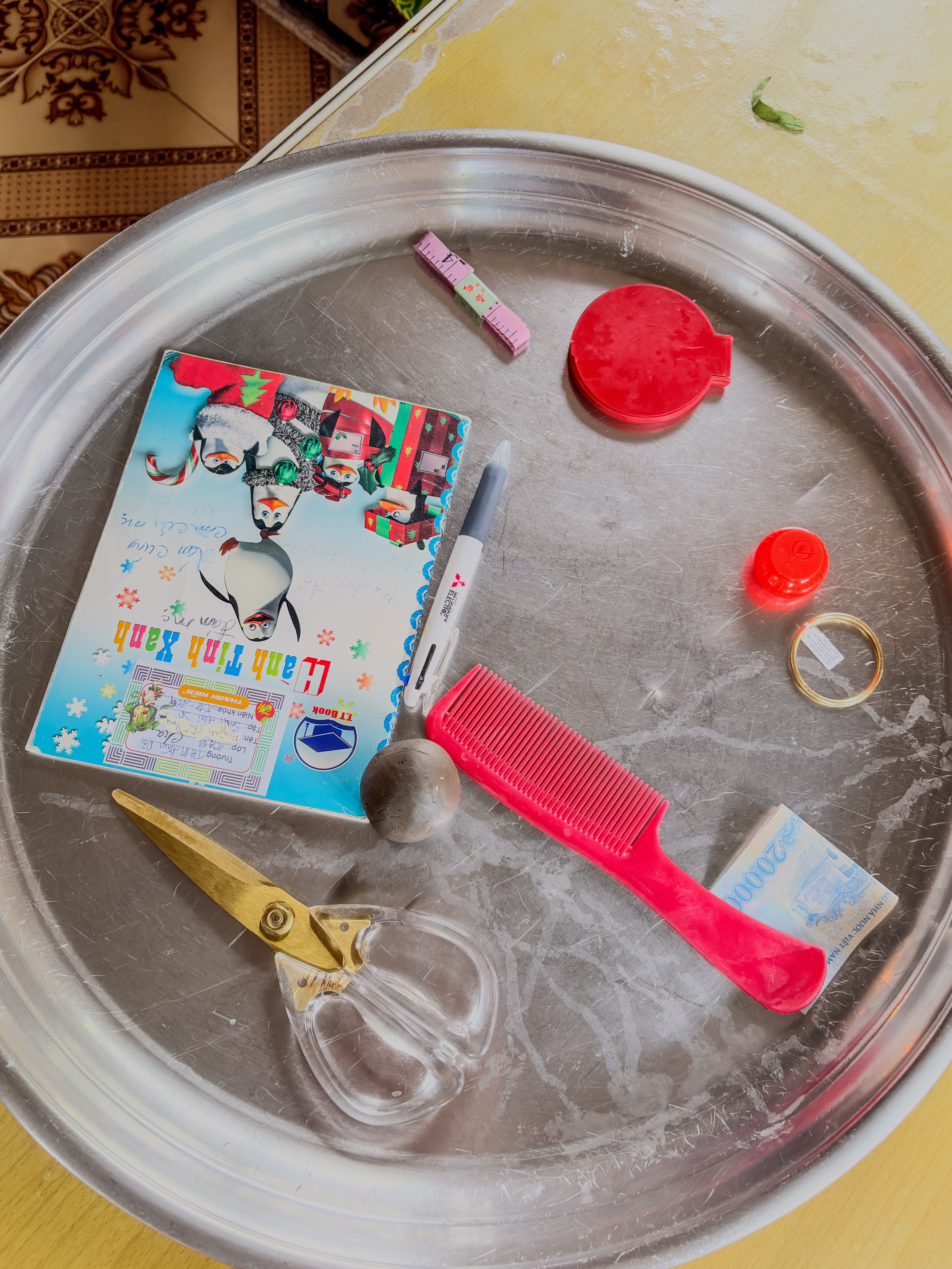
Her hand wandered over the spread – a gold ring, a little mirror, a pencil, a school notebook, a comb, a pair of scissors, a tape measure, a folded 20k Đồng note, a lump of grey clay – and came back holding gold, the mirror, the pencil, the book. Money, beauty, and letters. The whole room exhaled at once, because in the logic of what was happening, she’d just drawn an extremely good hand.
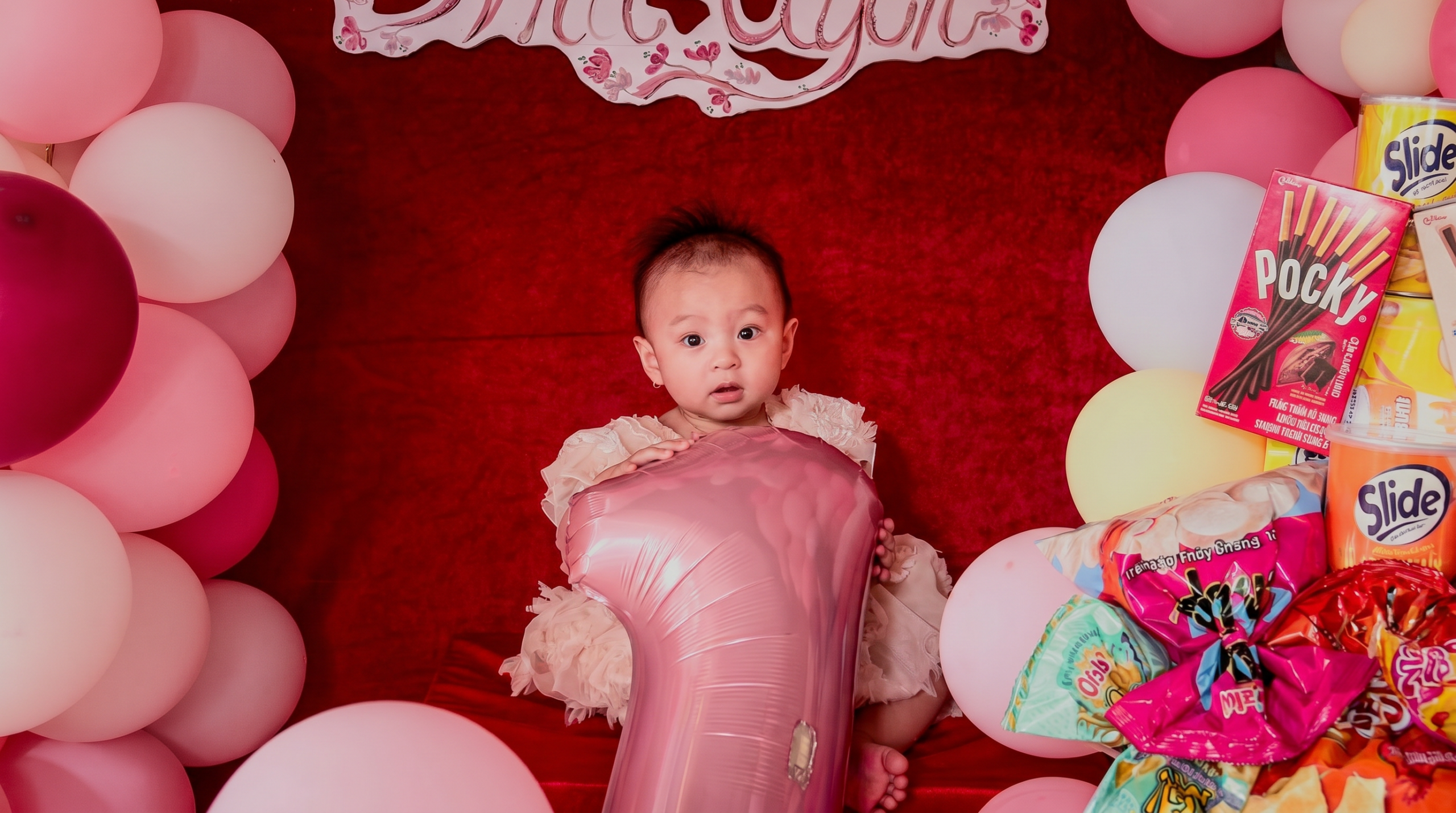
Her name is Nhã Uyên. Everyone calls her Bánh Bao – steamed bun – because that is exactly what her face is doing: round, soft, and mildly unimpressed with you. She’s Jayden’s brother’s daughter, which makes her some flavor of niece to me, and yesterday she turned one. In Việt Nam, a first birthday is not a cake and a song. It’s a ceremony, and a small piece of fortune-telling, and it has been running in roughly this shape for about 1,500 years.
Leaving the cradle
The day is called thôi nôi. It means “leaving the cradle” – the moment a baby is considered done with the basket they slept in as a newborn and ready to be part of the family. Down here in the south we say thôi nôi; up north the same milestone is more often lễ đầy năm, the full-year rite. Bánh Bao is a Cà Mau kid, so: thôi nôi.
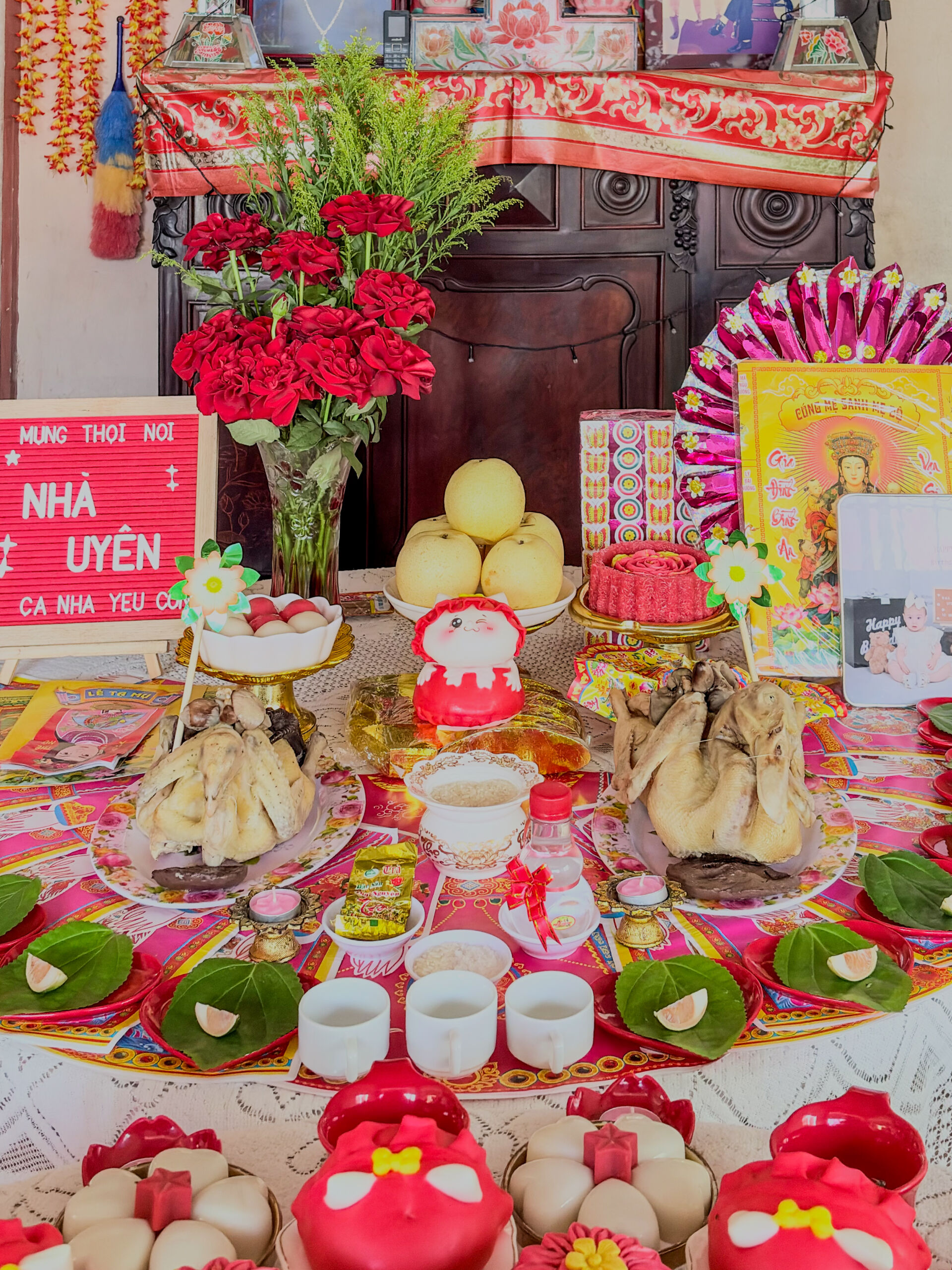
Most of the day is about gratitude, and the people you’re thanking are not entirely of this world. Vietnamese folk belief hands every newborn to the Bà Mụ – the twelve Midwife-goddesses – who are said to shape the baby in the womb and then teach it, one by one, how to smile, how to talk, how to hold up its own head. So the family lays out a table to thank the goddesses. Boiled chicken, sticky rice dyed deep red with gấc, chè molded into little flowers and cat-faces, pears, tea, a forest of incense. Twelve of some things, one per goddess. The signs propped on the table said it outright – mừng thôi nôi, lễ tạ Mụ: celebrating the cradle-leaving, thanking the Midwives.
Then comes the part everyone actually waits for: they set a tray of objects in front of the baby and let her grab. Whatever she reaches for first gets read as a window into the kind of life she’ll have – the work, the temperament, the shape of the thing. Gold, she’ll never want for money. Mirror, she’ll be beautiful. Pencil and book, she’ll live by her mind. It’s basically the character-creation screen at the start of an RPG, except the one-year-old is rolling her own stats live, in front of everyone, and cannot be talked out of a single choice.
If the whole idea feels oddly familiar, it should. The grab is the Vietnamese cut of an old Chinese ritual called zhuazhou, “catch the week”, documented as far back as the 5th century and spread across half the continent – it’s doljabi at a Korean dol, erabitori in Japan. So when Bánh Bao slapped her hand down on that gold ring, she was doing a thing babies have been doing, in living rooms all over Asia, since before the western half of Rome fell over. Big swing for a person who cannot yet talk (but, surprisingly, walk).
2000
This is where the culture explanation turns into a story about the man I’m going to marry: twenty-six years ago, in the same yet slightly less upgraded house, another baby sat in front of another tray. Full Nike outfit. Hair sticking straight up. Grandmother mid-laugh beside him, an elder leaning in to steady his little fist. The prints have faded to that specific early-2000s magenta wash, the color every film photo from that decade turns after twenty years in the wet heat, so I gave them a quick AI-powered refresh. That baby was Jayden, my fiancé.
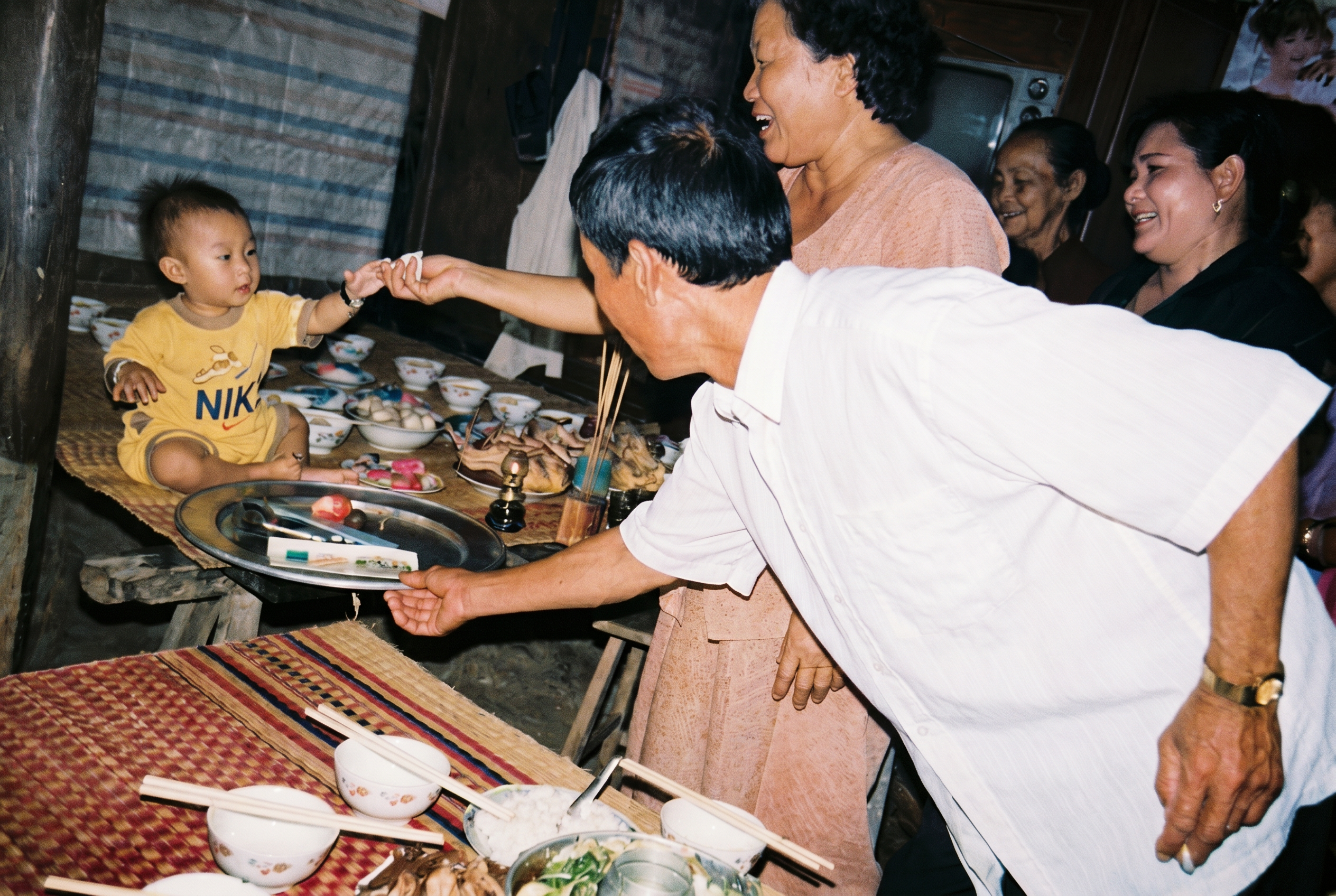
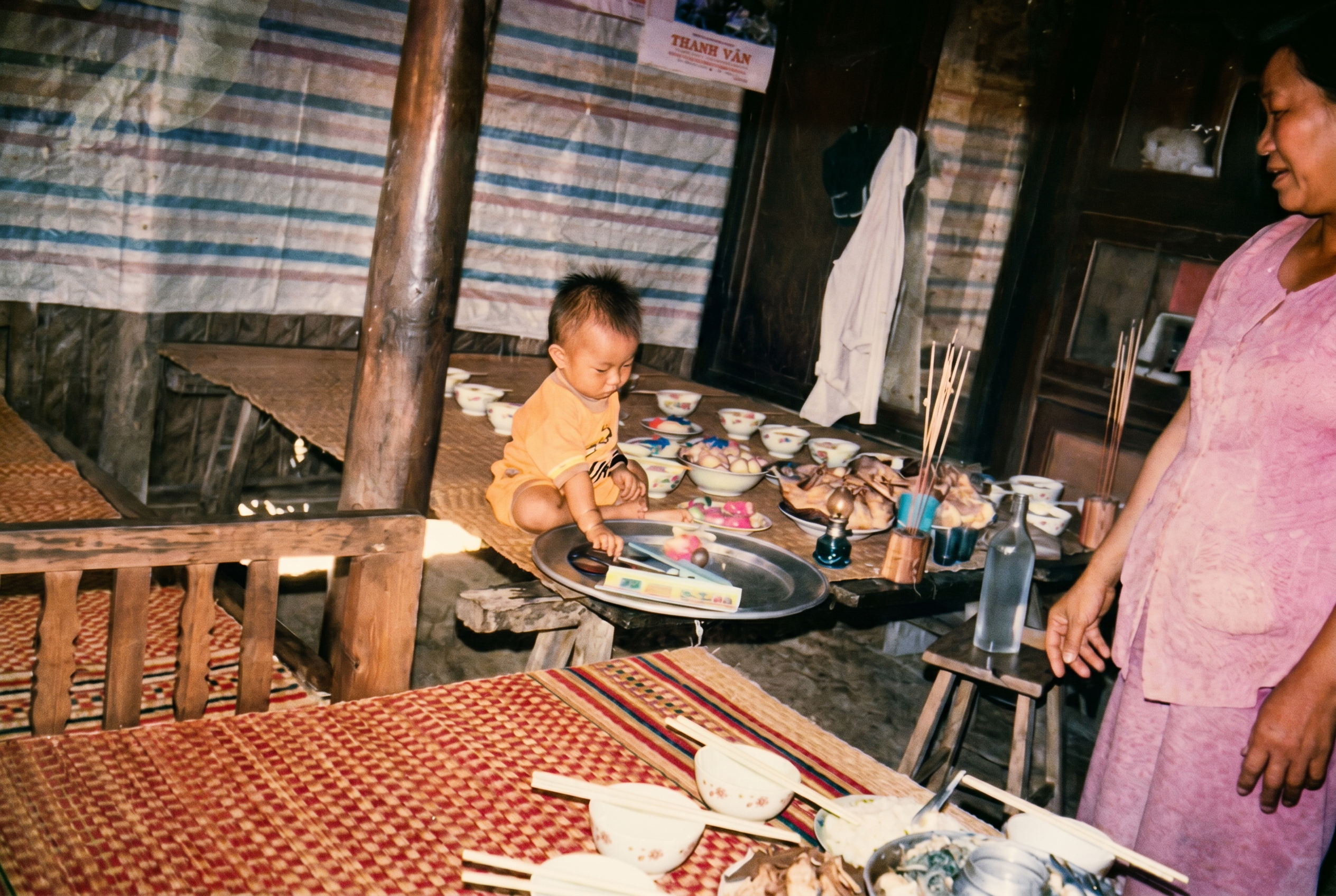
He grabbed a tape measure. Then a pencil. Then a book.
Let that sit for a second, because his family certainly has. Jayden grew up to be a fashion designer and an artist. The tape measure is the tailor’s tool, the literal instrument of the trade he landed in. The pencil and the book are the artist’s. He reached, at twelve months old, for the exact two things he’d spend his life doing, and the family has been telling the story at every gathering since, the way you’d tell a prophecy that came true on schedule.
I don’t think it predicted anything. He thinks it didn’t, mostly. His relatives believe it completely, and honestly, they’ve got a card to play, because here is the part that made me put my coffee down.
The paint on the wall
Around 2013, still a teenager, Jayden painted the walls of the family house. Inside and out – a Madonna, flowers, the uncle milk grandpa, whole murals, the colors soft now but still there. He did it because he was the kind of fourteen-year-old who paints a Madonna on the family wall. Which is to say: exactly the kid the tray said he’d be.
And yesterday, Bánh Bao did her grab in a room his teenage hands had decorated.
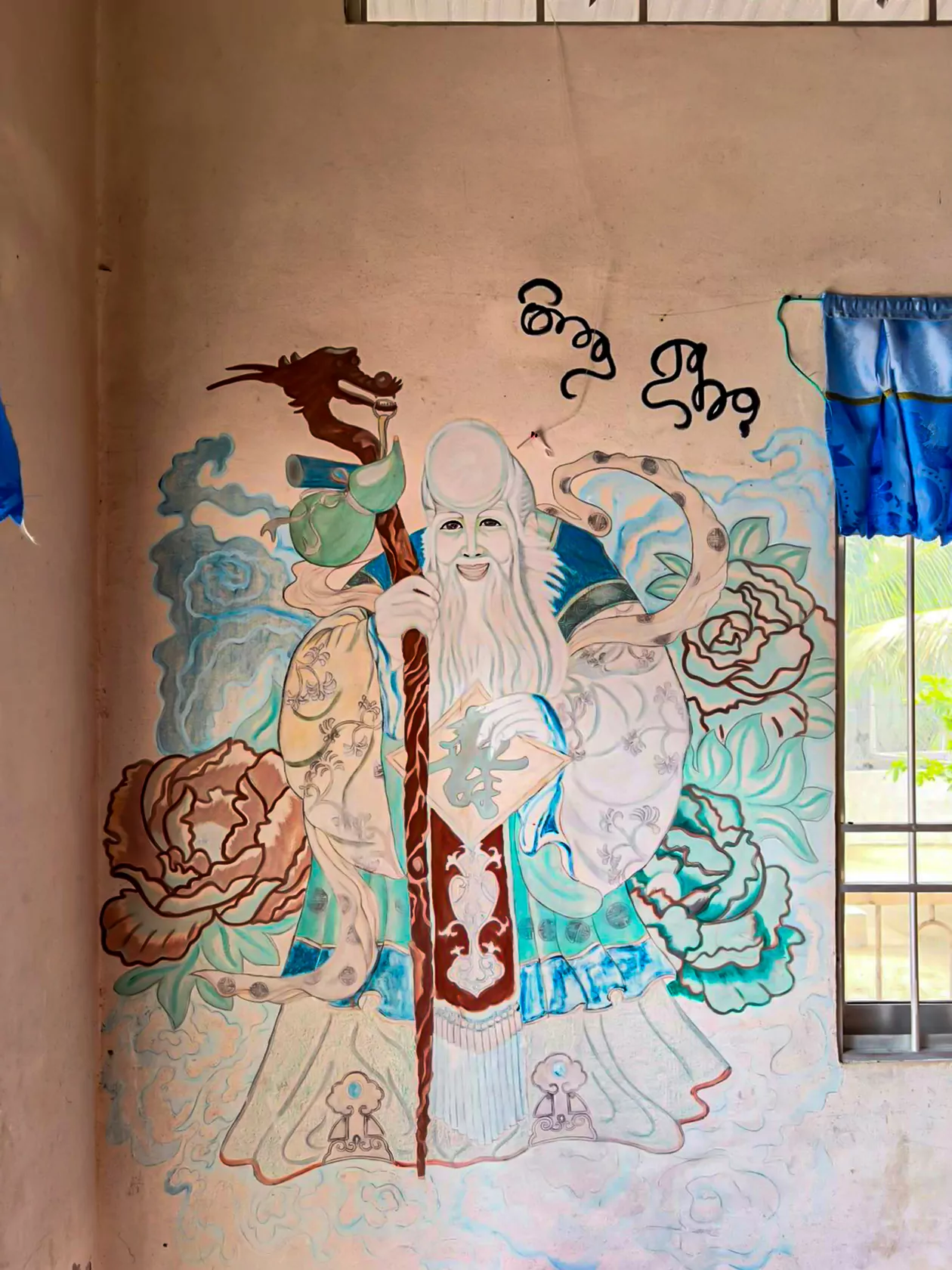
Which is the thing I can’t get past: the prophecy isn’t a cute anecdote the aunties trot out over rice wine. It’s the backdrop. The grab came true, the grown-up version of that baby picked up a brush and put the proof on the wall, and then the wall became the set for the next baby’s turn at the same ritual. You couldn’t write it. I’d be embarrassed to write it. But there it is, in faded acrylic, behind a balloon arch and a giant foil “1”.
Built on water
I should tell you where all this happens, because it changes the weight of it, at least a bit.
Jayden is from the southern countryside of Cà Mau – the very bottom of Việt Nam, the last muddy smear of land before the country gives up and becomes sea. His family farms shrimp. The whole place is built in and with and around water: canals where you’d expect streets, shrimp ponds and fish farms where you’d expect fields, and a thin wire mesh of mud and concrete paths just wide enough for one motorbike strung between them. No big roads. No cars, not for dozens of kilometers in any direction (go check it on Google Maps – these aren’t fields; this is all water). You arrive by boat, or by bike, or you don’t arrive. Even the rice wine on the offering table came off a boat – cheap, strong, red-labelled stuff the floating vendors sell, the same brand stacked in any corner shop back in town.
And I’m from Munich. I live in Phú Mỹ Hưng, District 7, where the avenues are wide enough for Porsche SUVs and the GS25 on the corner sells iced coffee at two in the morning. The gap between my apartment and that shrimp farm is maybe nine hours by road and bus and boat, and roughly an entire civilization by every other measure. That gap – the glass tower and the stilt house, the convenience store and the boat vendor – is the whole reason this lands on me the way it does. I didn’t grow up with thôi nôi. I married into it (well okay, not yet, but soon). I’m the outsider in the room again, the way I’ve been the outsider in every room since a Bavarian village I never belonged to, and this is somehow the one where I feel most like I’m exactly where I’m supposed to be.
Belief, and the thing under it
One more thing about Jayden, because it’s the same thread. Literally.
When he gets an eye infection, he ties a red string around his finger to keep the ghosts off so it can heal. He also uses the eye drops. Both, at the same time. He doesn’t think the string is medicine, and he doesn’t think it’s nothing – he just does it, the way he was raised to, modern pharmacy in one hand and folk-ward on the other, no contradiction felt. It’s the old logic: có thờ có thiêng, có kiêng có lành – roughly, honor the spirits and they answer, keep the custom and you stay well. Costs nothing. Might help. Definitely doesn’t hurt.
That’s about where he sits with the tray, too. He’ll tell you he doesn’t really buy it. He ties the string anyway. Because the string and the tray were never really about ghosts or careers in the first place – they’re his grandmother’s hand on his wrist, thirty years on, still there. That’s not belief. It’s belonging. And it turns out you don’t have to swallow a single word of a thing to be completely held by it.
Bánh Bao won’t remember any of this. She’ll be told the story – the gold, the mirror, the pencil, the book, the year everyone agreed she’d have a good life – the same way Jayden gets told his. Maybe in twenty-six years she’ll reach for a brush, or a ledger, or a mirror, and someone will say, see, we knew. Maybe she’ll grab something nobody predicted and they’ll quietly forget the tray ever happened.
Either way, the walls will still be his.


