Two Flags Apart Thirty Years of Wuseln – The Settlers 2 and the Fan Project That Refuses to Die

Winter of 1994. Five-year-old me was sitting on the floor, watching one of my older brothers play The Settlers I on a 66 MHz DOS machine in our brand-new home near Munich. I didn’t fully understand the mechanics – I was five, after all (and not the cracked, iPad-raised, sigma-brained kind of five that exists today) – but I understood that little people living in a colorful pixel-world were carrying valuable things to other little people, that forests were being grown and cut down and houses were being built (and burnt down), and that something about this felt deeply, inexplicably right (even the burning part). My brother let me take control from time to time, and I loved it, even though I couldn’t explain why. I was hooked!
So when The Settlers II came out in April 1996, my brother immediately bought the base game and later the Mission CD. He was still in charge of mouse and keyboard, while I watched from behind with wide eyes, absorbing every road and flag placement as if they were sacred knowledge. He taught me every aspect about the game, especially what he called the Goldene Abstandsregel – the “Golden Distance Rule” – meaning there should never be more than two free fields between road flags to ensure an efficient distribution network. I can still hear him explaining it, his voice carrying the authority of someone who had figured out something genuinely important. From the perspective of child-me, he had. I mean, it was a rule – a golden one. Wow, such importance! I was deeply impressed by his wisdom. And by the way he treated these shimmering golden coins the mint produced; he treated them as if they were key to the rise and fall of this empire. Those tiny, pixelated golden coins – and the golden distance rule – fascinated me in a way that I still can’t fully rationalize.
Then, in late 1997, my brother was critically injured in an accident. He survived, but his previous life and hobbies came to a sudden stop and were never the same. The memory of that event became intertwined with every memory I had of us sitting together in front of that old CRT monitor, of watching him play Commander Keen, Duke Nukem, Tomb Raider, Full Throttle, and above all: The Settlers II. Those hours became something more than just childhood gaming. They became a small archive of a time when everything was still intact.
The Explorer’s Cape
There’s a unit in The Settlers II called the Erkunder – the explorer. You send him out at the borders of your territory to reveal the fog of war, to sneak into the dark and undiscovered areas of the map. He wears a cape in your player color. And as in almost every RTS game of that era, the default color used to be blue, unless you connected a second mouse to your computer and played with a friend in split-screen mode (in that case, the second player’s color was yellow).
I’d already been in elementary school in 1996, when The Settlers 2 came out. And because a seven-year-old processes the world through the logic of a seven-year-old, I decided that what I wanted to become when I grew up was an explorer. Not an astronaut, not a firefighter – an Erkunder. The guy with the blue cape who walks into the unknown. I asked my mom to sew me one. She did – shimmering blue fabric, like the real thing. I wore it in the school, ran with it down the schoolyard hill, and tried to impress a girl I had a crush on. I wanted to be her hero, her savior, and her, um, explorer (sounds more wrong than intended). I wanted to kiss her (sounds about right) and protect her somewhere in the undiscovered, dangerous lands waiting for us beyond the distant horizon.
Didn’t work. But the motivation was real. And led to yet another Settlers-related memory.
Carpet, CRT, and the Art of Silent Gaming
By the late 1990s, I had figured out how to run the game myself. DOS commands, the directory structure – all of it. My parents didn’t allow me to play on the PC as much as I wanted, so I started sneaking out of bed after midnight and playing through the night until the early morning, when I heard them getting up. On our upgraded Windows 95 machine, later Windows 98, sitting in front of the flickering CRT monitor without background light, without moving, without talking, with all sounds muted. The old PC tower’s CPU fan was noisy enough to betray me through the wooden floor, so I put the entire tower on extra layers of carpet to muffle the sound. This was serious stealth operations for a kid who hadn’t even reached double digits yet.
I played through the Roman campaigns, the world campaigns (especially the Europe and South Asia maps), free game mode. I built maps with the map editor from the Mission CD, and messed around with the game mechanics. For example, I built farms all over a large-sized map and created multi-lane highways toward the headquarters. I filled its storage with wheat until the number hit 65,536, at which point it reset to zero. If the game didn’t crash first, which it did constantly. And when that wasn’t enough – because it was never enough – I started grabbing the CDs and biking to friends’ houses. I had about 6-7 friends across the neighborhood who would take turns watching me play or playing themselves while I watched. The Gold Edition was a godsend for this: everything on one disc instead of two. Less cargo for the bicycle courier service.
I modded the game before I knew the word “modding.” There was a website from 1998 – jnsoftware.de – that offered custom add-ons for The Settlers 2. I downloaded mods onto 3.5″ floppy disks at my dad’s company on his Windows 98 machine and smuggled them home to install and play them there. That page, by the way, is still online in 2026. Twenty-eight years. The real internet stone age, preserved in amber.
And then there was the music. The Settlers 2 soundtrack, composed by Haiko Ruttmann, is one of those scores that lives in a part of your brain you can’t access on purpose – it just surfaces when the conditions are right (both the MIDI and CD audio versions). I used to put the game CD into a disc player and listen to the OST on loop. In summer, I slept in our Kinderhäuschen – a two-story garden shed with an attached treehouse my dad built for us kids – and I’d fall asleep to the Settlers 2 soundtrack mixed with the Gangsters: Organized Crime, SimCity 3000, Holiday Island, and other OSTs playing from evening until morning. Absolute bliss.
Thirty Years of Wuseln
The Settlers II – or Die Siedler II: Veni, Vidi, Vici, as it was called in the German-speaking markets – was released in Germany on April 17, 1996 by Blue Byte Software. Developed under project manager Thomas Häuser, who had previously done QA on the first game and compiled a list of improvements that the original team had no time to implement, it was the sequel that took everything the 1993 original established and refined it into something close to perfection. Four distinct nations (Romans, Vikings, Nubians, and Asians), a road-based logistics system that rewarded careful planning, an economy of interlocking production chains, the buggy harbor & ship mechanic, and those thousands of tiny animated settlers – which became an unofficial metric in German game journalism, lovingly called Wuslefaktor – bustling across your territory with an autonomy that still feels remarkable today.
The Gold Edition followed in October 1997, bundling the base game with the Mission CD expansion and minor graphical tweaks. PC Games Magazine gave the original a 91% score, a “PC Games Award,” and named it Game of the Month. The series went on to sell over 10 million units globally, but among fans, The Settlers II remained the one – the peak. Blue Byte even acknowledged this when they released The Settlers II: 10th Anniversary in 2006, a 3D remake that deliberately left the core gameplay mechanics almost entirely untouched because, as their business development director put it, changing them would completely change what the game was about.
And just when you thought the game’s story had been fully written: in October 2025, the Rheinbreitbach-based company Look Behind You released a lovingly optimized, officially licensed Amiga port of The Settlers II Gold Edition. Almost 30 years after the Amiga missed out on the sequel that defined the genre on PC. The king of home computers finally got its crown jewel – available as a box edition, a limited collector’s wooden box (250 copies), and a digital download.
Return to the Roots
Here’s where the story turns from nostalgia into something alive.
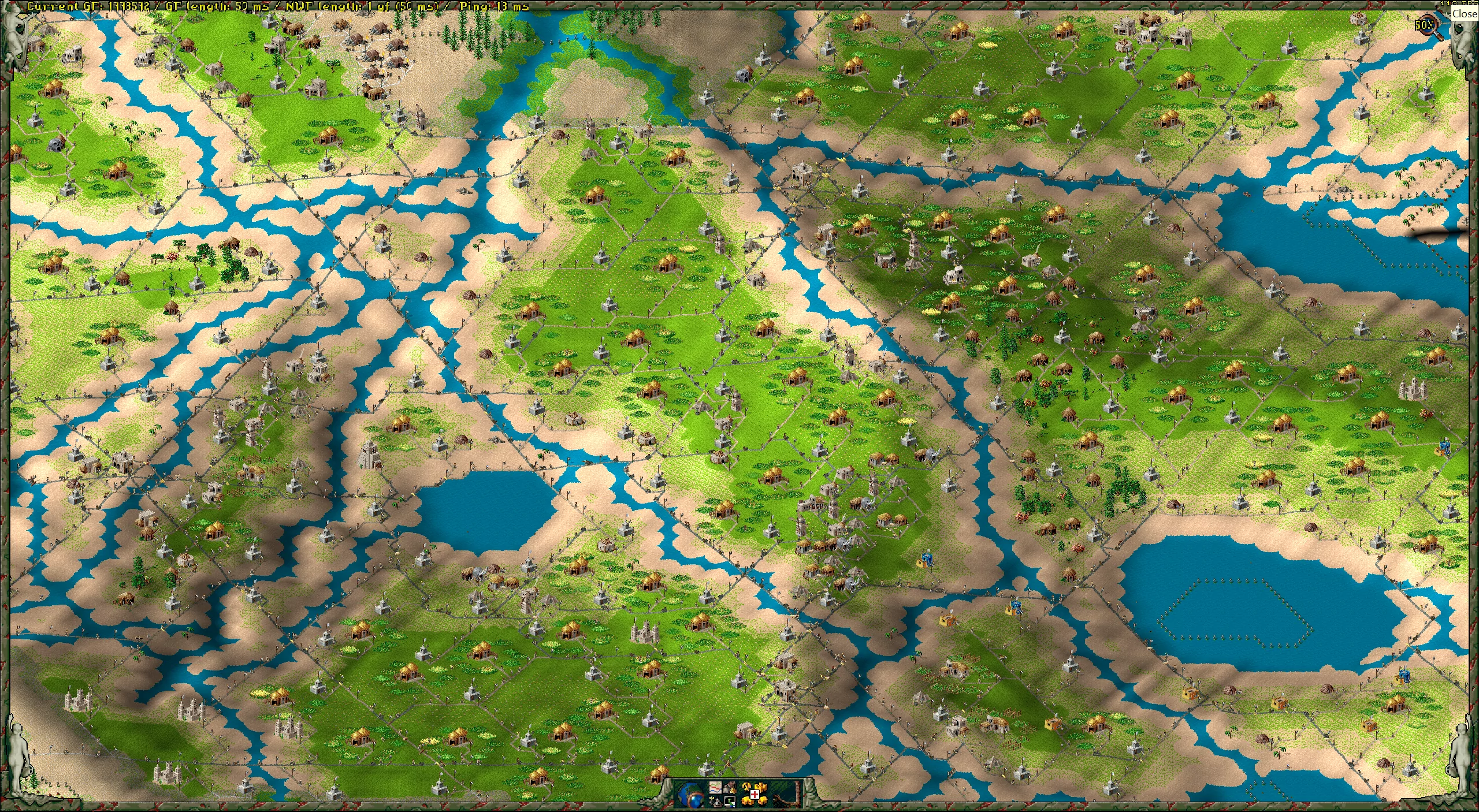
Return to the Roots – or RttR, or Siedler 2.5, as the community originally called it – is a complete open-source reimplementation of The Settlers II. Not a patch. Not a wrapper. A full ground-up rewrite of the game engine in C++, using the original graphics and sounds from the Gold Edition but running natively on modern hardware and operating systems: Windows, Linux, and macOS. The project has been in continuous development for nearly two decades, driven by a small but dedicated community of fans who call themselves Settlers Freaks, and it is – in my opinion – one of the most impressive and underappreciated fan projects in gaming history.
I first discovered Return to the Roots around 2008. I’ve written about it on this blog as early as December 2008, and again in 2010 – back when this blog was still a German-language affair. That’s over 16 years of returning to a project that returns to the roots. Recursive nostalgia.
What RttR delivers is staggering for a non-commercial fan project: internet multiplayer (the original game only supported LAN), support for arbitrary screen resolutions with a stepless zoom, an improved AI, fog of war as an optional addon, a fifth playable nation – the Babylonians, introduced over a decade ago – new buildings like the charcoal burner, sea combat mechanics, dozens of gameplay-adjusting addons, and a level of polish that puts some commercial remasters to shame. The codebase lives on GitHub with over 6,364+ commits, 561+ stars, 50+ contributors, and is licensed under GPL-2.0. It is, quite literally, a labor of love spanning two decades and counting.
What’s New: Wine and Leather
And the thing is – it’s still evolving. Two major new economic systems have been added to the nightly builds in the past year, and they fundamentally change how late-game economies work.
The Wine Economy
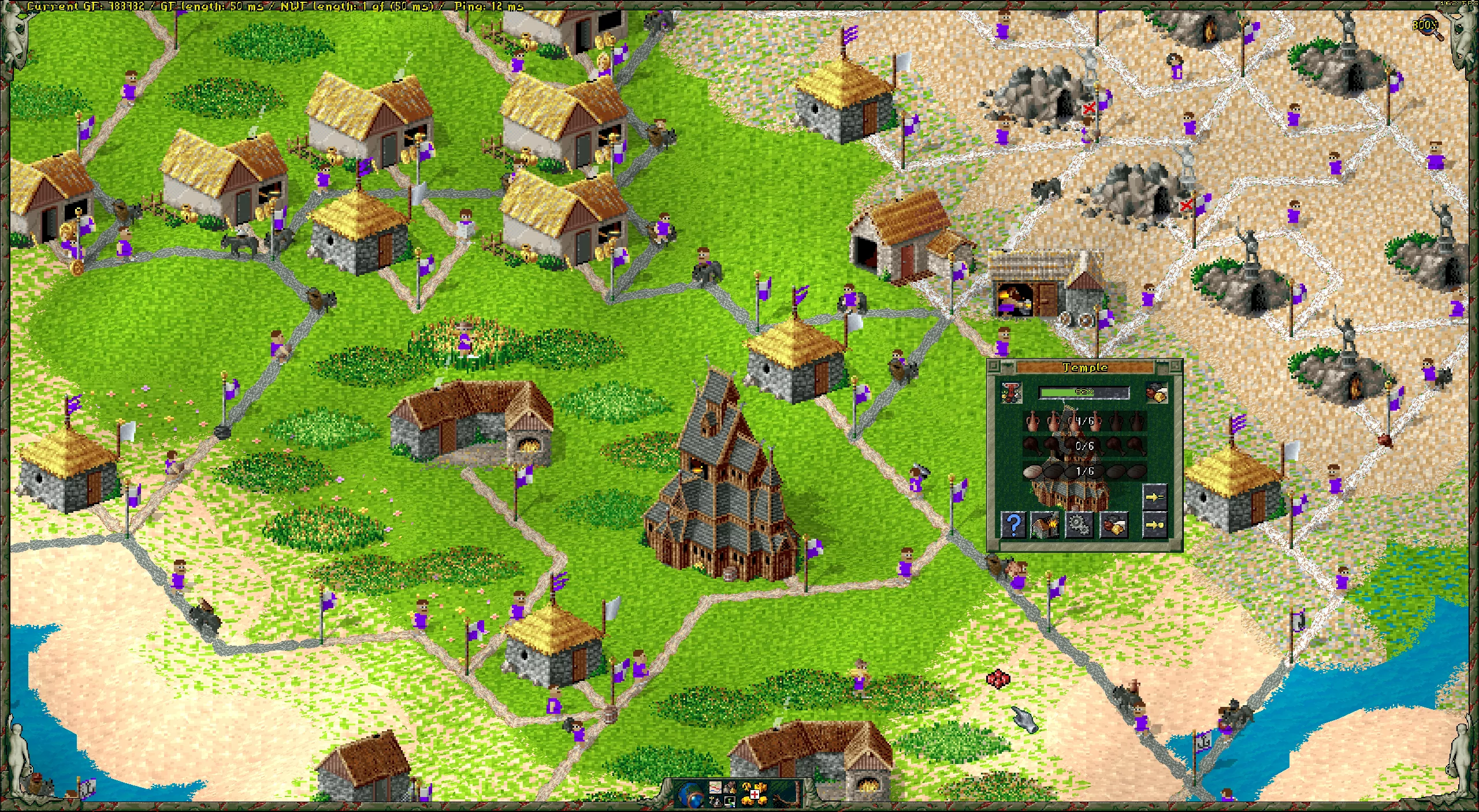
Introduced in August 2024, the wine economy addon adds three new buildings and two new wares to the game. A Vineyard (where a winegrower uses a shovel, one log, and one water to cultivate grape fields), a Winery (where grapes are processed into wine), and a Temple (where a temple servant sacrifices wine, meat, and bread to produce minerals). The Temple’s output can be toggled between random distribution, iron ore, coal, or granite – making it a renewable source of resources that were previously finite once your mines ran dry.
This changes the endgame dramatically. In the original Settlers 2, once the mines were exhausted, your economy stagnated. Full stop. The wine economy provides an alternative production chain that rewards players who invest in farming infrastructure and balance their wood and water economies carefully. It doesn’t compete with the charcoal burner (which produces coal from a single building on beach or desert terrain) but rather complements it. Two food per mineral, plus the entire vineyard-to-temple pipeline, means it’s a serious investment – not a shortcut.
The Leather Economy
Even more recently – February 2026, as in last month – a leather economy addon was introduced. Three new buildings (Skinner, Tannery, Leatherworks), two new wares (skins, leather), and one game-changing item: armor. The Skinner gathers skins from animal carcasses in forested areas and can also be supplied with pigs for extra output. The Tannery processes skins into leather using boards. The Leatherworks crafts armor from leather, which is then transported to military buildings.
Here’s the kicker: an armored soldier can withstand an additional hit in battle and has roughly a 50/50 chance of surviving a catapult strike – but the armor is destroyed when hit. Unlike coins, which promote all soldiers in a building, leather armor buffs one soldier at a time. It introduces a genuinely new tactical dimension: do you invest in gold for promotions, and/or leather for survivability? And it gives forests a secondary strategic value beyond wood production – leave some trees standing and your skinner gets free skins from the wildlife.
Both addons are created by the same team (concept and graphics by aztimh, coding by Sunrise, supervised by Flamefire) and both are available as toggleable options in the addons menu – nightly builds only, for now.
Ships, Fights, Grapes, and Wastelands
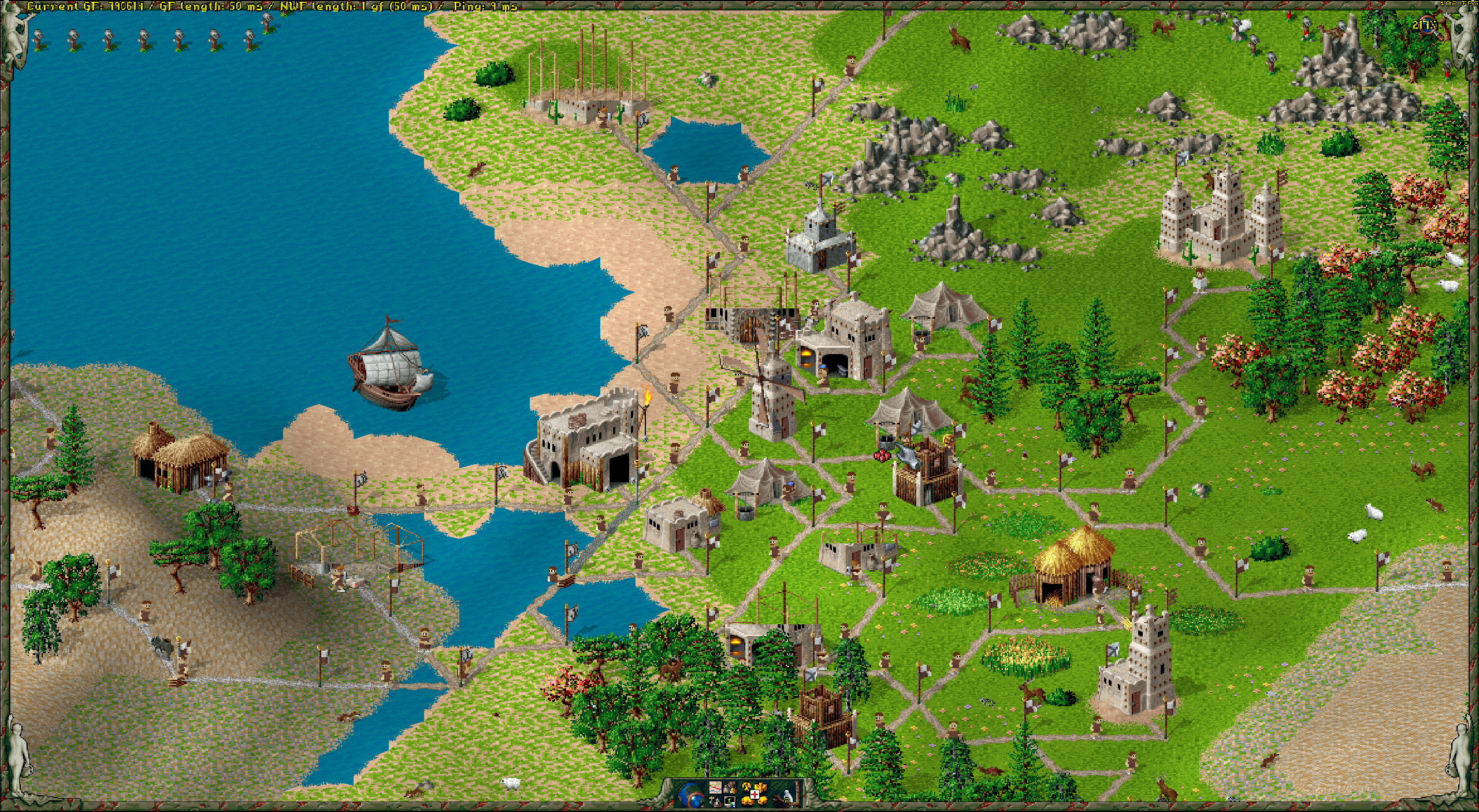
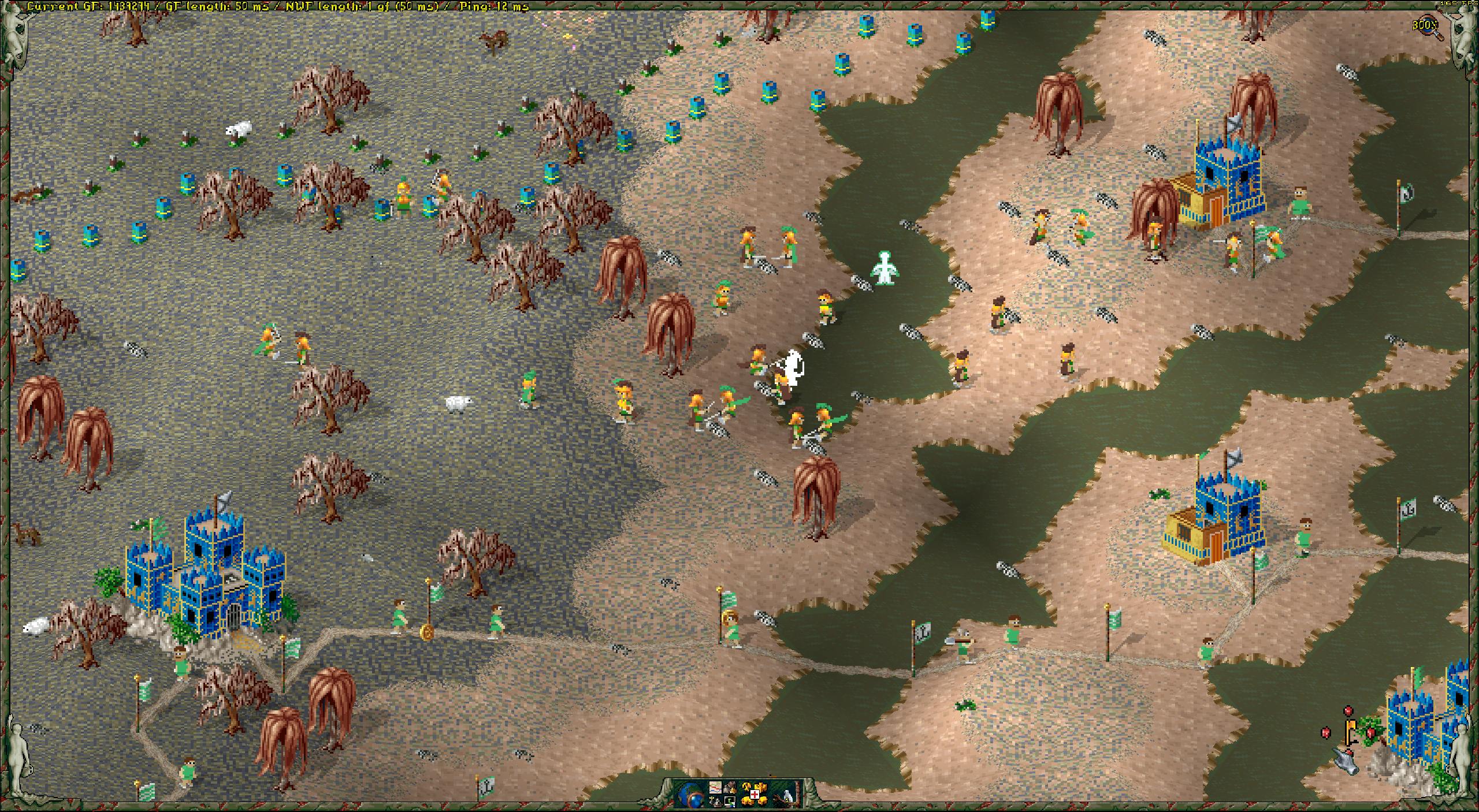
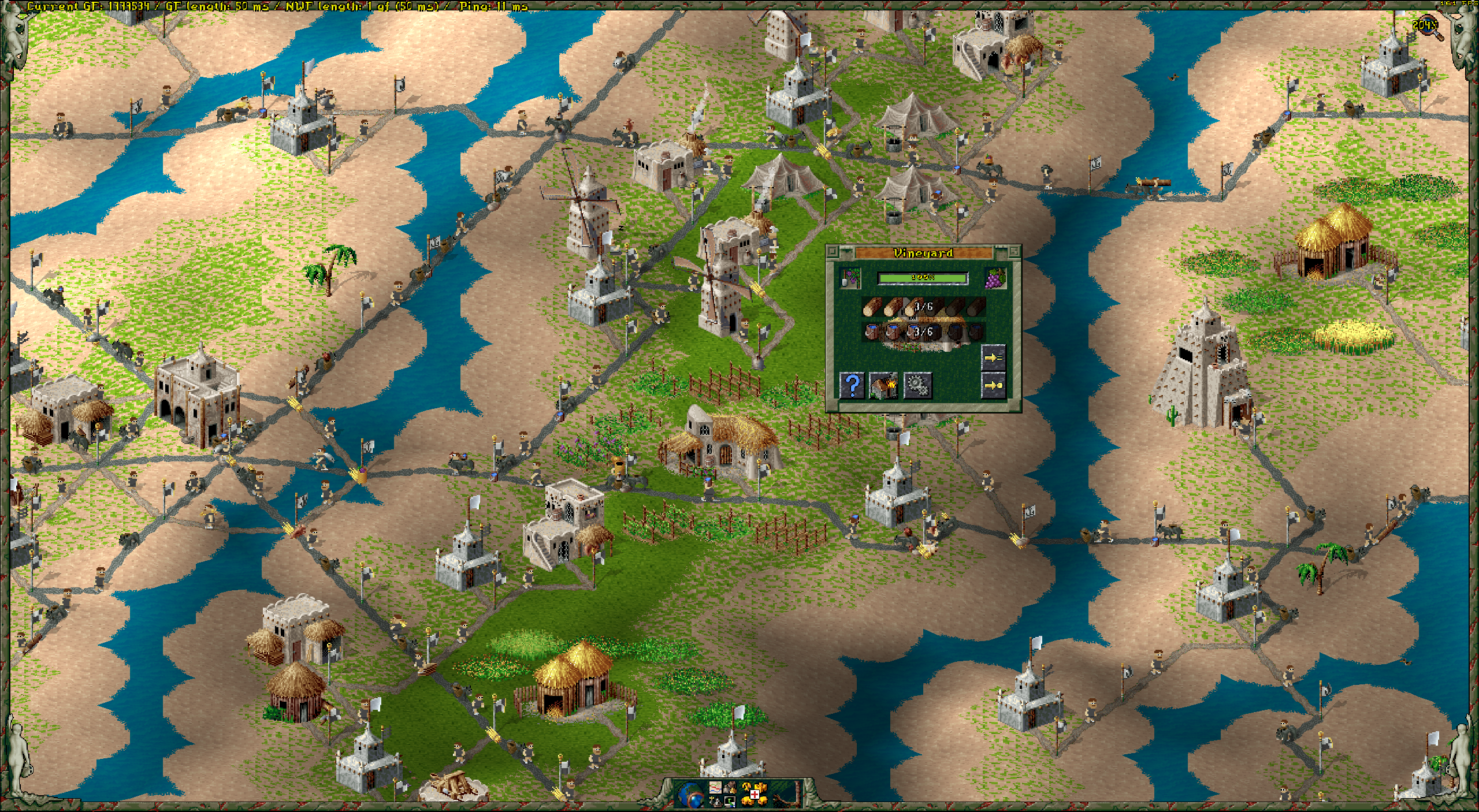
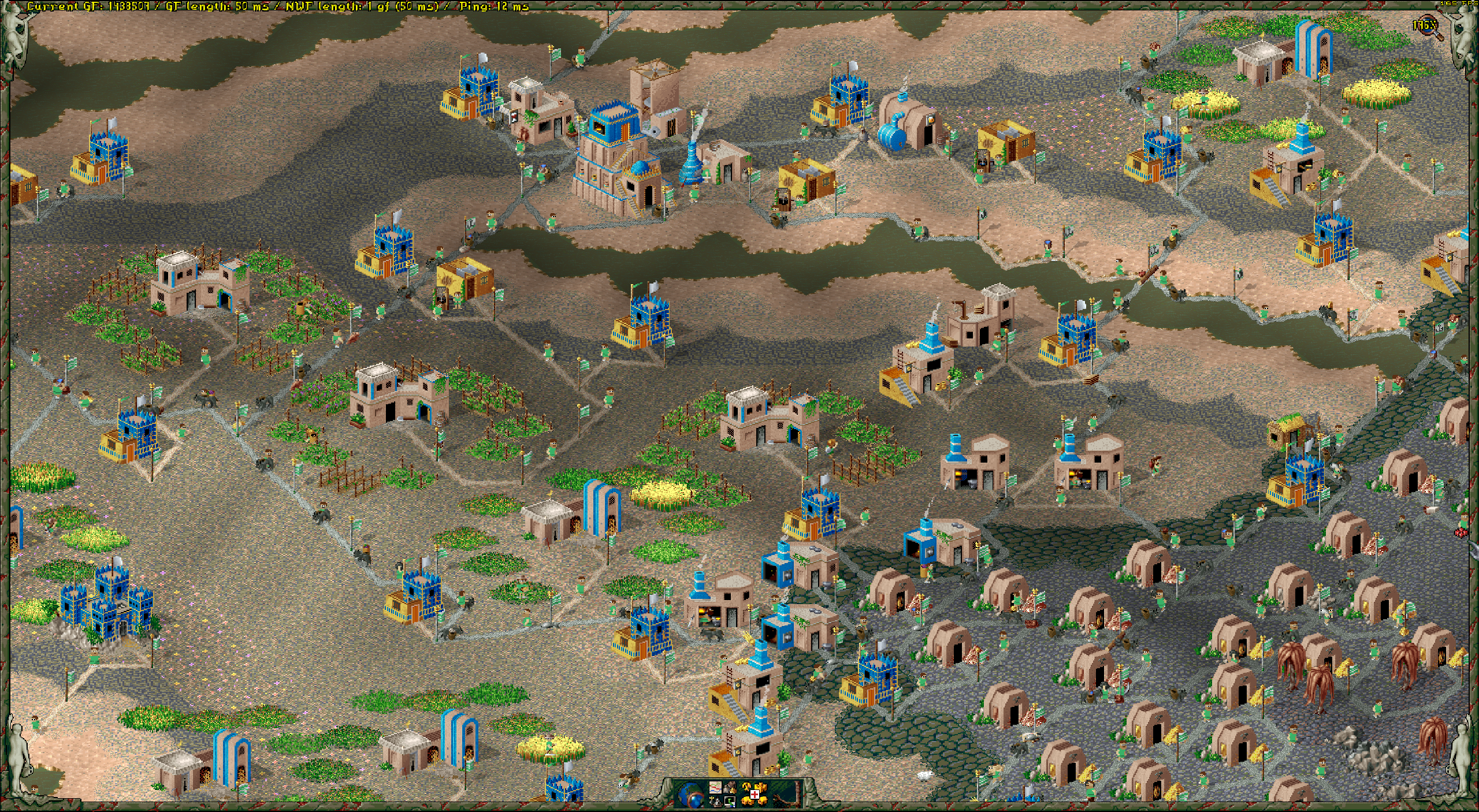
Meditation at 2560×1440
I’m playing The Settlers 2 again right now, as I do almost every year. Have been, without exaggeration, since 1996. The game has accompanied me through Windows 95, 98, XP, Vista, 7, 8, 8.1, 10, and now 11. It was one of the first games I installed on my first own PC. I installed it on the school computers during IT lessons (the Windows 2000 based school-overlay was too easy to circumvent – which also facilitated some early music piracy via torrents, but that’s a different confession). The Settlers 2 has been with me for almost my entire life.
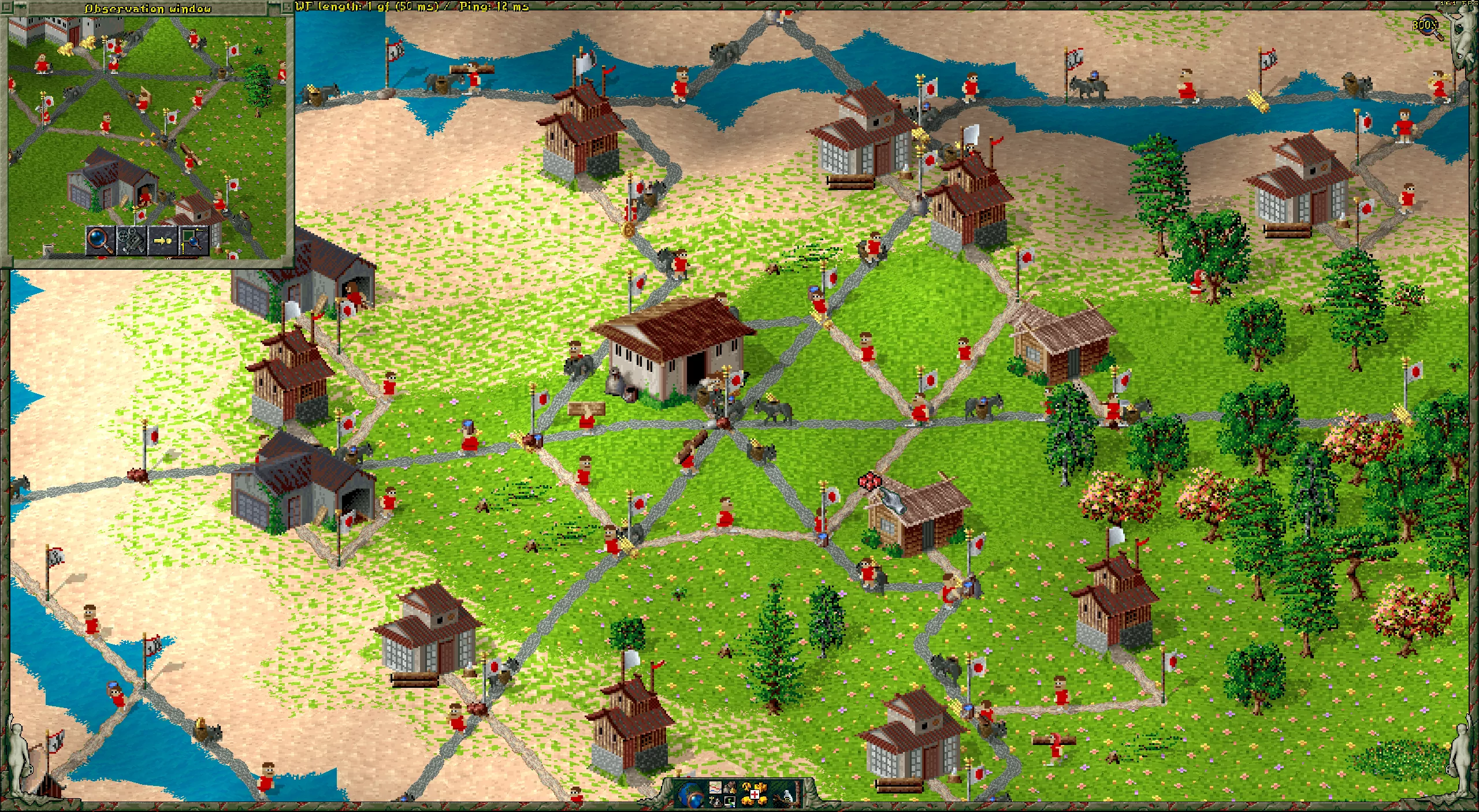
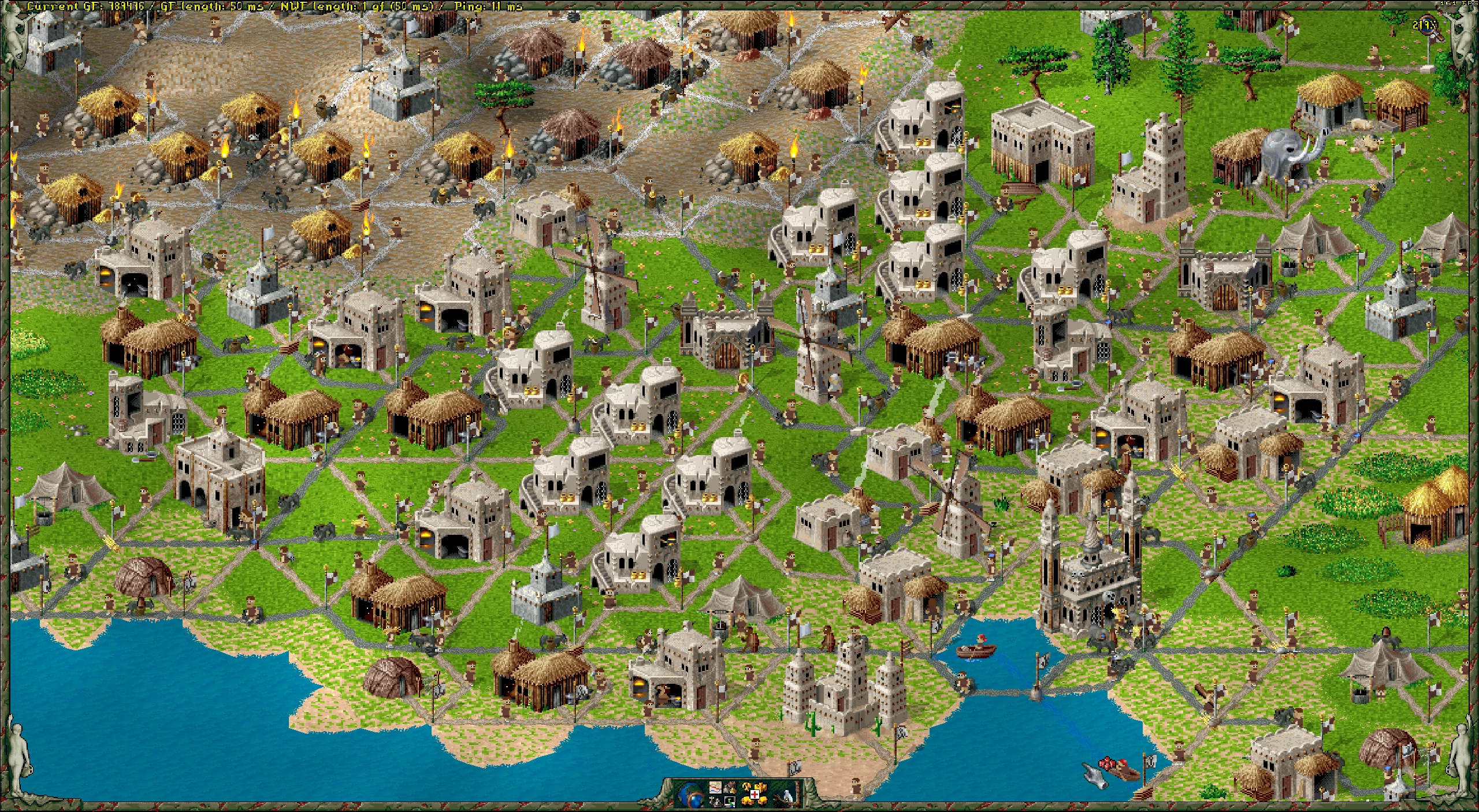
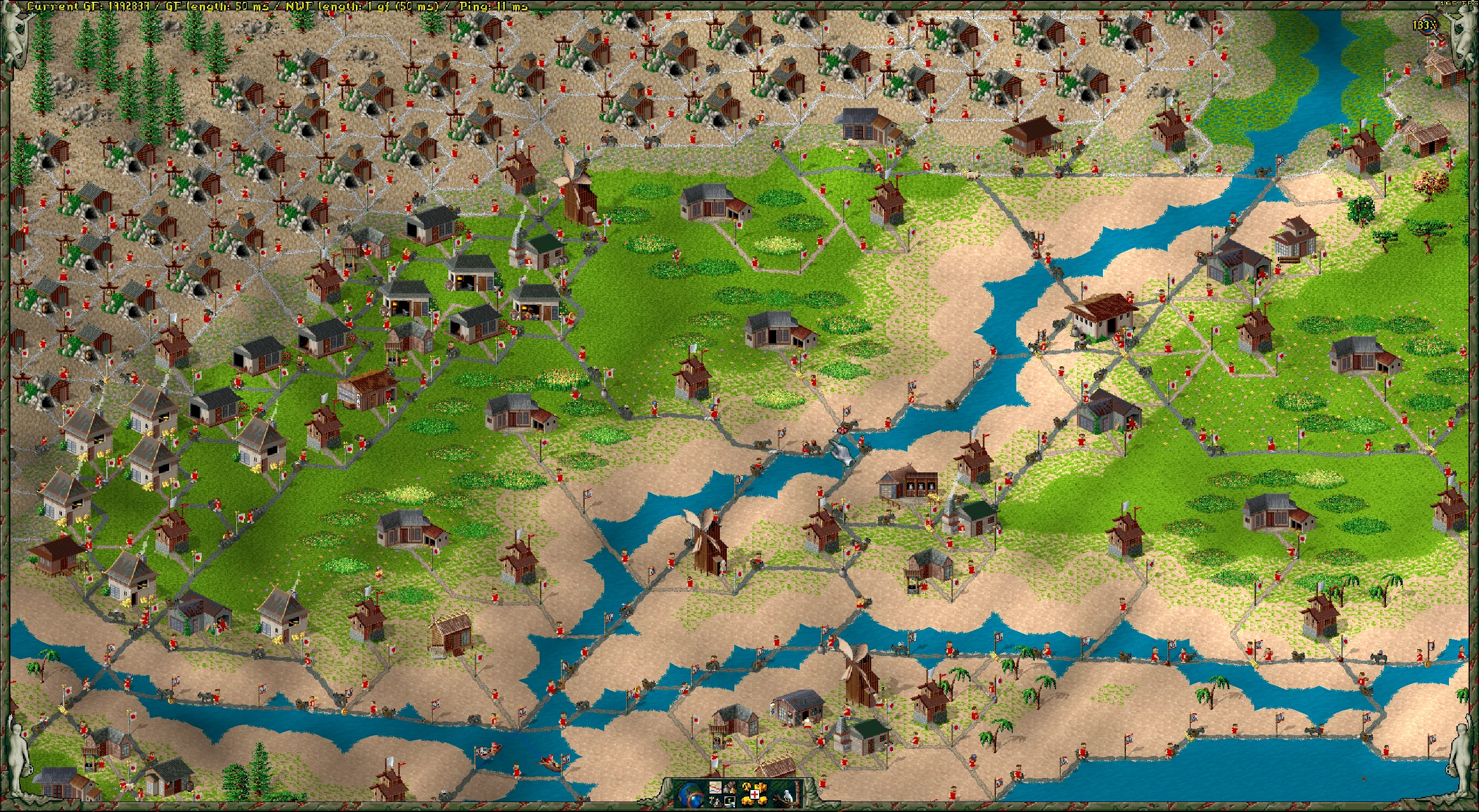
Right now, I’m running the latest nightly build of Return to the Roots on free game mode against the AI, playing mostly as the Japanese (for aesthetic reasons – and who knows, maybe this early fascination with East Asian pixel art is where my eventual move to Sài Gòn started) and the Babylonians, that beautiful fifth nation RttR introduced over a decade ago. Both the wine and leather economy addons are enabled, alongside a generous handful of RttR’s other gameplay-adjusting addons (infinite mines FTW!).
And it’s different now. Not just because the game renders at modern resolutions and runs on a modern OS and has new content I couldn’t have dreamed of in 1997. It’s different because of what the act of playing has become. As a kid, The Settlers 2 was adventure, obsession, a secret midnight ritual. As an adult in Sài Gòn, it’s meditation. I watch the little settlers wusel across my territory, I expand my road networks (still following the Golden Distance Rule, obviously), I optimize production chains, and while I do all of this, I think. About work, about life, about whatever needs processing. I watch my AI agents doing their – or rather, my – work, or enjoy YouTube documentaries and Let’s Plays on a second and third monitor. I listen to the full soundtrack – all SFX, all tracks, volume up, no fear of waking anyone. Sometimes I play through the night until the tropical sun comes up again. Same game, same rhythm, but without the carpet-muffled PC tower and without the muted speakers. That silent, anxious kid in front of the CRT has been replaced by someone who can finally enjoy every single sound this game makes (YIPPEE! – iykyk).
The game feels both impossibly old and impossibly fresh at the same time. And I think that’s the real achievement of Return to the Roots: it doesn’t just preserve a 30-year-old game. It lets you grow with it.
How to Get Started
If any of this resonated with you – whether you’re a returning veteran who lost track of The Settlers II somewhere around Windows XP, or a newcomer curious about what all the fuss is about – here’s how to get into it.
Step 1: Get the Original Game
Return to the Roots requires the original game data from The Settlers II Gold Edition. This is a legal necessity – RttR is an unofficial, non-commercial project and cannot redistribute Blue Byte’s assets. The easiest way to get the original is via GOG.com, where The Settlers 2: Gold Edition is available DRM-free for a few bucks (frequently on sale for as little as €2.49). It includes the base game, the Mission CD expansion, the soundtrack, a manual, and even a map generator as goodies.
Step 2: Download Return to the Roots
Head to the RttR downloads page. You’ll find two options:
- The stable build (v0.9.5) is available for Windows (32-bit and 64-bit), Linux (x86_64), and macOS. It’s the safer choice – tested, reliable, and perfectly playable. If you just want to jump in without surprises, start here.
- The nightly builds are compiled from the latest source code, sometimes daily. They contain all the newest features – including the wine and leather economy addons described above – but come with the usual caveat: untested code can be unstable. That said, the siedler25.org page itself notes that “most players play with the current nightly build,” and from my own experience, the nightlies have been remarkably solid. If you want the full RttR experience with all the latest toys, this is where you go. Just save often. Linux users can also grab RttR via Flatpak on Flathub.
Step 3: Install
Extract the RttR archive into your local The Settlers II Gold Edition install directory. Launch via rttr.bat (Windows) or rttr.sh (Linux) to auto-update and start the game, or run s25client directly. Do not use symlinks for subfolders inside your installation – they can cause issues.
That’s it. You’re playing The Settlers 2 in 2026.
Join the Settlers Freaks
Return to the Roots is a community project – always has been, always will be. It runs on the passion of people who love this game enough to spend two decades rewriting it from scratch. If you want to be part of that:
- The GitHub repository is the heart of development. C++ programmers are always needed, but contributions come in all forms – bug reports, translations, map creation, testing nightly builds, documentation. The project currently has 50 contributors and 272 open issues waiting for hands.
- The siedler25.org forum is the community hub – discussions, announcements, support, and a gallery of screenshots and maps.
- The Discord server is where the day-to-day conversation happens – the fastest way to connect with other players and developers for anything about The Settlers II and everything in between and beyond.
And if you just want to play? That’s contribution enough. Every new player keeps this 30-year-old game alive. Every person who discovers that the little Wusler are still bustling, still carrying planks and ore and fish and shimmering golden coins across hand-placed roads – that person becomes part of a story that started in 1993 and still, improbably, beautifully, has no ending in sight.
I have worn the explorer’s cape. I have biked across villages with game CDs in my backpack. I have muffled a PC tower in carpet at midnight and mapped out economies in the dark. And thirty years later, in a two-bedroom apartment in Phú Mỹ Hưng with the tropical heat pressing against the windows and the game running at resolutions my childhood self couldn’t have imagined, the Golden Distance Rule still holds.
Two flags apart. Always.
The Settlers II at a glance
- Personal rating:
- Developer:
- Blue Byte Software
- Publisher:
- Blue Byte Software
- Release date (Germany):
- 17 Apr, 1996
- Genre:
- City-building, real-time strategy
- Where to buy:
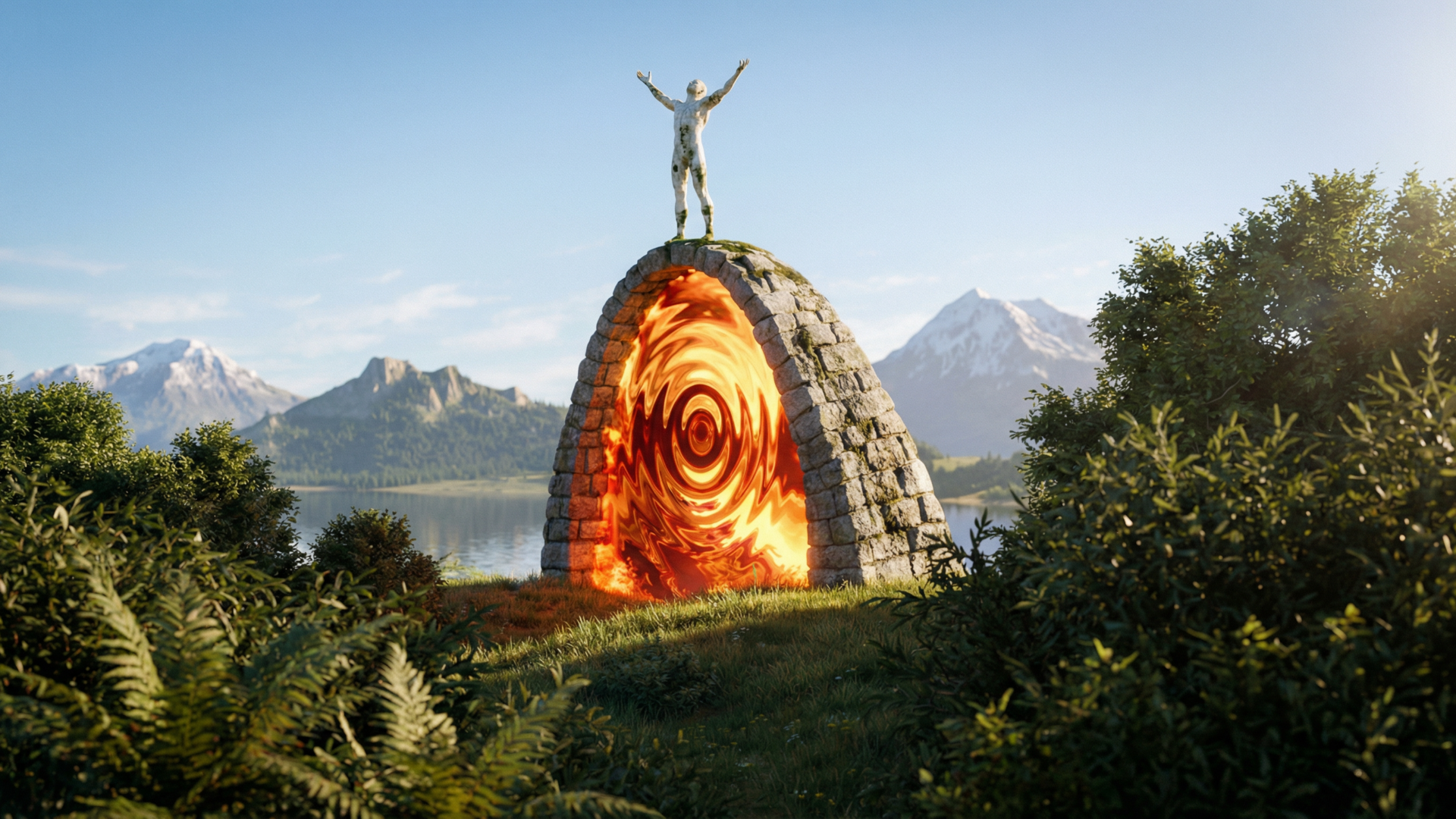
Hero image: The Settlers II Roman campaign winning screen. It was visually extended on April 1st, 2026, at 12:22 AM with the help of google/nano-banana-pro.