Thirty Years of Smoke One pfennig per breath

The towers across the canal are gone. Not demolished (Phú Mỹ Hưng rarely demolish, it mostly adds), just erased a few hundred meters out, dissolved into something that has been sitting on the city since Sunday and that my brain keeps filing as fog, because fog is the closest word it has. It isn’t fog. At night every streetlight wears a halo and every headlight a smear, as if I’d put in yesterday’s contact lenses; the far distance has been switched off entirely, and IQAir’s live ranking has Sài Gòn at number three among the most polluted cities on the planet.
I’ve lived here eight years and I know what this city’s air does and when: the haze season is November and December, AQI orange on the good days, red to purple on the normal ones, an occasional spike into maroon that sends the expat groups into a screenshot frenzy. A dense, persistent lid in mid-September isn’t on the schedule. So something was off – and then I stepped onto the balcony and smelled it.
Fire. Faint, everywhere, attached to nothing.
After dinner, the Tagesschau
Germany, fall 1997: a village of ≈1,200 people in the Bavarian hinterland east of Munich, and in it an eight-year-old with an illuminated globe on his desk and a shelf of atlases too heavy to carry with one arm. Evenings had one fixed point – dinner, then the whole family in front of the Tagesschau, every day, no exceptions, so German it should’ve come with a rubber stamp. And that fall, night after night, the Tagesschau was followed by a Brennpunkt, the ARD special they only ran when something was properly on fire, and the thing on fire was Indonesia. (Maybe the ZDF auslandsjournal too; I couldn’t swear to it).
Those images I remember better than most of that year: cities under a thick, brownish-reddish haze; people in masks talking into the camera about breathing, about their lungs; walls of fire, endless, with black and white smoke pouring off them, and in front of those walls tiny firefighters, day and night, armed with broomsticks and palm leaves – helplessly simple tools against something that plainly didn’t care. Burned wildlife: insects, birds, snakes, monkeys, and so on. And hilly landscapes covered in gray and black ash all the way to the horizon, the haze lying in the valleys between them like something poured in.
I knew exactly how far away that was; that was the problem with the globe. One finger on Germany, one on Borneo, and the two didn’t fit on the same side of the ball. It didn’t help. Eight-year-old logic ran like this: fire spreads, that’s what fire does; this fire was bigger than anything I’d ever seen; nobody on the screen seemed able to stop it, so it wouldn’t stop. It would cross the sea, eat the jungles and forests across borders and continents, consume the green lungs of the earth, and eventually everything that breathed would suffocate. Me included – probably last, because Bavaria was far, but included. I was scared in the specific way you can only be scared of something you’ve measured on a globe.
Tuesday, 2 PM
Where was it coming from? Windy.com has an aerosol layer: AOD at 550 nm, aerosol optical depth, the satellite measure of how much junk hangs in a column of air, and on Tuesday at 2 PM it showed a tongue of orange running out of southern Sumatra and Kalimantan, up across the South China Sea, and stopping on top of my apartment.
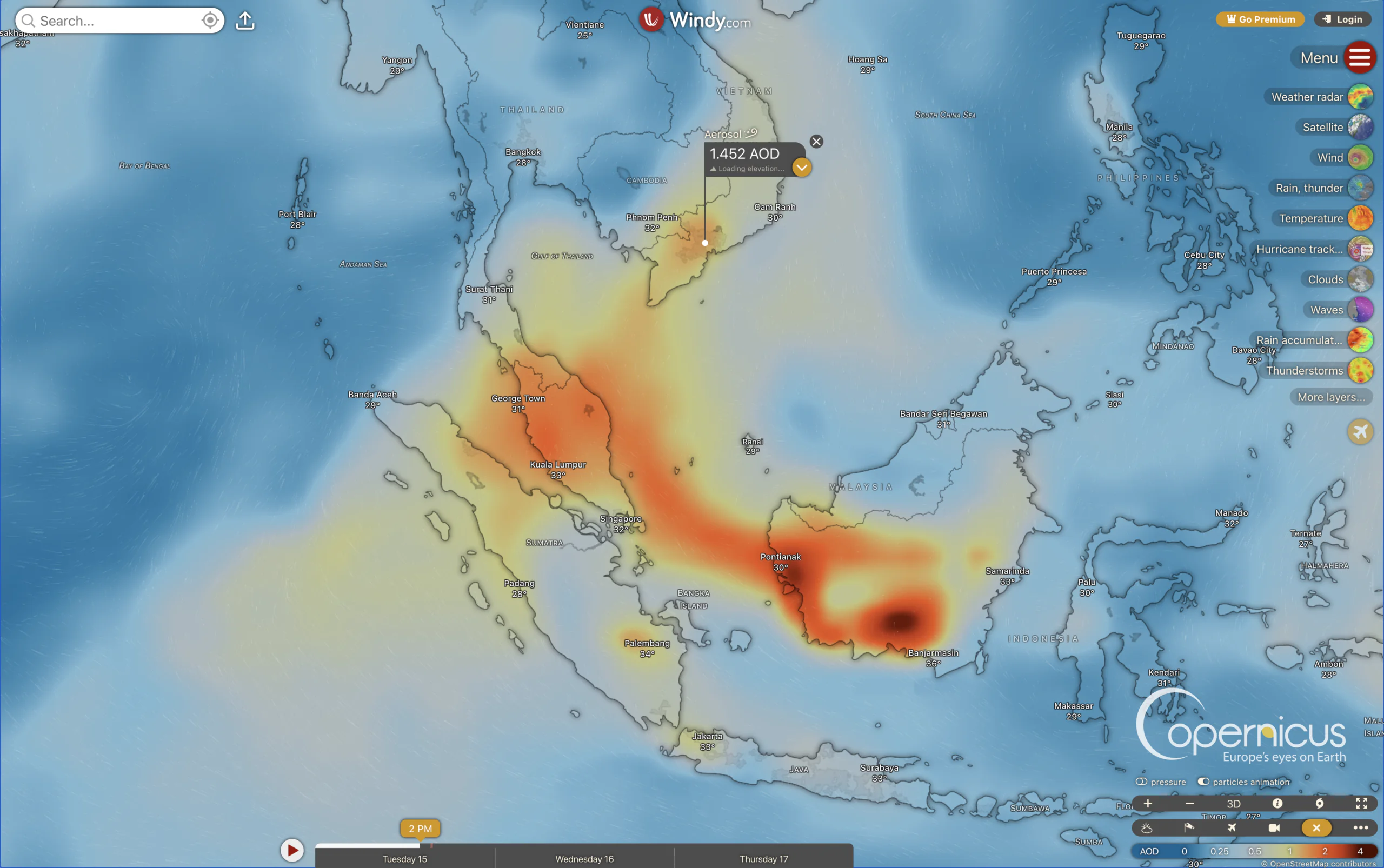
I checked that page before the papers did, no press release needed. The papers came anyway: Singapore’s regional haze watch, the ASMC, had Alert Level 3 up for the southern ASEAN region – top of its scale – and its bulletin listed transboundary smoke over Sarawak, Peninsular Malaysia, Singapore and the southern parts of Viet Nam, winds mainly from the southeast, dry conditions to persist.
That last clause matters more than it sounds: in September 2019 Sài Gòn asked the same question, and the Southern Hydro-Meteorological Station answered that there was no data proving Indonesian smoke had crossed over; the haze was local, thank you, move along. This time the region’s own haze center puts southern Vietnam in the bulletin by name.
And the thing about the smell: it’s better evidence than any number. Sài Gòn’s homegrown haze is mù quang hóa, photochemical smog – traffic, humidity and the September-November inversion cooking together – and it’s odorless and breaks up around noon. Charcoal is a constant here too; every second sidewalk has a grill going, and I stopped registering it years ago. Smoke that isn’t coming from a grill, that sits in the air with nothing burning in sight, is combustion aerosol that traveled. My nose found the source before windy.com confirmed it.
Pocket money
Somewhere in those weeks in front of the TV the fear found its shape, and to this day I don’t know where I got it from – some series, some novel, some cartoon dubbed into German for the afternoon program: in the future, air would cost money, one pfennig (Germany’s pre-euro currency) per breath – not much. And I did the math, because I was the kind of eight-year-old who did the math, and I ran on pocket money and lawn-mowing money: a pfennig a breath meant I couldn’t afford to keep breathing. Not a bike, not a Game Boy game – breathing. A naive kid’s mind, sure, but the arithmetic was clean, and nobody on the Tagesschau was offering a counterargument.
What I didn’t know then, because nobody puts it in a eight-year-old’s newscast, is what was actually burning. A year or two earlier Suharto‘s Mega Rice Project had sent excavators into ≈1,000,000 [one million] hectares of Central Kalimantan peat swamp and cut thousands of kilometers of canals through it, to grow rice that never grew. Drained peat is dried fuel, meters deep; it smolders underground at low temperatures and doesn’t stop for firefighters, because the firefighters are standing on top of it, out of reach. Then the 1997/98 El Niño arrived, rainfall from March to December ran about half of normal, and somewhere between 5,000,000 [five million] and 10,000,000 [ten million] hectares burned, depending on who counted. Sarawak’s air pollution index hit 500 for the first time and the state went into a ten-day emergency. On September 26 a Garuda Airbus on approach to Medan flew into a wooded hillside in 400 meters of visibility and killed all 234 people aboard. Years later a team around Susan Page worked out in Nature that the burning peat and forest had released the equivalent of 13-40% of a full year of global fossil fuel emissions. The broomsticks and palm leaves were real, and so was the scale they were up against.
Rain, on cue
It started raining while I was typing the paragraph about the smell above, which is the kind of timing you’d cut from a screenplay for being too much. I sat with the AQI tab open and watched. Tropical rain scrubs the air – anyone who’s stood on a Sài Gòn balcony after a downpour knows that – but PM2.5 is the exception: the particles are small enough that raindrops mostly fall past them, and much of a transported plume rides above the layer a shower reaches anyway. Haze episodes end when the wind turns; the fires end when the peat is wet again, which per NASA means October or November. The rain stopped, and the halos came back.
Monsoon, as taught
Between the boy at the TV and the man on the balcony there are ≈29 years and one migration, and the smoke arriving here was never a surprise. I learned the mechanism at school: wind dynamics, seasons, the monsoon – the southwest monsoon that blows from June to October and carries whatever Sumatra and Borneo put into the air straight up the Malay Peninsula and across the sea. The apocalypse turned out to have a chapter in the geography textbook, with arrows. By the time I moved here in 2018 I expected it the way you expect winter, and every November since has confirmed it: haze is a season, not an event.
Which makes this year the exception, and the exception has numbers. Nearly 300,000 hectares burned so far, and between August 28 and September 3 alone the fires emitted ≈23,000,000 [23 million] metric tons of carbon, a week comparable to or above the peak weeks of 2015 and 2019, the two strong El Niño years everyone here remembers. More than 12,500,000 [12.5 million] people across seven provinces exposed; respiratory infections in those provinces from 50,891 on September 1 to 113,336 on September 9, which is more than doubling in eight days. ≈1,400,000 [1.4 million] students learning online because the schools closed. Malaysia declared an emergency in Serian, Sarawak, on September 4, after the API passed 500. Two volunteer firefighters died in Central Kalimantan; a rescued orangutan in West Kalimantan died of suspected smoke inhalation. Pontianak was nearly invisible from the air, and Indonesia’s forestry minister told reporters that “the field of struggle is right here in September” – and he isn’t wrong.
The neighbors are all coughing. Singapore on Monday posted its first islandwide unhealthy reading since 2019, central PSI at 154. Metro Manila, at the other end of the southwest monsoon, was acutely unhealthy from August 30 to September 2, at points more than four times the WHO guideline. And before anyone files this under Southeast Asian problems: New York spent a week in July under Canadian smoke with an AQI forecast of 200, France set a national record for burned area, a fire in Almería killed 14 people, and the EU had 627,611 hectares gone by August 26. The eight-year-old’s map had the fire crossing the sea; the adult’s map has it everywhere at once, from different sources, with the same smell.
Who lit it
The Brennpunkt had the walls of fire; it never had the match. Only about 4% of the world’s forest fires start naturally; the rest have a person behind them, and in Kalimantan this year Walhi put 74% of hotspots inside corporate concessions – 10,739 in oil palm land, 7,880 in mining, 6,905 in forestry permits. The drainage canals that feed the plantations are what dried the peat in the first place; El Niño is the match, never the fuel.
What El Niño actually buys the people holding the match is three things, and none of them is dryness: a drought year doesn’t dry anything the canals hadn’t already dried; what it does is widen the burning window from weeks to months, and open it earlier. It cuts the labor: one ignition in a drought does what needs a crew and several attempts in a wet year. And it hands over deniability, because when a whole province is alight a deliberately set concession fire is statistically indistinguishable from spread – a satellite hotspot tells you something is hot, never why. In 2023, an El Niño year, 1,160,000 [1.16 million] hectares burned, five times the year before, with fire cheaper than machinery for clearing oil palm land. This February, months before the dry season and while the “Godzilla El Niño” was still a forecast, 32,637 hectares had already burned, twenty times the same period of 2025 – somebody was getting an early start.
The enforcement runs on two speeds. On August 23 police arrested 72 people for starting fires, described as plantation owners and traditional farmers clearing land, and put 30 helicopters over Kalimantan and 22 over Sumatra. Smallholders and logging laborers get arrested fast; corporate cases move at a glacial pace. 19 concession companies are under investigation for over 11,000 hectares of burned holdings; the ministry has sanctioned six permit holders and suspended one. The precedent exists – in 2015 the Supreme Court fined PT Kallista Alam 366,000,000,000 [366 billion] rupiah (≈26.5 million USD) for burning 1,000 hectares of the Tripa peat swamp – and so does the money on the other side: at least 429,000,000,000 [429 billion] USD flowed into deforestation-linked industries between 2016 and 2025. Rewetting the peat and blocking the canals would cut emissions by half to two thirds. That’s known, that’s cheap, and that’s a swamp – and nobody has ever gotten rich by making a swamp wet, which is the infuriating part.
Where the kid was right
The flames never crossed the sea, obviously; the eight-year-old had the physics of fire wrong and the physics of wind not yet in his textbook. But the second half of his fear was better than the first, and it took the scientists a while to catch up to him: each burn on peat kills the canopy, drops a layer of dead fuel, lets in sun and grass, and sets up the next fire to run hotter in a less extreme year; the degradation is decoupling the fires from the droughts that used to be needed to start them. It burns in El Niño years, and now it burns in normal years too. He was wrong about the flames crossing the water and right that it wouldn’t stop where it was.
Last weekend, before any of this, I ordered 1,000 black masks on Shopee. Not for the haze – I didn’t know about the haze; the household’s long-standing mask supply had simply run low, the way rice runs low. Masks are standing inventory in this apartment and country: ordered by the thousand, restocked on a weekend, no more remarkable than dish soap.
One pfennig per breath. The kid got the price wrong and the invoice right.


