Words Nobody Asked For A kennel for maidens

Jungfernzwinger. Kennel for maidens. It means convent.
Meuchelpuffer. Assassination-popper. It means pistol.
Mengeklumpf. Mixing-lump. It means primordial chaos, the kind that comes before gods.
All three were proposed, in writing, with arguments, by the same man. His name was Philipp von Zesen, he was born in 1619, and for four centuries he has been the punchline of German language history – the guy who looked at a convent, thought “kennel for maidens”, and put it in a book.
He is also the reason German has a word for spelling: Rechtschreibung. Leidenschaft, passion. Bücherei, the small library on your corner. Mundart, dialect, literally mouth-manner. Verfasser, author. Tagebuch, diary. Anschrift, the address on an envelope. You cannot write a German sentence about writing without using his words, and nobody who uses them knows they were pushed into the language by a man who spent his whole life broke and got laughed at by his colleagues for it.
I am German and I write in English. I have lived in Sài Gòn since 2018 and there are weeks where German comes out of my mouth exactly once, on a phone call, and then goes back in the drawer. That distance is the only reason I notice any of this. You do not examine a language you are swimming in – you examine one you have to reach for.
And before we go any further: this is not going to be an essay about German being deep, or precise, or uniquely equipped to say things other languages cannot. That claim is nonsense in every language it gets made in, and it gets made in all of them. What is unusual about German is not the language. It is the paper trail. The people who built it did it in public, in print, with their names attached, insulting each other in footnotes – so you can still open the ledger and read who proposed what and who lost. Most languages did the same work quietly – this one kept the receipts.
The palm tree club
On 24 August 1617, in Weimar, a group of princes and courtiers sat at a funeral meal. They were burying Dorothea Maria of Anhalt, who had died after a riding accident, and one of the mourners was her brother. The conversation turned to the language academies they had seen abroad and the fact that German had none. Somebody floated the idea. And by the end of the meal, eight men – five princes and three courtiers – had founded the Fruchtbringende Gesellschaft, the Fruitbearing Society.
Say the name out loud once. Fruchtbringende Gesellschaft. It sounds like an order of monks who are extremely into jam, and I have loved it since I was 15. The Fruitbearing Society!
The model was Italian: the Accademia della Crusca in Florence, which had admitted the dead woman’s brother – Ludwig von Anhalt-Köthen, the society’s first head – back in 1600, under the name L’Acceso, the Ignited One. So the founding act of German linguistic patriotism was copying the homework of some Tuscans. This will keep happening.
Every member got a society name, an emblem plant, and a motto, all entered in a book. Martin Opitz, who wrote the poetics that made German a possible language for serious verse, was The Crowned One. Andreas Gryphius was The Immortal. Justus Georg Schottelius, whose grammar is the theoretical spine of the whole enterprise, was The Seeking One. The emblem of the society was the palm, the motto Alles zu Nutzen – everything to use.
Titles were dropped inside the club – Ludwig’s idea was a society where rank did not apply. In practice, of the ≈890 members it accumulated over ≈63 years, roughly three quarters were nobility, and the actual language work was done by the educated middle class who made up a sliver of the roll. So: an aristocratic club with a minority of bourgeois scholars doing all the linguistics. Which is, ahem, also a pattern that will keep happening.
18 years later, in 1635, Richelieu founded the Académie française on the same Florentine template, with something the Germans never had – a state behind it. Hold that thought for about 2,000 words, because the state turns out to be worth nothing at all.
The man they would not let in
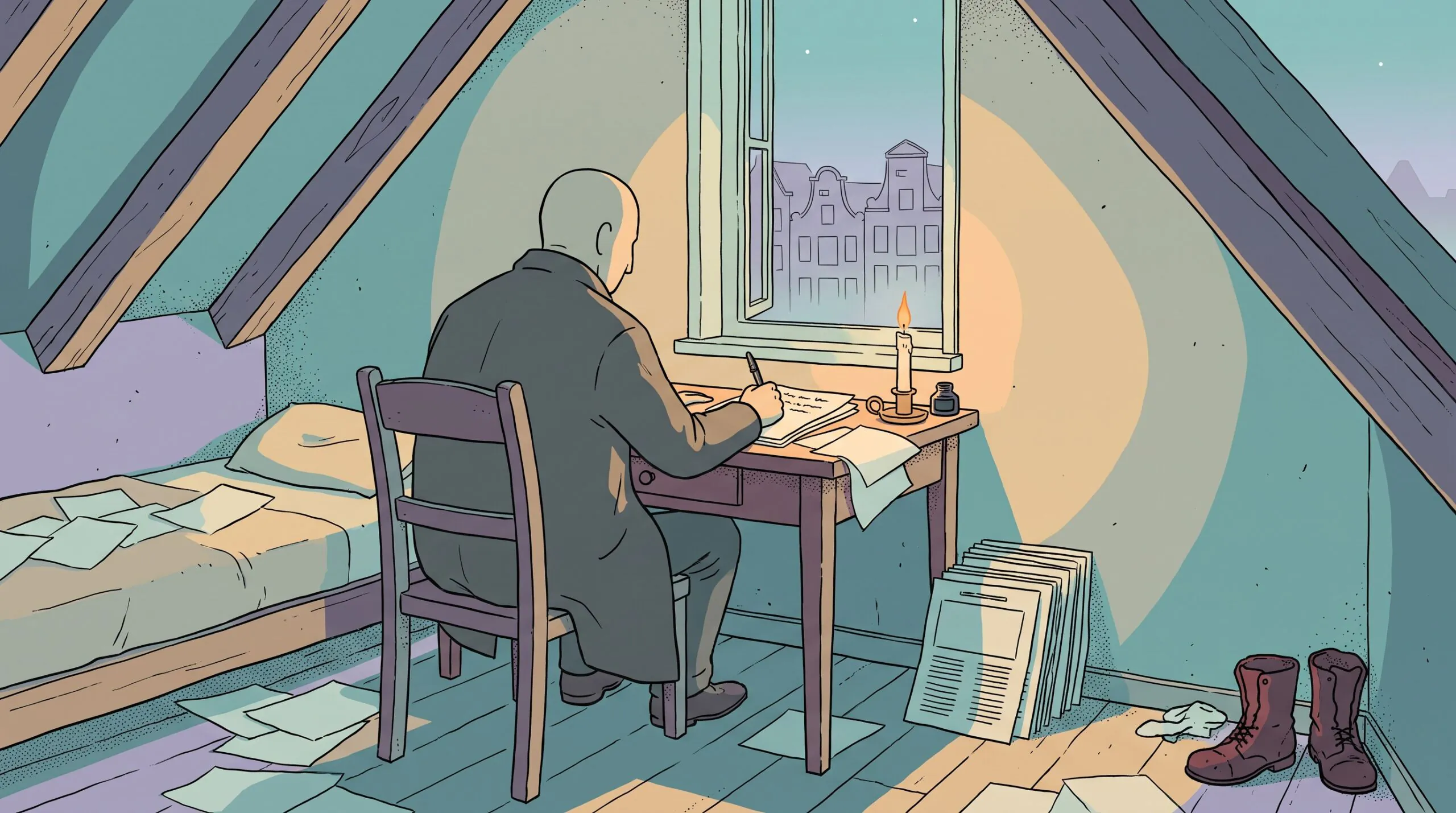
Zesen was not at that table. He would not be born for another two years.
He grew up a pastor’s son in Priorau, studied under Christian Gueintz in Halle and August Buchner in Wittenberg, and then failed for the rest of his life to land a permanent position – which makes him one of the first freelance writers in German literary history, not by choice but by nobody hiring him. He lived in Amsterdam, Leiden and Hamburg, was one of the most important people in the Elsevier printing house, and paid rent by producing text. Roughly 90 books. Poems, hymns, novels, translations, pamphlets about spelling.
In 1643, in Hamburg, he founded his own language society, because the palm order would not have him. His took women. It also, gloriously, took people who had no idea they were in it – Catharina Regina von Greiffenberg found out she was a member from somebody else. The palm order took neither women nor, for a very long time, Philipp von Zesen.
He kept applying and they kept turning him down, and the sticking point was his orthography, which everybody thought was insane. It took a personal trip to Köthen in early 1649, standing in front of Ludwig, to finally get in as member number 521 – and disagreements with the other members over meter, spelling and foreign words broke out almost immediately and escalated into open attack. Johann Rist went from friend to sharpest critic. Ludwig withdrew his favor by letter on 16 May 1649, roughly four months after admitting him.
And the rhyming motto they entered next to his name in the society book was, unmistakably, a warning against forced innovation in language.
They let him in and engraved a subtweet on his membership record. In 1649.
His spelling reform was the part that made everyone crazy. He wanted German written as it is spoken, and he meant it: si where the norm had sie, zz for tz, kk for ck, and combinations like chch in the middle of versprochchen. Some of it was ahead of its time. Most of it looked, to his contemporaries, like a man having a seizure with a quill.
Iceland is where this approach won outright. The policy of building new words from native stock was formalized there in the last quarter of the 18th century, around the Icelandic Learned Arts Society founded in 1779, and it has been running ever since: build transparent terms out of Old Norse roots, revive dead words, compound morphemes, refuse the loan. Sími, telephone, revives an Old Norse word for thread. Þota, jet, comes from the verb for zooming. And tölva, computer, was coined in 1965 by the saga scholar Sigurður Nordal out of tala, number, and völva, the prophetess of the Eddas.
The number-prophetess. That is Zesen’s exact method, done beautifully, 300 years later.
The difference is arithmetic. Iceland had something like 50,000 speakers when the program started and still has fewer than 400,000 today, on one island, with one set of institutions and a living medieval archive to quarry. Zesen had millions of speakers spread across hundreds of principalities, no state, no academy, and absolutely no way to make anybody do anything.
The nose he never had
If you have ever heard one German purism joke, it is this one: that Zesen wanted to replace Nase, nose, with Gesichtserker – face-oriel, a bay window in your face.
He never wrote it. It appears in none of his works. The earliest trace is at the poet Matthisson in 1795, in a letter he printed decades later, and it is not even pinned on Zesen by name there – the word looks to have been minted at the end of the 18th century to make purists look ridiculous. The internal evidence kills it too: Erker is itself a loanword, from Old French, while Nase is native Germanic. A purist proposing Gesichtserker would be swapping a German word for a French one. No purist has ever been that stupid, including this one. Perish the thought.
It got attached to him anyway, and it stuck for 230 fucking years. A man’s entire reputation, worldwide, resting on a nose he never named.
He was already fighting this in his own lifetime, and you can hear how much it enraged him. Someone claimed he had used Windfang, draft-catcher, for a coat. His published reply calls it an ungainly, foolish word that never entered his thoughts, let alone his writings.
Four centuries of being misquoted, starting immediately. Every list of his words you will ever see – including the three I opened with – is a claim, not a fact. Hugo Harbrecht went through the sources word by word for his 1912 dissertation and concluded that most of the Germanizations filed under Zesen were not his at all, but lifted from German or Dutch writers. Herbert Blume, in 1967, took the opposite position: credit Zesen with anything the Grimm dictionary cannot date earlier. Some of it belongs to Campe, a century later. Two scholars, 55 years apart, arguing over the same ledger, and the ledger is still open.
Why anybody bothered
The motivation gets flattened into “nationalism”, and the real thing is much stranger.
Schottelius held that German was a Hauptsprache, a cardinal language – one of the unmixed original tongues, never diluted, unlike the Romance languages, which are Latin’s mongrel children. Under that theory a loanword is not seasoning. It is damage to an inheritance older than Rome. Purity becomes a claim about age and rank.
He had a second argument, and it is the good one: German builds from short root words plus compounding and derivation, which makes its words self-explaining. Rechtschreibung tells you what it is – right-writing. Orthographia tells you only if you went to Latin school. So the purism was also a program about who gets to know things: build a German technical vocabulary, and medicine and law and philosophy become readable by people who never learned Latin. That is the Reformation’s logic applied to the dictionary, and it is not a small or silly ambition.
Then there is the war. The society was founded in 1617, one year before the Thirty Years’ War, and German-speaking Europe spent the next three decades being marched across by foreign armies while its own courts spoke French and Italian. The polemics of the period treat clothing, manners and speech as one single package of foreign occupation. Language purism there is not an abstract cultural mood. It is people watching everything get requisitioned and defending the one thing nobody can carry off.
And underneath all of it sits a theological idea that is easy to miss: that the right word participates in the thing it names. Which is why these coinages had to render the meaning rather than the shape. It is not translation. It is an argument about what the thing actually is, compressed into a noun.
Now watch this same theory show up in Ankara: Turkey’s language revolution was institutionalized in 1932 under Atatürk‘s direct patronage, replacing the Arabic and Persian layer of Ottoman Turkish with words coined from Turkic roots, revived from old Turkic, or dug back out of Anatolian dialects. By the mid-1930s the purge had gotten so aggressive that ordinary words Turks had used for a thousand years were on the block. The escape hatch was the Sun Language Theory, worked up over about 10 months across 1935 and 1936: the claim that every human language descends from a primordial Turkic tongue. It received formal government backing at the Third Turkish Language Congress in 1936. And since all words were now originally Turkish, there was no longer any need to remove the loanwords.
Same premise as Schottelius, exactly. Our language is the ancestor of the others. Deployed by one man to justify a purge and by an entire state to call one off. It lost its standing almost immediately after Atatürk died in November 1938 and went unmentioned at the next congress in 1942.
The paper that started it was sent to Ankara by Hermann F. Kvergić, a linguist working in Vienna, a German-speaking area. Of course it was.
The machinists
Zesen is the loud one. The people who actually moved the language were duller and far more effective.
Luther set the base, and not by inventing German. He picked a variety – the East Central German of the chanceries – and handed it to everyone in a book they had a religious obligation to read. His 1530 letter on translating contains the line the whole tradition runs on: that you find out how to say a thing by looking ordinary people in the mouth, not by asking the Latin letters.
Christian Wolff is the one nobody outside Germany has heard of and everybody should. By Germanizing Latin technical terms he laid the ground for German philosophy to exist at all – Bewusstsein, consciousness, is his 1719 calque of Latin conscientia, and it is now a word four-year-olds can parse. Kant had a language to think in because Wolff spent decades building one.
And then Campe, the Enlightenment’s Zesen, publishing his Germanization dictionary in 1801. He produced replacements for ≈11,500 foreign words. About 300 entered general use. That is a hit rate of ≈2.6 %, and it still gave German Stelldichein for rendezvous (stand-yourself-here), Erdgeschoss for the ground floor, Feingefühl for tact, Zerrbild for caricature, Streitgespräch for debate, and the ordinary everyday tatsächlich, actually. The other ≈11,200 include Zwangsgläubiger, forced-believer, for Catholic, and Menschenschlächter, people-butcher, for soldier. Campe had opinions.
His word for chaos was Wust, and it won. Zesen’s Mengeklumpf did not. Two men, a century and a half apart, both naming the void, and the tidier one took it.
Two neighbors did this better than Germany managed: in Bohemia, the National Revival built a Czech scientific vocabulary that is almost entirely native – Jan Svatopluk Presl named most of the known chemical elements in Czech, and kyslík for oxygen comes off kyselý, sour, the same move as German Sauerstoff, except Czech kept no Latin twin standing next to it. Josef Jungmann put the whole thing in a dictionary. And Hungary’s language reform, associated with Ferenc Kazinczy, coined or revived thousands of words and got Hungarian made an official language in 1844. Compared to Campe’s ≈2.6 %, that is a demolition.
Nobody tells the story that way, because the story people like is the funny German with the nose.
The people who made it stop moving
Gottsched‘s grammar of 1748 tried to legislate correctness. Adelung‘s dictionary of 1774 to 1786 became the authority that Goethe and Schiller actually kept on the desk.
Then the Grimm dictionary, which is the most German object ever produced. The brothers started in 1838. The first installment appeared in 1852, the first bound volume in 1854. They died working on it – Wilhelm at D, Jacob at F, in the entry for Frucht, fruit. Four generations of editors carried it on. It was completed in 1961, by a joint East-West German effort out of Göttingen and Berlin, in the middle of the Cold War, 16 volumes bound as 32, 123 years after it began.
I do not think there is a better image for what this whole tradition is. Two brothers famous worldwide for fairy tales, spending the second half of their lives on an alphabet, and dying somewhere in the F’s.
And in 1880, Konrad Duden published a spelling dictionary whose sixth edition became the basis for the orthographic conference of 1901, where the culture ministers signed off on one spelling for the entire German-speaking world. That is the moment German spelling stopped being a matter of personal taste – which means it is also the moment Zesen lost, formally and forever, 212 years after his death. No more kk. No more versprochchen.
English never did any of this. Swift proposed an academy in 1712 and got nowhere, and English has been unregulated ever since, which everyone now describes as a strength because it worked out. It still had its Zesen: William Barnes, a Dorset poet who wanted English rebuilt from Germanic roots. Wordstock for vocabulary. Birdlore for ornithology. Sun-print for photograph. Speechcraft for grammar, which he used in the title of a whole book in 1878.
Not one survived, and the reason is structural rather than personal. By 1850 English had digested so much French and Latin that there was no clean native layer left to build out of. Barnes was not purifying a language. He was proposing one that had never been spoken.
The ones who left phrases behind
None of the people above are why anyone loves the language, and it would be dishonest to pretend otherwise. Nobody has ever been moved by a spelling dictionary.
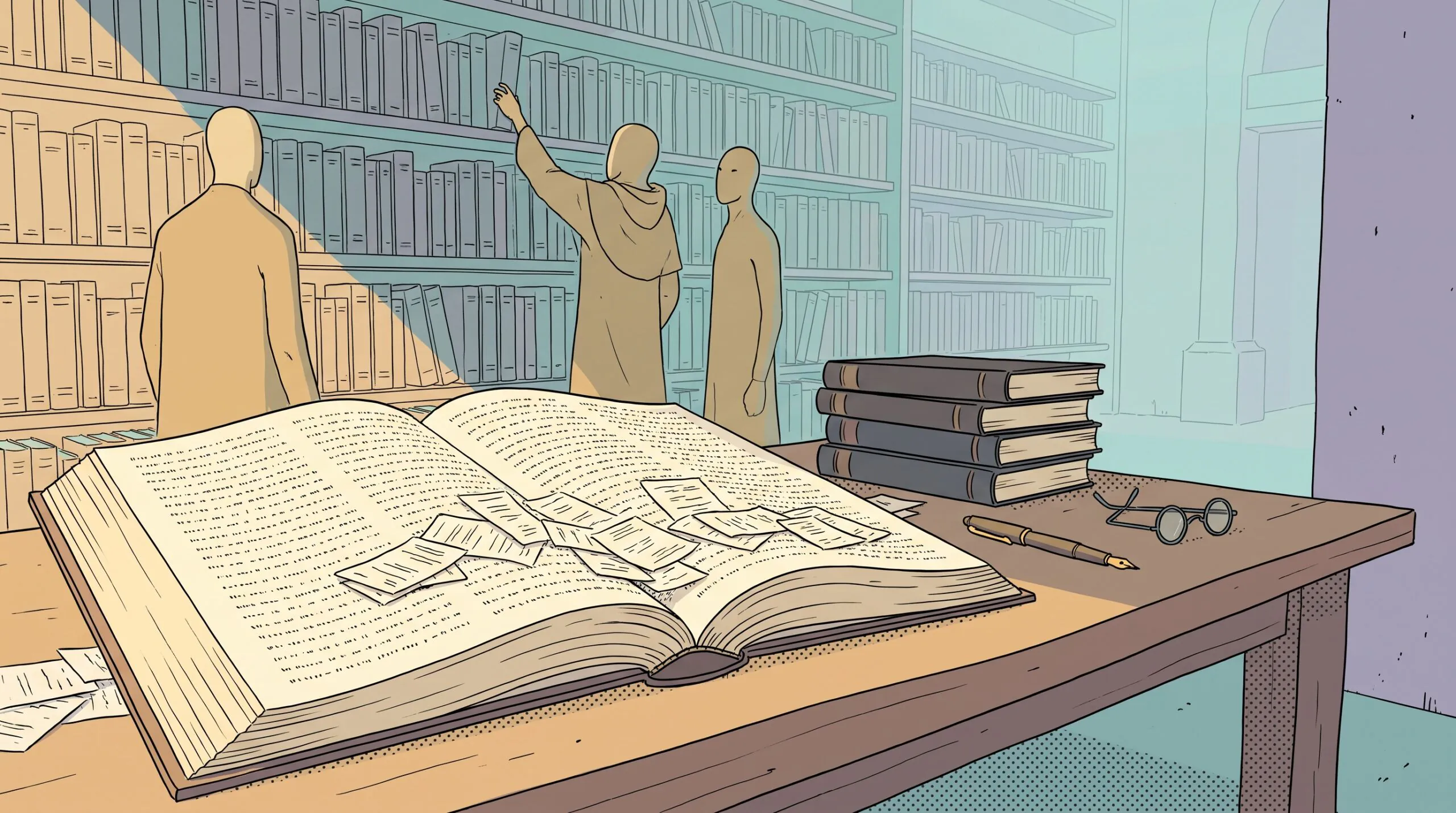
Goethe said Weltliteratur, world literature, to Eckermann on 31 January 1827, in the same breath as the line that poetry is the common property of humanity and that national literature does not mean much anymore. Eckermann wrote it down, published it, and it has been an academic discipline ever since. Goethe also left Faust, which functions in German the way Hamlet does in English: a quarry that ordinary speakers strip for parts without knowing where the parts came from.
Schiller is worse, or better – a one-man phrase factory whose lines are still deployed by Germans who have never read the plays.
Which is why Georg Büchmann, a Berlin schoolteacher, published Geflügelte Worte in 1864 – Winged Words, the quotation-hoard of the German people. The term comes from Homer, where words fly from the speaker’s mouth to the hearer’s ear. Büchmann’s rule was that a phrase counted only if you could document where it came from, and he chased each one back to its first appearance and its variations. The year before, he had stood up in front of the Berlin society for modern languages and given a talk on faked quotations.
A man in 1863 lecturing a scholarly society about fake attributions. Same problem as the nose, yet different century.
Thomas Mann belongs here too, doing something different from all of them – he barely coined a word. What he did was syntax: sentences with three subordinate clauses nested inside each other that arrive, unhurried and fully intact, at a verb you have been waiting for since the previous line. He proved the architecture could hold that much weight. Every German writer since has either used that permission or deliberately refused it, and both are a response to him.
The English-language equivalent of this whole section is Shakespeare, and it comes with a warning label. The first edition of the Oxford English Dictionary quotes him something like 33,000 times, which is where the folklore about him inventing thousands of words comes from – but he is the earliest recorded use in only about 1,500 of those entries, and as the dictionary gets revised that number keeps falling, because the editors had a concordance of Shakespeare on the desk and nothing comparable for anybody else. He was not necessarily coining; he was frequently just the first person who got printed.
Which is the same thing that happened to Zesen, running in the opposite direction. One man credited with words he never made. Another credited with words he only wrote down first. The ledger lies in both directions, and it lies in every language.
Thinking in it
Kant wrote philosophy in German instead of Latin and forced the language to grow the vocabulary as he went. Marx took Mehrwert and Klassenkampf and Entfremdung – surplus value, class struggle, alienation – and welded them so hard to his own argument that nobody can use them innocently anymore. Nietzsche did the same to Übermensch, a word that had been kicking around German since 1527, when a Dominican used it as an insult for Lutherans, plus Umwertung aller Werte, and a prose style that half the language is still recovering from.
And then Freud, who did something that gets completely lost in English – he built his vocabulary out of the plainest German available. Das Es – the It. Das Ich – the I. Das Über-Ich – the Over-I. Verdrängung, pushing-away. Fehlleistung, a mis-performance. These are nursery words. A German child understands the components of every single one.
His English translators turned them into id, ego, superego and parapraxis. LATIN.
So Anglophones think Freud sounds like a physician and Germans think he sounds like a novelist, and both are reading the same man. Latin got put back on top of the plainest words he could find, in the one place it did real damage. Zesen’s project, run in reverse, on Zesen’s own language, by people with the best intentions.
Heidegger is where the whole thing ends up. Dasein, being-there. Geworfenheit, thrown-ness. In-der-Welt-sein, being-in-the-world. That is Schottelius’s doctrine taken to its terminal conclusion 300 years later: build the entire philosophy out of native roots plus etymological excavation, and treat the fact that nobody can translate it as evidence you arrived somewhere. Whether that is the summit of the tradition or its reductio is a fight people are still having, loudly, and I am not settling it here.
Meiji Japan did the same operation and did it better than anyone in Europe. Scholars building kanji compounds for imported Western abstractions – 哲学 for philosophy, 社会 for society, 自由 for freedom, 科学 for science. Transparent, compositional, readable by anyone who knows the characters, exactly the Schottelius argument in a writing system built for it. And then those coinages were exported into Chinese and Korean, so a share of modern Chinese abstract thought runs on words invented in Tokyo.
The loan translation went home and colonized the neighbors. Nobody in Europe managed anything remotely like it.
The post office and the office
Heinrich von Stephan, who ran the German postal service and built the Universal Postal Union, put out a decree in June 1875 replacing 671 foreign postal terms with German ones in a single stroke. He won some: postlagernd for poste restante, Einschreiben for recommandé, Briefumschlag for Couvert. He lost others: everyday German kept frankieren over his freimachen, and kept Telefon over Fernsprecher, which survived only inside the post office’s own paperwork, where it slowly became a joke about the post office.
That is the pattern for all of it, and it is worth saying out loud: the replacement almost never replaces. It moves in next door.
And then there is what the bureaucracy does with a compounding language once nobody is supervising it. Personenvereinzelungsanlage, person-singularization-installation, is a real term for a security turnstile. Straßenbegleitgrün, street-accompanying-green, is real road-planning vocabulary for the plants along a road.
Raumübergreifendes Großgrün, space-encompassing-large-green, allegedly a German official’s term for a tree, is the one everybody quotes – and it is the title of Hinrich Lührssen’s 2010 paperback about bureaucratic German, which went to number 23 on the Spiegel bestseller list and tells its stories with a wink.
The funniest item on the list is the one nobody can source, and it is the one everybody remembers. Same machine that built the nose. Still running, in my lifetime, on a book I have seen in an airport.
French institutional purism is the flop that proves the German case, by the way. The Académie française has had a state, a budget and 400 years, and courriel for email is mostly ignored in France – and courriel is not even a Paris word. Québec’s language office made it in 1997; France got around to officially recommending it in 2003 and then largely carried on saying mail. The one enormous win, ordinateur, was not the Académie either – a Sorbonne philologist named Jacques Perret coined it for IBM France in April 1955, out of an old theological adjective meaning the one who orders and arranges. And the purism that actually functions in French happens in Québec, not Paris, because in Montréal it is a survival strategy and in Paris it is a dignity project. Turns out the state was worth nothing. Fear works better.
What gets built now
Modern German coins constantly. It just does it in two very different moods.
There are the pseudo-anglicisms, which are German words wearing an English costume: Handy for a cell phone, Beamer for a projector, Showmaster, Dressman, and Public Viewing, which in American English means something considerably grimmer than watching a soccer match on a big screen outdoors. Nobody sat down and thought about any of these. They came out of marketing departments and, well, they show it.
And then there is the quiet stuff that worked so well nobody notices it happened: a big chunk of German computing vocabulary is native – Rechner, Bildschirm, Festplatte, Zwischenablage, Suchmaschine, herunterladen. The best of them is Datei, the word for a computer file, welded together out of Daten and Kartei, a card index, and standing in the DIN standard by 1972. Formally independent of the English word, semantically exact, universally adopted, and so thoroughly naturalized that no German alive experiences it as an invention. Nobody even knows who made it.
That is Zesen’s move, executed cleanly, in the 20th century, by an anonymous committee.
The traffic goes the other way now too. Energiewende gets used untranslated in English-language energy policy. So do Waldsterben, Schadenfreude, Zeitgeist. The compounding machine is in perfect health. It stopped being aimed at Latin and got aimed at things nobody else had bothered to name.
The difference between Datei and Handy is not native versus borrowed. It is whether anyone was paying attention when the word got made.
There is a whole other history here – the deliberate engineering of German for power rather than for clarity, which runs from the Kaiserreich through 1933 and the GDR and into the vocabulary of the present. That is its own post and I am not going to compress it into a paragraph here.
So where does German actually land?
Iceland replaced. Turkey replaced by decree. Hungary and Bohemia replaced. Germany produced doublets – Bibliothek beside Bücherei, Dialekt beside Mundart, Adresse beside Anschrift, Passion beside Leidenschaft – and every one of those pairs has since split by register or by sense, so that a Bücherei is genuinely not a Bibliothek anymore. The purism failed at substitution and accidentally succeeded at something more useful: it doubled the keyboard. German got a native layer and a Latinate layer that can be played against each other, which is roughly what English has through its Germanic and Romance split, and it is the thing that makes a language stylable.
None of which is a fact about the German soul. It is a fact about enforcement. No state, no academy, hundreds of principalities, and every proposal decided by whether printers set it and readers repeated it. German has a double keyboard because nobody in 400 years could ever make anybody do anything. That is not depth. That is a committee failing, at length, in public, and leaving the minutes on the table.
Which brings it back to the rhyming motto the palm order carved next to Zesen’s name in 1649, as a rebuke, after making him wait years to get in.
Wer dan aufbringen wil was neues, nehm in acht / Das er es stell’ und schreib’ aus gutem vorbedacht.
Whoever wants to bring in something new should take care to set it down and write it with good forethought.
They meant it as an insult. It is the best writing advice in the book.


