Living In The Patch Notes My neighborhood shipped a version number

There was a lot near my building with trees on it. Not landscaping – trees, the grown kind, with scrub underneath and whatever lived in the scrub, and at night the whole thing made noise: insects, frogs, some bird with a naughty opinion about something. It’s a fenced rectangle of mud now, and a trench cutter sits in the middle of it looking pleased with itself.
Phú Mỹ Hưng had dozens of those lots when I moved in at the end of 2023. Plain grass on some, small honest wilderness on others, and together they did the thing you only notice once it’s gone: they held the temperature down a notch, they ate the sound coming off Nguyễn Văn Linh, and they let a district built on a filled-in swamp feel occasionally like a place with weather rather than a place with air conditioning.
Most of them are gone.
What’s replacing them is branded Phú Mỹ Hưng 2.0, and the branding is the most honest thing about it – this is a version number, from a developer that has always shipped releases rather than let a neighborhood happen.
The catalog
The developer published the roadmap in July, and it reads like patch notes. A seven-floor arts and culture complex on plot C10, 24,000 m² of floor area, designed by B.L.U.E Architects out of Beijing; the basement package broke ground on July 22. A 23-floor mixed-use gateway block on C1 by Nihon Sekkei, the Tokyo firm behind the Azabudai Hills towers, 99,984 m² and running to 2030. A 27-floor office slab on the Crescent by AtkinsRéalis, who did the Burj Al Arab, so you can guess the vibe. Gensler – Shanghai Tower Gensler – on a 21-floor block that will become the developer’s own head office. And the Tâm Anh general hospital, 1,000 beds across two towers, targeted to open in 2028.
Then the housing, and here the list stops being varied. Handel Architects of New York is designing what looks like most of it: The Regency, Triton Crown, CR5-2, MD3-1, MD4-1, H8. One studio, six towers, one house style. Say what you like about the result, but nobody can accuse the plan of indecision.
I like a lot of this. The hospital isn’t a first – Tâm Đức Heart Hospital and FV are both already here, and a third big one makes this a medical cluster rather than a rescue mission. The arts center is closer to a genuine gap: we have the Saigon Exhibition and Convention Center a walk away, which is a trade-fair hall doing culture as a side effect, and then a drop-off. A real venue in walking distance moves me more than anything else on that list.
It was never a neighborhood
Phú Mỹ Hưng Development was founded on May 19, 1993, as a joint venture: 30% Tân Thuận IPC on behalf of the city, the rest Taiwanese, from a conglomerate then called CT&D. CT&D was owned by the Kuomintang – the Chinese Nationalist Party, which at that point still ran Taiwan and was looking for somewhere to park capital while the Taiwan Strait got tense. So the most expensive square kilometer in southern Vietnam was seeded by the business arm of a party that lost a civil war to a communist one, invested in a socialist republic, on a swamp. History has a sense of humor and no shame about using it.
The deal itself is the part that explains why this place feels the way it does. The developer got 600 ha on a 50-year lease, and in exchange it built Nguyễn Văn Linh – 17.8 km, ten lanes, 220 ha of right of way – plus another 150 ha of serviced public land: road for land. In 1993 the city had no money and a swamp; the Taiwanese had money and wanted certainty. Both sides got what they came for.
Lawrence S. Ting, who ran CT&D and is now a building, a school, and a memorial park around here, then did something nobody had done in Vietnam since 1975: he ran an international urban design competition. Skidmore, Owings & Merrill won it, with Koetter Kim and Kenzo Tange Associates on the team, and the Prime Minister signed off on the master plan on December 8, 1994. So the Taiwanese-funded, KMT-financed model city was designed by Americans and a Japanese modernist. Everyone calls Phú Mỹ Hưng the Taiwanese district; the money and the management discipline were Taiwanese, the drawings were not.
The plan covered 2,600 ha of Saigon South in 21 zones. Phú Mỹ Hưng built five of them. The rest went to other developers who, in the words of one of the men who initiated the whole thing, stopped caring about the blueprint entirely.
And that – not the trees, not the money – is why crossing out of here feels like crossing a border. It isn’t that Phú Mỹ Hưng is rich and the wards next door aren’t, though that’s true too. It’s that this is the only part of Saigon South that got built the way it was drawn.
The Taiwanese district that everyone calls Korean
Behind the curtain it’s Taiwanese. On the street it’s Vietnamese and Korean, and has been for twenty years. The Vietnam – Korea Friendship Association put nearly 11,000 South Koreans in the old District 7, most of them here; the consulate’s own estimate has run as high as 20,000. Whole blocks are signed in Hangul only, with the Vietnamese translation as an afterthought if it’s there at all, and nobody involved seems to consider this a problem worth solving.
Westerners, meanwhile, are thin on the ground. I run into fewer of them in a month here than in an afternoon in Thảo Điền, and I’d be lying if I said I didn’t enjoy that. Being a mild curiosity rather than one of a set is a better way to live somewhere.
Little Seoul has a lot of teenagers in it
The schools explain a good chunk of the district. Saigon South International School, the Lawrence S. Ting Memorial School, the Japanese school, the Taipei school, the Korean school, the Canadian one, Sedbergh – and that’s not a complete list, just the ones inside a kilometer of my door. Tuition at several of them runs past what most families in this country make in a decade.
Which produces the best thing about living here, and it costs nothing – after dark the low grass mounds in Nam Viên park and the ones ringing Hồ Bán Nguyệt fill up: couples on every slope, picnics out of plastic bags, somebody’s phone playing something for everybody, studying that isn’t really studying, flirting conducted with enormous inefficiency, hand-holding, the occasional kiss executed with the tradecraft of a Cold War handoff. A few hundred people deciding nightly that the most expensive landscaping in Vietnam is basically a free living room.
Jayden – my fiancé – and I have done it too, sitting out on one of those mounds until long after midnight, in the moonlight, with no plan and no reason to go in. That’s the difference between residing somewhere and living there.
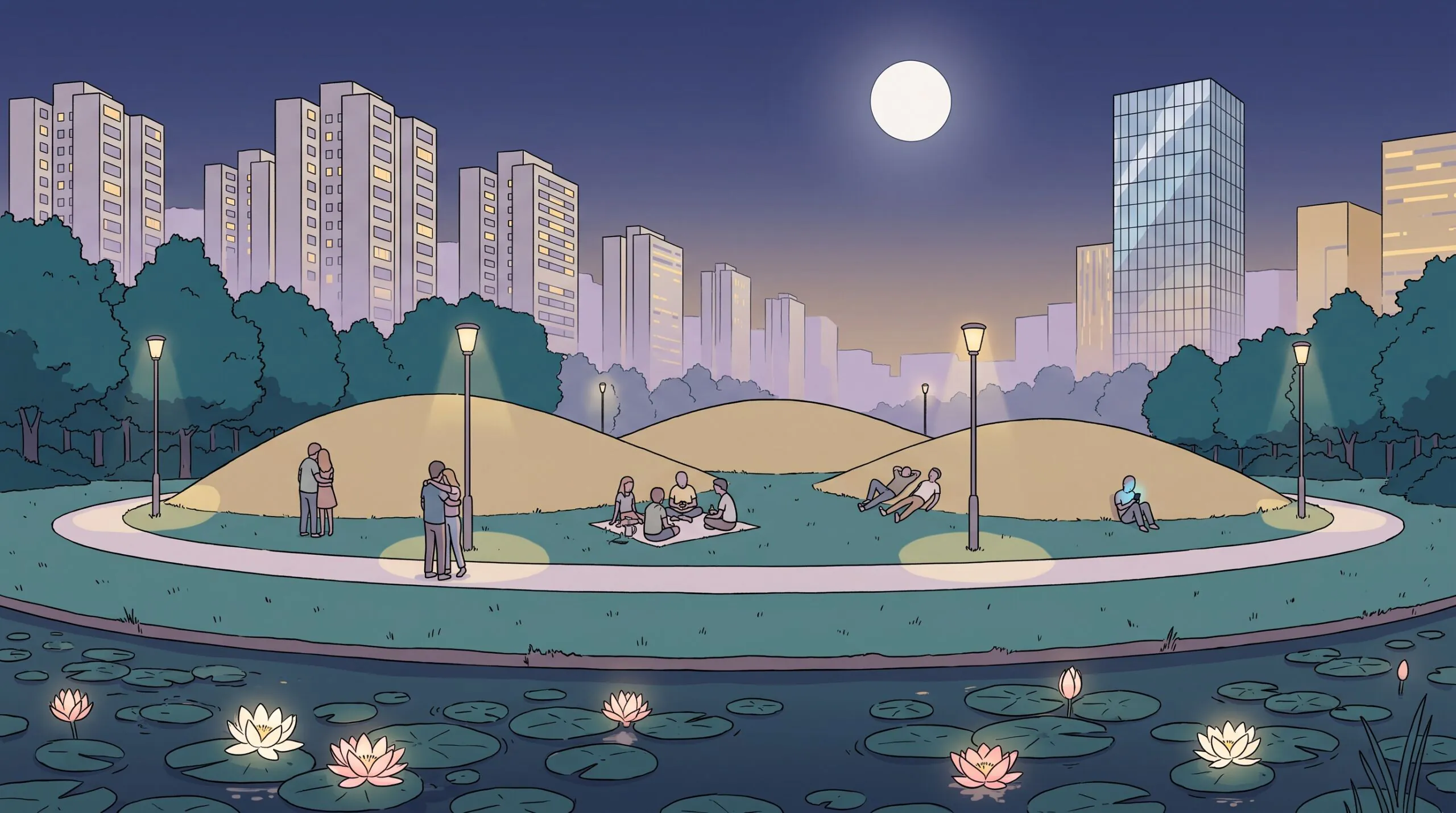
I didn’t pick this district for the park, and I’d move for it.
The parallel world, described honestly
Walk the villa sections and you get an architecture zoo: neoclassical porticos, something doing a Renaissance impression, a postmodern box with a water feature, a French château that would look ridiculous anywhere including France. Wide side streets with nothing on them. Empty sidewalks – actual sidewalks, unparked-on, an endangered species in this city. Parks that get maintained. Private Phú Mỹ Hưng security who will salute a particular limousine and wave the rest of us through. Korean executives, Maybachs on Cambodian plates, and the general sense that a lot of money here is quietly from somewhere else.
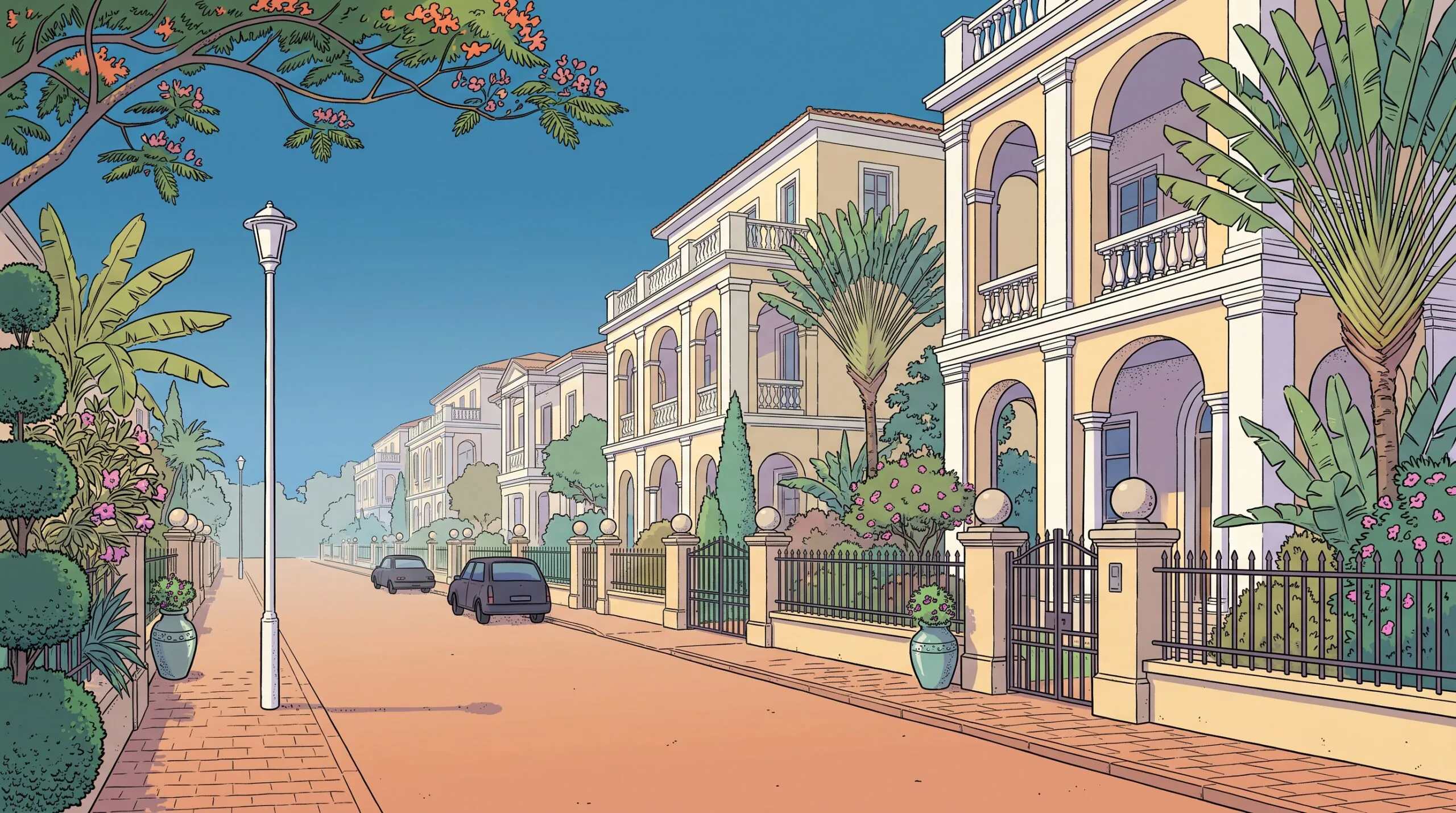
I’m a foreigner with a software salary living inside that, so let’s not pretend I’m reporting from the outside. I benefit from every single thing on that list. The sidewalks I like are a product feature I’m paying for.
Losing the crown, then buying it back
I used to repeat the line that Phú Mỹ Hưng is the most expensive place in Vietnam. It isn’t, and it hasn’t been for a couple of years. Apartments here run roughly 80 to 150 million VNĐ per square meter; across the river, Thủ Thiêm riverside resales are at 180 to 200 million, and JLL has them closing on the old District 1 rather than on us. The crown moved east.
The villas are where the ceiling still lives. Listings across Nam Thiên, Mỹ Kim, Phú Gia and Chateau run from about 30 billion VNĐ for a tired older house to 340 billion for a 637 m² river-view place in the Chateau compound – call it ≈1.15 million USD at the bottom and ≈13.1 million USD at the top, for a house, in a country where the median monthly wage is a rounding error against either number.
And 2.0 is the answer to the apartment crown, and the answer is not subtle. Residential land is now barely 10% of the developer’s remaining land bank, and most of that is reserved for luxury and ultra-luxury. Casa Luna, announced this month although under preparation since a while already, is two 20-story towers on the Crescent holding 49 apartments total, 233 to over 500 m², at more than 100 billion VNĐ each (≈3.84 million USD). Do that per square meter and you land somewhere between 200 and 430 million VNĐ – Thủ Thiêm money and then some, on 49 units, from a company that needed to prove it could still play at that table.
The spec sheet is where it gets interesting: one or two units per floor. A private lobby and dedicated elevator per residence. 118 parking spaces for 49 homes, including double-width bays for full-size SUVs. A green barrier over two meters high, plus setbacks from the surrounding roads. Japanese management from Nihon Housing. And no shophouses on the podium – the ground floor is reception lounges, fine dining, a business center, wellness.
No shophouses – in Vietnam, in the country where the ground floor of a building is where the country actually happens: the bánh mì cart, the phở place with the plastic stools, the woman who fixes your shoes while you wait, the entire economy of a street. Deleting the podium is a design decision that says, out loud, that the street is a thing to be protected from.
That’s when the mixed feelings stop being mixed and start being specific. I can love an arts center and a hospital cluster and a park full of couples at one in the morning, and still think a two-meter hedge with a business center behind it is a sad little answer to the question of what a city is for.
What’s coming at the street
And the street is about to get louder anyway, from three directions at once.
The Bến Thành – Cần Giờ line – line 12 in the city’s rail plan, VinSpeed’s project in practice – was approved in May to run down Nguyễn Văn Linh, straight through Phú Mỹ Hưng, then along the middle of Nguyễn Lương Bằng before crossing Rạch Đĩa into Nhà Bè. Double track, electrified, design speed 350 km/h against Line 1’s 110. It broke ground in December 2025 and targets service in late 2028, which, based on every metro this city has ever built (which is, um… one), I’d file under aspiration.
I wrote in March that this thing would put a station less than 500 meters from my building. That’s still true. I simply left out the timing, and the timing is the joke: phase one has exactly two stations, Bến Thành and Cần Giờ. Tân Thuận, Tân Mỹ, Nhà Bè and Bình Khánh are phase two, built “when demand warrants”. So for now it’s a train doing 350 km/h past my window on its way to a beach resort, and my platform exists in the same sense that my retirement does.
Meanwhile the Cần Giờ bridge started construction in June – 6.3 km, a cable-stayed main span of nearly 3 km over the Soài Rạp, six lanes, 13,200 billion VNĐ, done in 2029 if the schedule holds. It lands in Nhà Bè, not here. But everything that wants to reach it from the city comes down our corridor, and the ferry it replaces currently acts as a valve on how much traffic bothers trying.
I already know what that sounds like. The pile drivers start before six, the dust settles gray on the balcony rail by noon, and on a still afternoon the air over the fences shimmers the way it does over a parking lot – a swamp district that used to breathe, learning to hold heat like concrete does.
Denser, louder, hotter, in two to four years; and all three are measurably true already, with none of these projects topped out.
The franchise
The last piece is the one I keep turning over: Phú Mỹ Hưng isn’t just building more Phú Mỹ Hưng – it’s exporting the format.
Hồng Hạc City went up in Bắc Ninh, near Hanoi, at close to 1.1 billion USD, the company’s first project outside this city in three decades. The Harmonie is selling in Thủ Dầu Một, which after last year’s provincial merger is technically the same municipality as my apartment, though. And the business is doing well on it: after-tax profit of 1,355 billion VNĐ in the first half of 2026, up almost 40% year on year, with bank borrowing up 45% as bond debt came down.
The company still quotes Ting’s founding line – we come to a place not to take away, but to leave values behind. I don’t think that’s cynical. I think he meant it, and the schools and the parks and the fact that this master plan survived when 16 other zones abandoned theirs are the evidence. It’s just that “values” was easier to define when the product was a road and a swamp, and harder now that it’s 49 apartments behind a hedge.
Where that leaves me
I’m not going anywhere. I chose this district on purpose, I still like living here, and I’d rather be inside a city that’s building than one that’s given up – Germany taught me what that looks like and it isn’t better, it’s just quieter.
But I’ve stopped telling people I live in a nice neighborhood. I live inside a thirty-three-year-old product going through its second major release, the roadmap is public, and I’m in it as a user rather than a resident. The lot behind my building was never a park. It was unsold inventory with trees growing on it, and the trees were a rounding error somebody eventually got around to.
The kids still have the park. I miss the frogs 🐸
