Where the Roads Don't Reach A childhood at the end of the water

He was six. The lamp was kerosene, the kind you carry by a wire handle, and it threw just enough light to show the next few steps of mud and nothing else.
Five in the morning. Often earlier. Jayden would leave the house while most of the family was still a pile of breathing in the dark, and he would start walking the five kilometers to school along paths that were not really paths – just the raised dirt between the canals and the fish lakes, packed down by feet over years, dissolving a little more every rainy season. On a good day it was a walk. On a bad day the mud took his sandals and built itself up under his soles until he was an inch taller and slipping sideways toward water he couldn’t see.
And the water was the problem. Not because of drowning – he could swim before he could properly run. The water was the problem because of what his grandmother said lived in it.
He didn’t have to be told twice. You learn fast, in a place like that, which stretches of canal you don’t look at too long in the dark, where the black surface goes flat and patient and something underneath it is supposed to be waiting for a foot to slip, a body to take, a turn at being alive that it lost and wants back. The lamp helped with the path, but it did nothing for the water. You just walked, and you didn’t look, and you held the light a little higher and told yourself the splash was a frog.
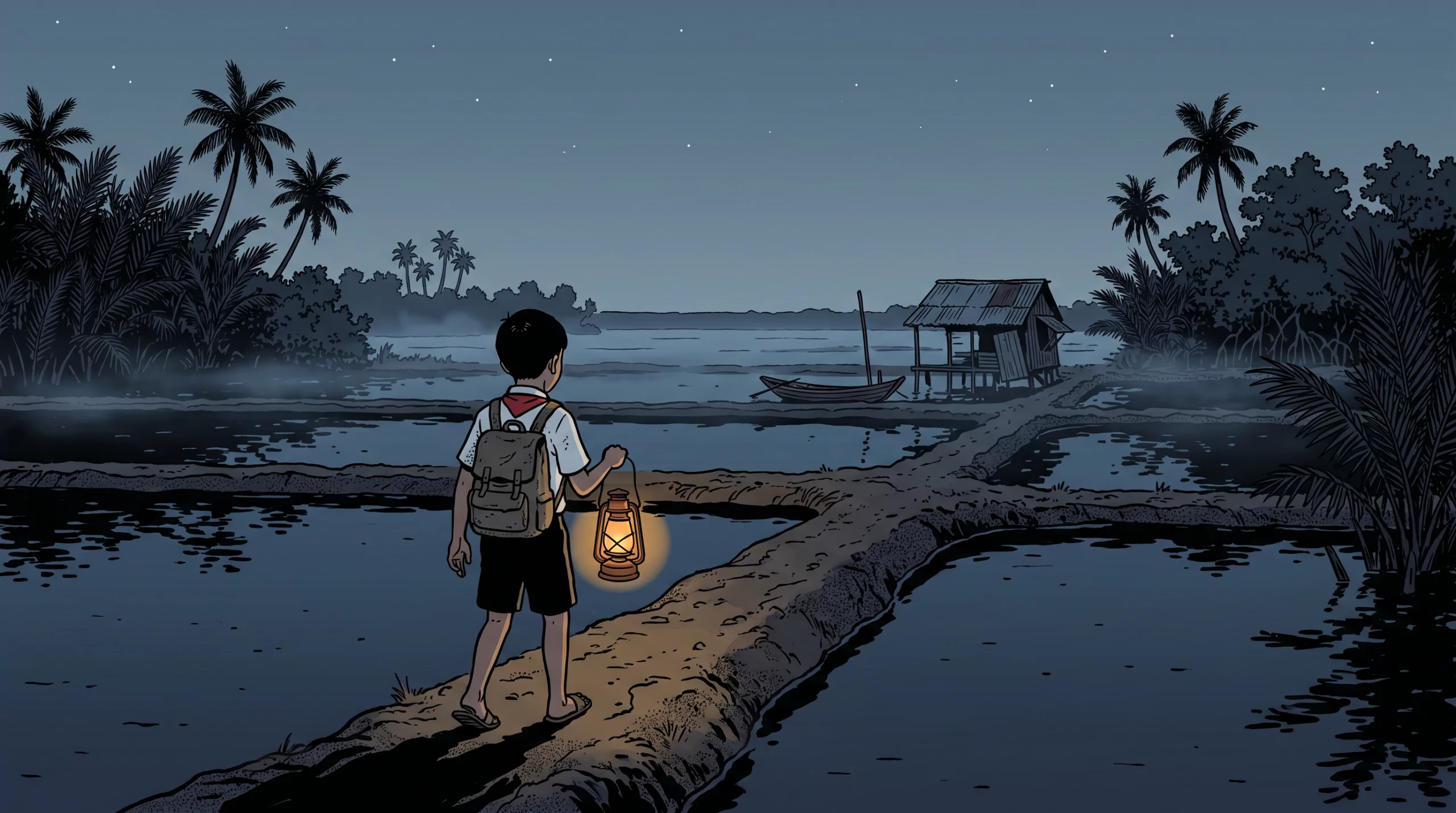
The bushes were their own negotiation. Snakes came out of them – real ones, the kind the grown-ups would later hunt down and kill when you reported them, which meant the fear was not a story, the fear was correct. A six-year-old in the delta dark is doing constant math nobody taught him: frog or not-frog, branch or not-branch, the shape ahead that is probably a buffalo and is probably asleep and is probably not interested in him.
Some mornings he reached the school soaked to the skin, legs caked to the knee, and sat through lessons drying slowly into his own clothes. The free meal there was a fist of sticky rice in a banana leaf, sugar and salt and a scatter of beans pressed into it – and on the hungry mornings that was the best thing waiting at the end of the walk. He was lucky on the mornings the family could spare the bills for the boat – a little ferry that ran the canal with other kids aboard, dry and easy. Most mornings they couldn’t. So he walked. With the lamp, past the water, through the snakes, in the dark.
He is twenty-six now and lives in a city that never goes fully dark. He will still not mess with ghosts. Ask him and he’ll tell you, completely serious, that you do not joke about these things – and I love him too much to argue with a single canal of it.
This is where he comes from. Let me show you a glimpse.
The house was built from whatever grew nearby
He was born in August 1999, in Cái Nước district, Cà Mau – the southernmost tip of Việt Nam, where the country stops being land and becomes a negotiation between mud and sea. At a year old he had his thôi nôi, the ceremony where a baby is set in front of a spread of objects and left to grab whatever calls to him, the family reading his whole future off one small fist. He reached for a tape measure, a pencil, and a book. Hold that thought. It comes back.
The house he grabbed them in was built from mangrove wood – đước, the tree that grows straight out of the salt mud all through Cà Mau – and roofed with nipa-palm fronds cut and dried in the sun before they went up. The floor was packed earth that you swept and that never quite stopped being ground. The walls, where the family had managed it, were lined with plastic tarpaulin against the storms – and that counted as an upgrade, the modern option, better than the branches and planks doing the same job on the older stretches. Inside stood the furniture that outlasts everything: dark, heavy hardwood, some of it carved, some of it plain, built by people who assumed a table should survive its owner.
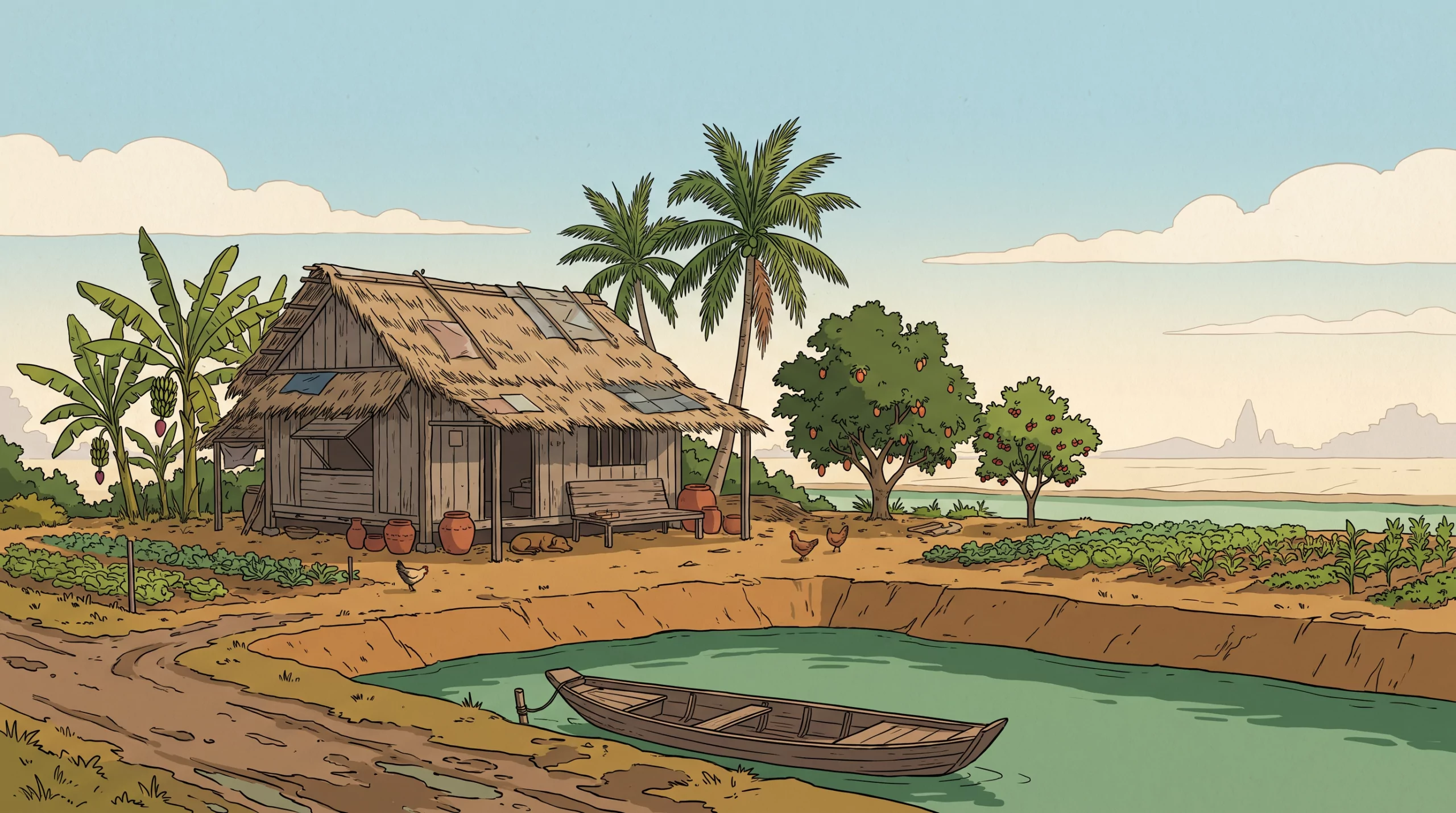
At the center, then as now, the bộ ván – a wide low platform of solid wood that every traditional southern house has. Sofa by afternoon, dining table by evening, bed by night. The room it sat in didn’t have one job. No room did. The whole western idea that a space should be for one thing, that a door is something you close, that privacy is a wall rather than a courtesy – none of that was in the architecture. People slept where there was room to sleep. They ate where the food was. A couple who wanted a private moment had it knowing the whole house could hear, and the house, for its part, had learned not to mention it.
I grew up with my own room and a door I could shut. He grew up inside a single shared volume of family, always within earshot of everyone he belonged to. I’m not sure which of us got the better deal, and I’ve stopped pretending it’s obvious.
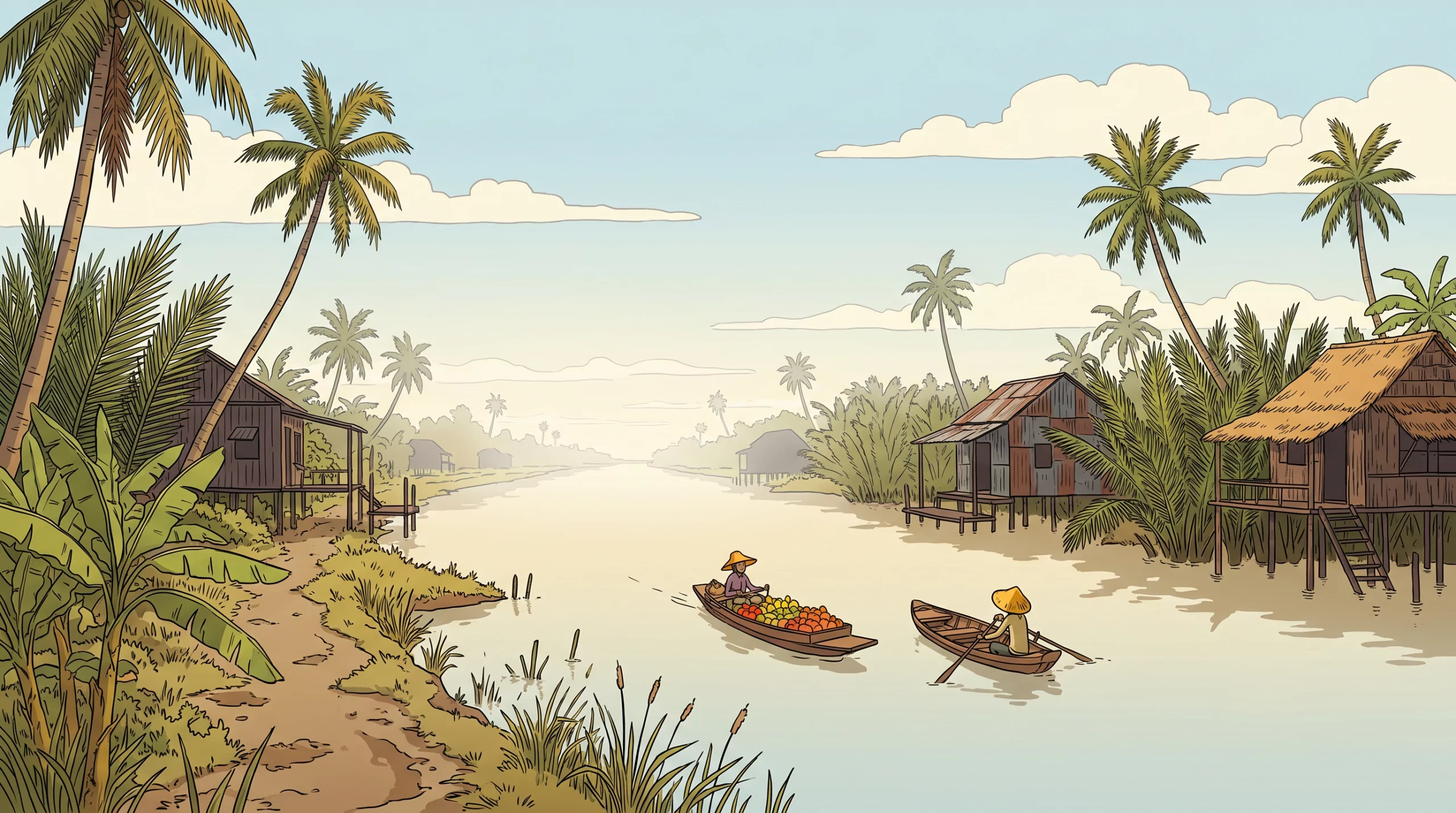
Pull the camera back from the house and it gets stranger, not simpler. There are no real roads out there – none for kilometers. The nearest bus stop sits about 25 kilometers away, forty-five minutes by motorbike once you’ve found enough bridges to string a route together. What the place has instead of roads is water: a whole webbed circulatory system of canals, and on the canals, everything. The market comes by boat. So does the fruit, the vegetables, the seafood, the construction sand, the snacks. There are repair boats and barber boats. You want a haircut, you wait, and the haircut arrives. It is exactly the motorbike-swarm service economy of Sài Gòn, the one I live inside now in District 7 – just floated onto the surface of the water and slowed to the speed of a paddle.
Everything in the water had eyes
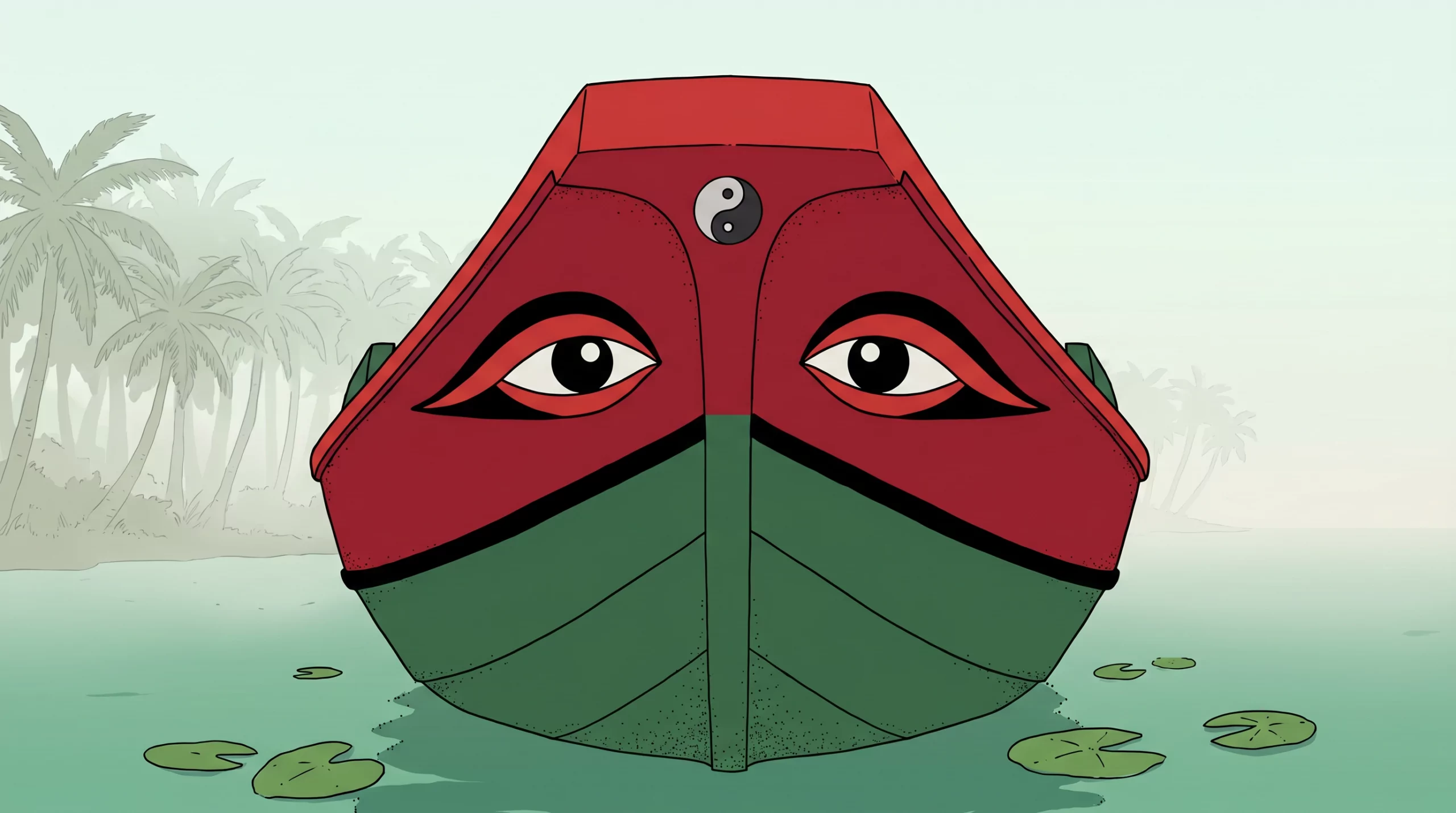
Look at the front of almost any boat down there and you’ll find a pair of eyes painted on the hull, almond-shaped, bold, staring down at the waterline. Mắt thuyền – boat eyes. They are not decoration. Before a new boat first touches the water the owner holds a small ceremony to “open the eyes,” incense and prayers, and only then are the pupils painted in – the moment the boat stops being an object and becomes a thing that can see. A boat needs eyes the way a fish needs eyes: to find food, and to spot what’s coming for it.
What’s coming for it is ma da. The drowned. In the delta a person who dies in the water and isn’t given the proper rites doesn’t move on – they stay, down in the canals, and the way back out is to pull someone else under to take their place. So the dead wait in the water, and every boat that crosses the water wears eyes to stare them down, and a small boy walking the bank before dawn keeps the lamp high and does not look too long at the flat black surface. The whole cosmology is internally perfect. The living and the dead, watching each other across the waterline, every single day.
How a day actually moved
For the first stretch of Jayden’s childhood the house had no electricity. None. Light was the kerosene lamp – the same flame that lit the walk to school lit the evening at home, the homework, the dinner, the talk. The one piece of technology that mattered was an old radio, and the radio ran off a car battery. When the battery died, Jayden’s dad carried it to another house somewhere across the area that had power, left it to charge, and carried it back – a man walking a car battery home through the heat so the family could have melodies in the room.
One neighbor was rich. Rich meant two things: electricity, and a television. So every evening the neighborhood folded itself into that one house and watched together – the news, the long revolutionary war dramas, the variety shows, whatever the two or three available channels were offering. People brought snacks. There was beer and rice wine – the cheap strong kind, rượu đế, doing its quiet work. There weren’t many channels and it did not matter even slightly. The point was never the programming. The point was the room full of people, which is a thing this culture builds out of any excuse at all.
Watch how a gathering arranges itself and you’ll see something that has not changed in Jayden’s lifetime: the women drift into one cluster, the men into another. Not by rule. By preference, cheerfully admitted – the women want to talk about women’s things and complain about their husbands, the men want to talk about farming and politics and, presumably, complain about their wives. Everyone sits on the floor. There’s no head of the table because there’s no table. The circle has no top and no bottom, just people and the distance between them closing.
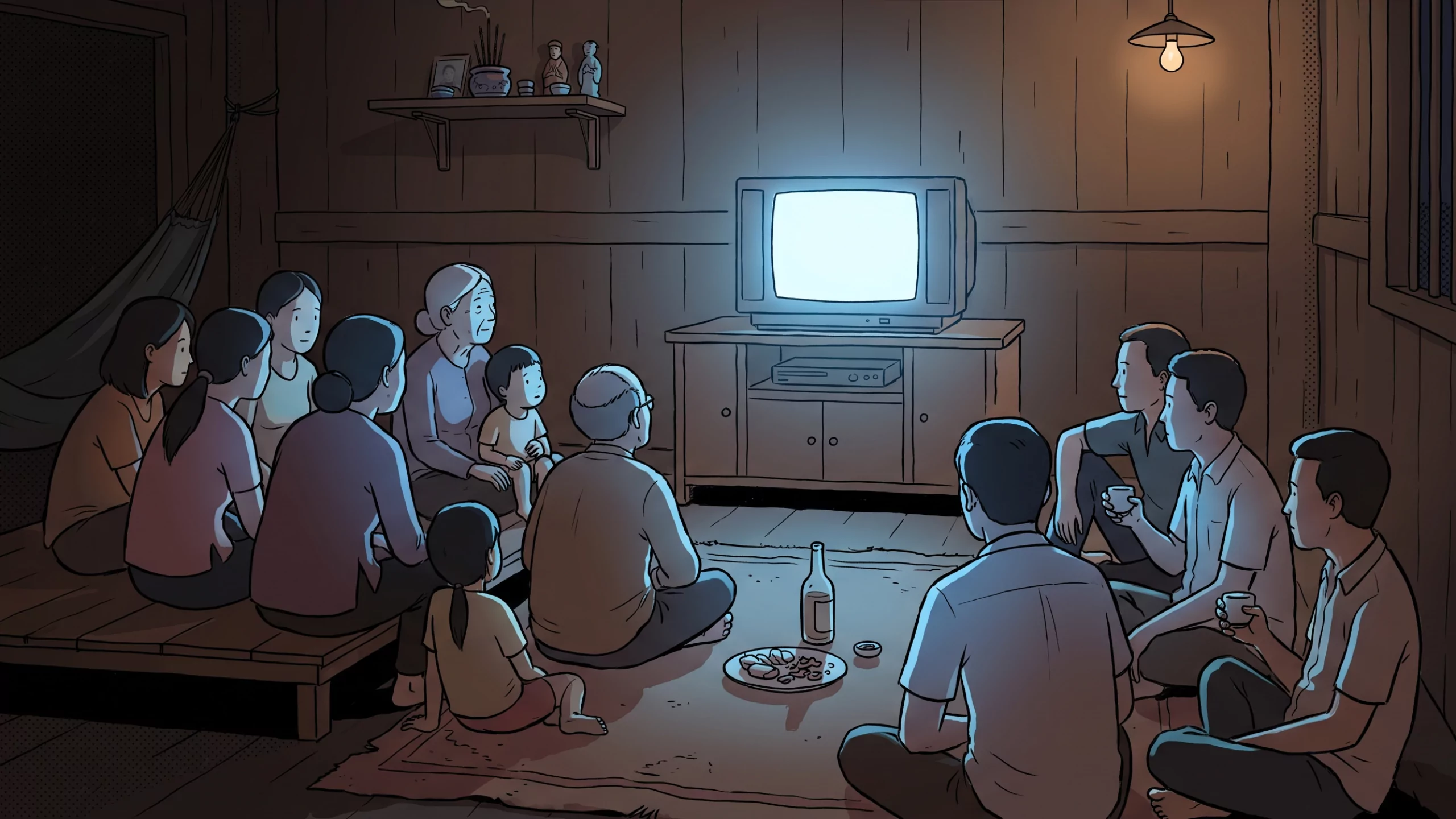
And the bodies are close in a way that took me, a German, a long time to read correctly. Friends lie tangled together in one hammock. Grown men rest a hand on a friend’s knee, drape an arm, lean in, with no charge to it at all. Boys touch each other the way my culture would flag and theirs simply doesn’t. Mothers kiss their children by pressing nose to cheek and breathing them in – hít hà – and somewhere along the way Jayden and I started kissing like that too. Back in Central Europe, the wiring runs the other way: couples touch in public, friends keep their distance, and a hand on another man’s shoulder means something. Here closeness is just the resting state. Proximity is how care gets expressed. The room with no walls and the hammock with four guys in it are the same idea, said twice.
The night the light came on
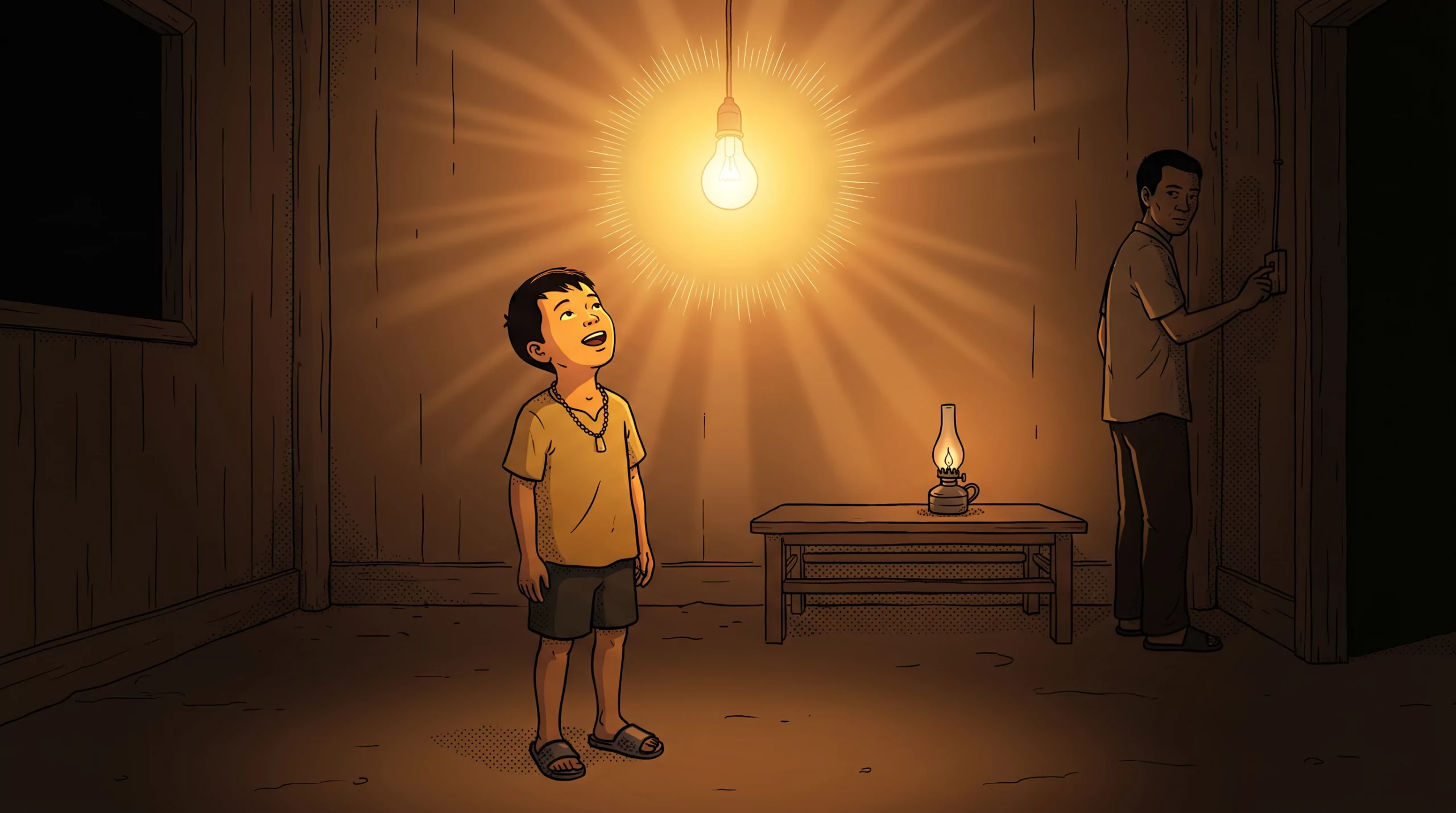
He remembers the exact moment the grid reached them. He was around school age. The house was dark the way it had always been dark. His father went to the wall and pressed something – and a bulb came on.
That’s it. That’s the whole memory, and it is one of the brightest things he owns. A light switch. The single most ordinary object in my entire life, a thing I have never once felt a feeling about, and for him it is lodged in there with the big ones – the night the house learned a new trick and the dark stopped being the only option after sundown. I can describe the scene but I will never be able to stand inside it. You can’t be amazed by electricity if you were issued it at birth.
Everything was a toy if you understood it
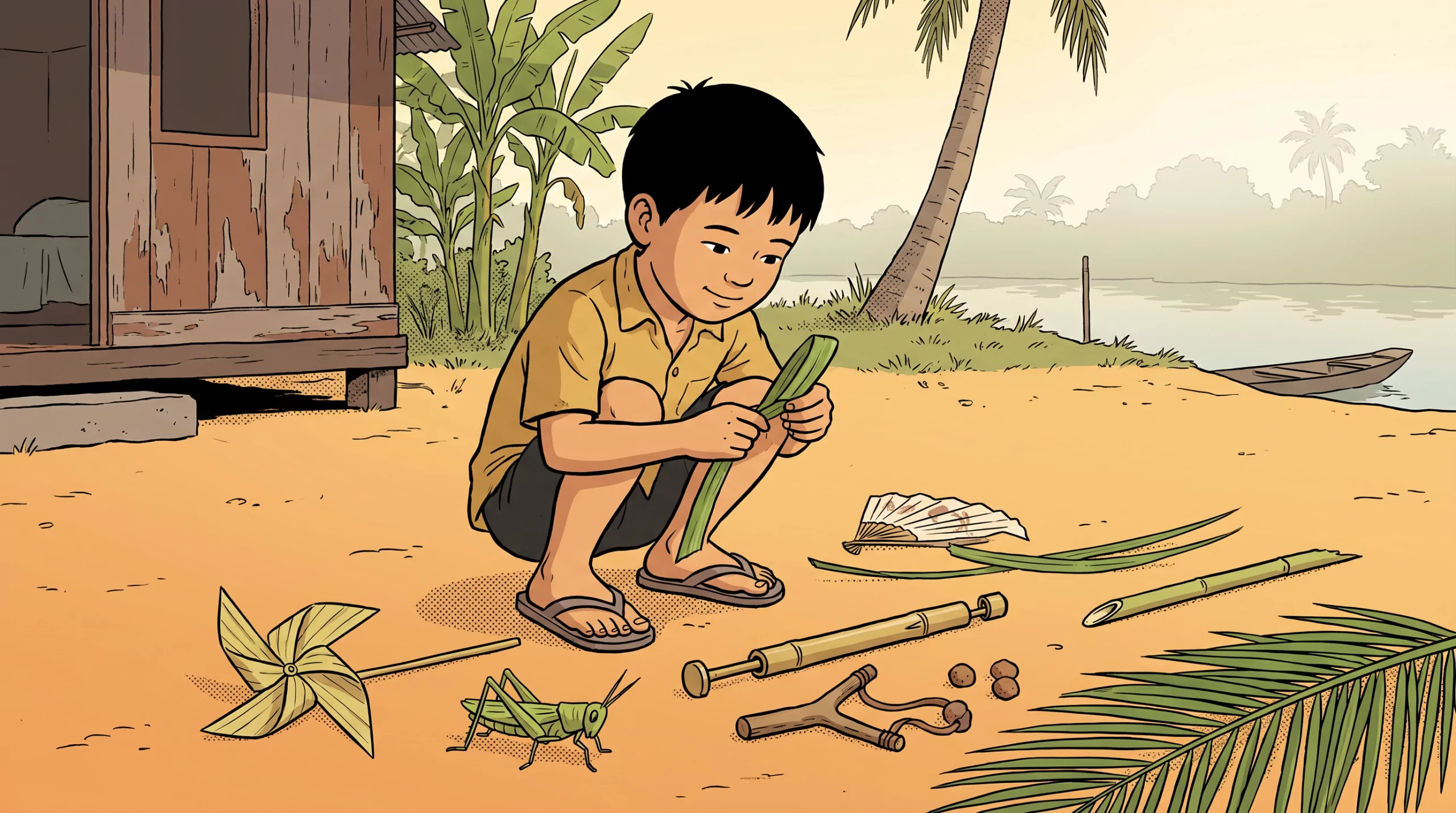
There was no money for toys and, out there, often nothing to buy even if there had been. So the toys got made, out of the canal and the garden and the palm trees, by a kid who treated the entire landscape as a parts bin.
The coconut palm alone gave him a workshop. (Not the nipa – dừa nước was for the roof and for food, its fronds wrapping cakes, its fruit eaten; the toys came from the coconut palm on dry land). You split and fold a coconut frond into a pinwheel and it spins in the wind. Fold it another way and you’ve got a grasshopper so convincing they still sell them at markets today. A horn that shrieks. A woven little handbag. A playful ring. Reeds along the canal became whistles. Bamboo and a rattan berry became a pop-gun that fired with a satisfying crack. And when the festivals came he built his own star lanterns out of bamboo and paper rather than buying one, because of course he did.
Some of it was less arts-and-crafts and more feral-child applied science. You can start a fire with the dried fluff of the cattail flower, which catches almost before the spark lands – and cattail also happens to be something the family ate, so the same plant fed you and lit your fires. A forked branch, a rubber band, and a ball of canal clay dried hard in the sun made a slingshot, and the slingshot was for birds, which were sometimes sport and sometimes dinner. And then, my favorite entry in the whole catalogue, the one that needs no justification because there is none: dropping rubber bands into kerosene to watch them swell up fat. Zero budget. Maximum curiosity. A boy and a jar of lamp fuel, finding out.
The rest of the time he was simply outside, in the way that has mostly gone extinct in my part of the world. Running the paths, swimming and diving in the farm lakes, lashing together little rafts from banana trunks and nipa sheaths because both float, building huts, hunting crabs and shrimp and fish and the occasional bird, catching tadpoles in the rain – the frogs only turned up when it rained, and the frogs were dinner – collecting the standard childhood inventory of scrapes and bruises, learning every plant and animal and weather mood of the place by being soaked and scratched and sunburned by all of them. Spiders bit, ants hurt, black wasps stung, and crabs pinched. Deadly Snakes turned up; snakes got reported; the adults handled the snakes. Apart from that one delta-specific footnote it’s the childhood a lot of us had, mine in a southern German village included – same freedom, same dirt, different fauna and a wholly different set of things in the water.
What his grandmother kept alive
When he first started school he was terrified of it – the crowd of strangers, the new everything – and cried at the thought of being left there. So for a while his grandmother took him herself, rowing him in by boat, and then she simply stayed. All day, outside, within reach, so that whenever he surfaced from the fear she was there. It went on for weeks, until the morning he could walk in and stay on his own. She made the frightening thing survivable by refusing to leave it.
The best hours happened on the small porch, in a hammock slung between two pillars, next to a Jamaican cherry tree that dropped its little red berries into the dark. Jayden and his grandmother would lie there as the day cooled, the oil lamp throwing its soft circle, and above them the kind of sky you only get where there are no streetlights for dozens of kilometers – the whole spilled, countless thing of it. And she would talk.
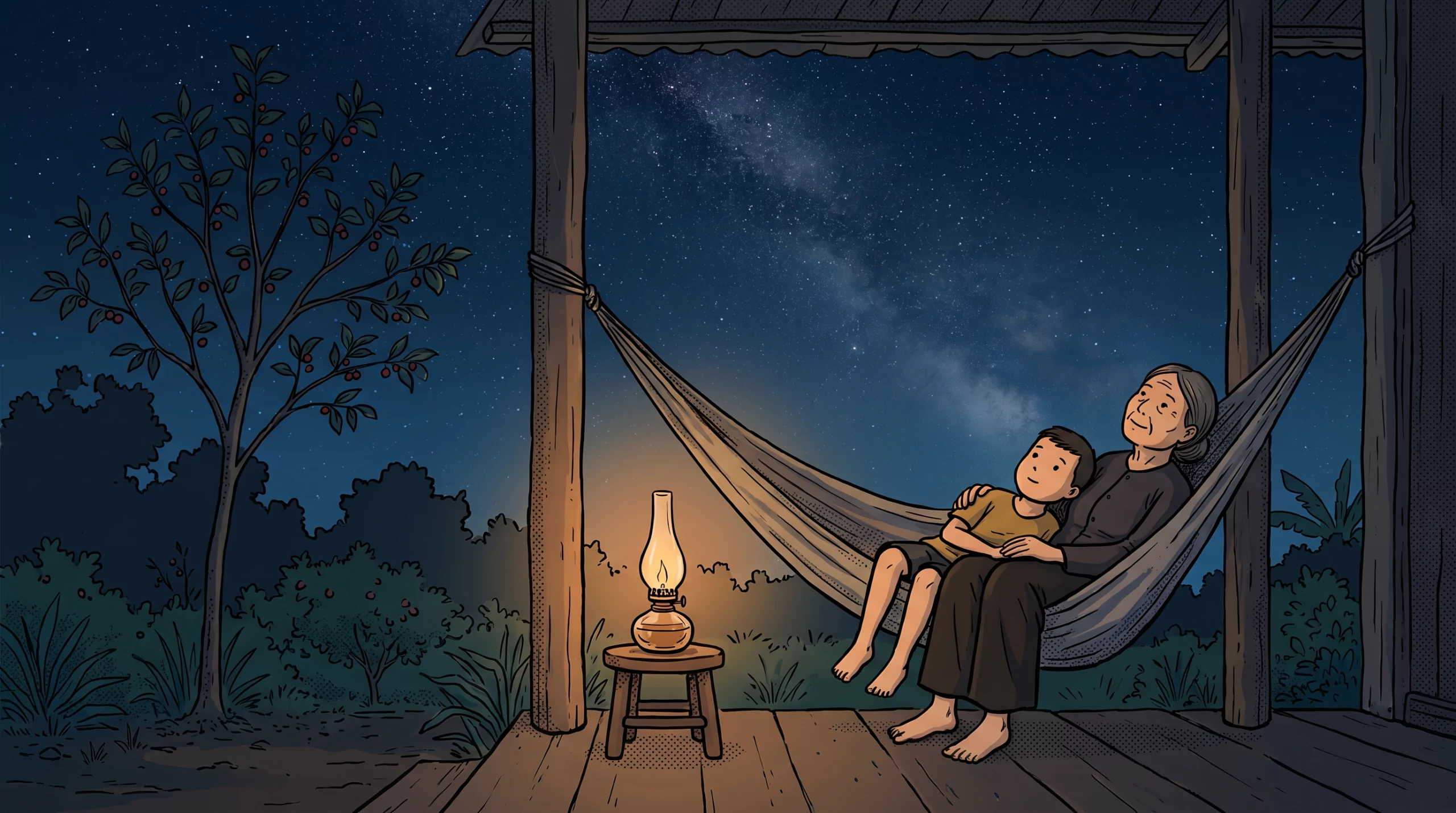
She talked about his father – how he’d been adopted, where the family had come from, what they’d done and survived. She handed him folk riddles to chew on, the old singsong kind: a stalk of green onion, a stalk of chives, a stalk of perilla – falls into the pond, head wet, tail dry. A soup ladle. You feel clever for a second and then you feel the centuries in it, a riddle worn smooth by every grandmother who ever passed it down.
And she told him about the dead, because in this part of the world the dead are not a horror-movie special effect, they’re a parallel society with its own rules and needs. Souls given the proper rites and offerings become ancestors, and ancestors look after the family. Souls denied those rites become cô hồn, hungry wandering ghosts, out there in the paddies looking for food and acknowledgment, capable of small malice if ignored. Down in the canals waited the ma da. And everywhere, in the specific way that only southern Việt Nam carries it, were the war dead – this was fought-over ground, carped bombed, napalm and Agent Orange soaked ground, ground that took people and never gave back their bodies, which by the logic of the whole system meant their souls were still out there, unfinished, unburied, close. Grandma’s ghost stories were not entertainment dressed as warning. They were the community’s actual memory of actual people who died badly, kept alive one hammock-night at a time.
The dark had rules. After six in the evening the children were expected home and indoors, because that was when the dead came up and moved around, and a child still out could be led off a path he knew by heart and walked somewhere he’d never be found. The ghosts could reach the grown-ups too – not by taking them but by closing their eyes for them, blinding a mother to her own child standing right in front of her, so the harder she looked the less she saw. The best defense a household had against any of it was a black dog: a black dog saw what people couldn’t, and plenty of homes kept one at the door for exactly that reason, Jayden’s among them – a dark shape that stood between the family and whatever was out there.
So when I say a six-year-old believed the water wanted him, understand it wasn’t a fairy tale he could put down. It was the cosmos as explained by the person he trusted most, under the truest sky he’d ever see. He still won’t joke about it. I think that’s the most honest thing a person can do with a thing their grandmother taught them.
But there was a defense against all of it, and he wore it. From not long after birth until the year he turned twelve, Jayden had a little protective necklace – the kind a family has made for a child, a blessed charm meant to keep wandering spirits off them. It’s there in the baby photos if you know to look, a small thing at his throat, on him before he was old enough to be afraid of anything at all. The logic runs underneath the fear like a second current: a young child’s soul is still loose, not yet settled into the body, easy for the dead to startle and bother – so you pin it in place for them, with a charm and a blessing, until around twelve, when the child is reckoned strong enough to hold their own soul steady. Then the necklace comes off.
A few days ago, a spirit guardian came to the house to make one for Bánh Bao, the newest baby in Jayden’s family. She wakes in the night, again and again, and the family reads those wakings the way the delta has always read them – someone unseen is visiting. So she got her own necklace, blessed, to wear until she’s twelve. The same span. The same reason. The same age Jayden took his off. Two children a generation apart, the same small weight at the throat, the same answer to the same dark water. It never went anywhere. The family just keeps replying to it the only way it has ever known how.
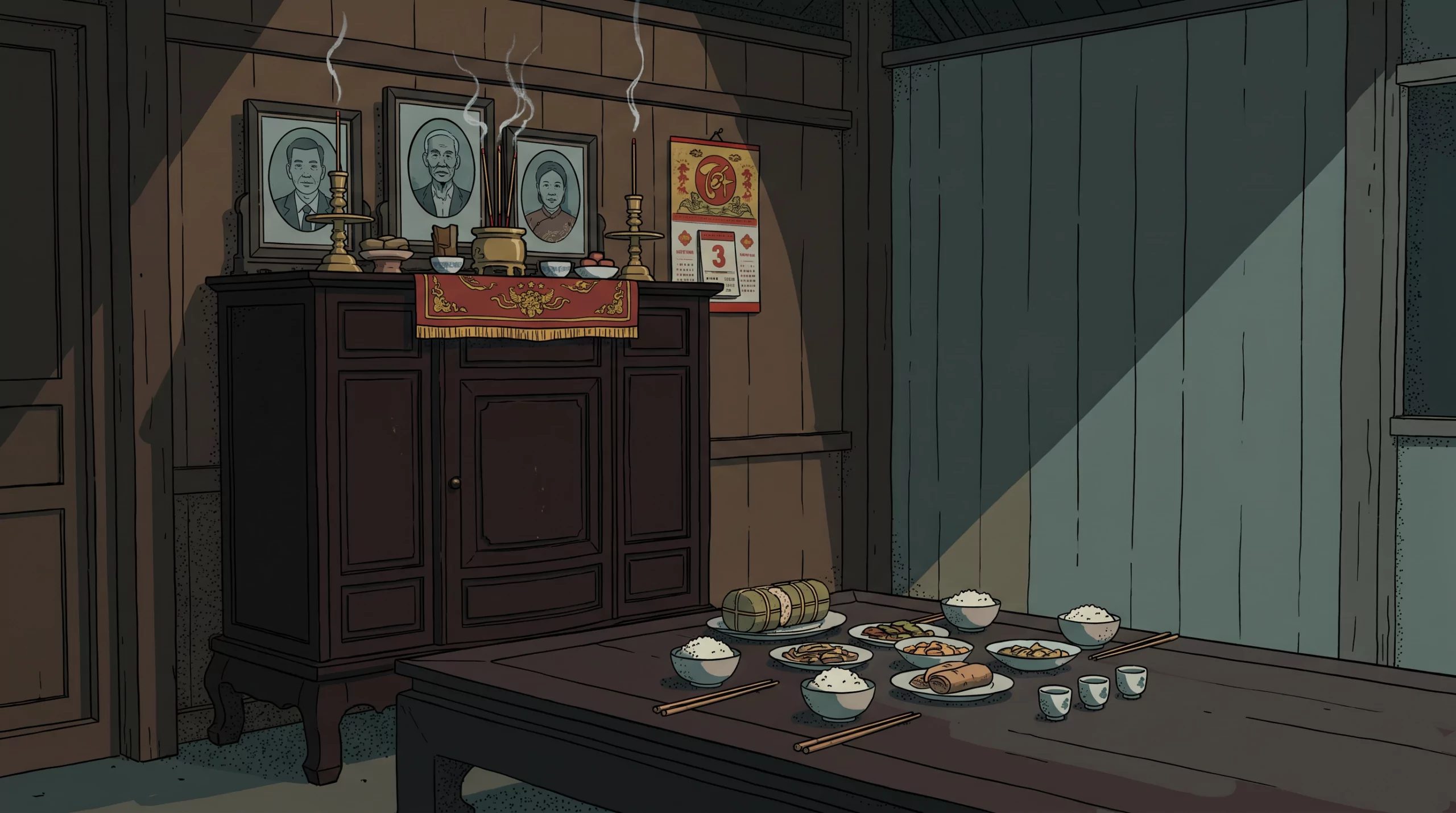
You feed the ancestors, by the way. Literally. The family lays out a full meal – rice, vegetables, braised meat, sticky-rice cakes, three small glasses of rice wine, incense standing in a jar – and sets places with empty bowls and chopsticks, and the dead are invited to sit down and eat with everyone. When the incense has carried the offering up, the living eat the same food. The dead are not gone. They’re just at the other end of the table.
The things nobody threw away
Walk through the house today and it’s a different building – Jayden’s family has spent years upgrading it, a solid floor now, solid walls, a corrugated metal roof, separate rooms, a flat-screen, a fridge, air conditioning, fans, a shower. The house grew up alongside the family. But the old house didn’t get demolished so much as absorbed, and the proof is in everything that never left.
His mother’s clothes, for one. She keeps everything, going back to the thời bao cấp – the subsidy period, the lean decade after 1975 when the whole country ran on ration coupons and the state decided how much fabric a person got. A rail of solid-color shirts, simple cuts, good cloth, no trends because there were no trends to have – a planned wardrobe from a planned economy, still hanging near Cà Mau in 2026. You don’t throw that away. You didn’t throw anything away, ever, because nothing came easy and the habit of keeping outlived the hunger that taught it.
And then, among them, his own childhood shirt: a wild pink-and-black-and-white patchwork button-up, geometric blocks crashing into each other, a little J-P label at the chest. That’s the Đổi Mới moment made of cloth – the years after 1986 when the economy cracked open and suddenly there was color, variety, imported fabric, the loud relief of having a choice after a decade of beige allocation. He wore it as a school kid. His mother kept it. Last year he found it behind glass, photographed it, and sent it to me with a “:))”.
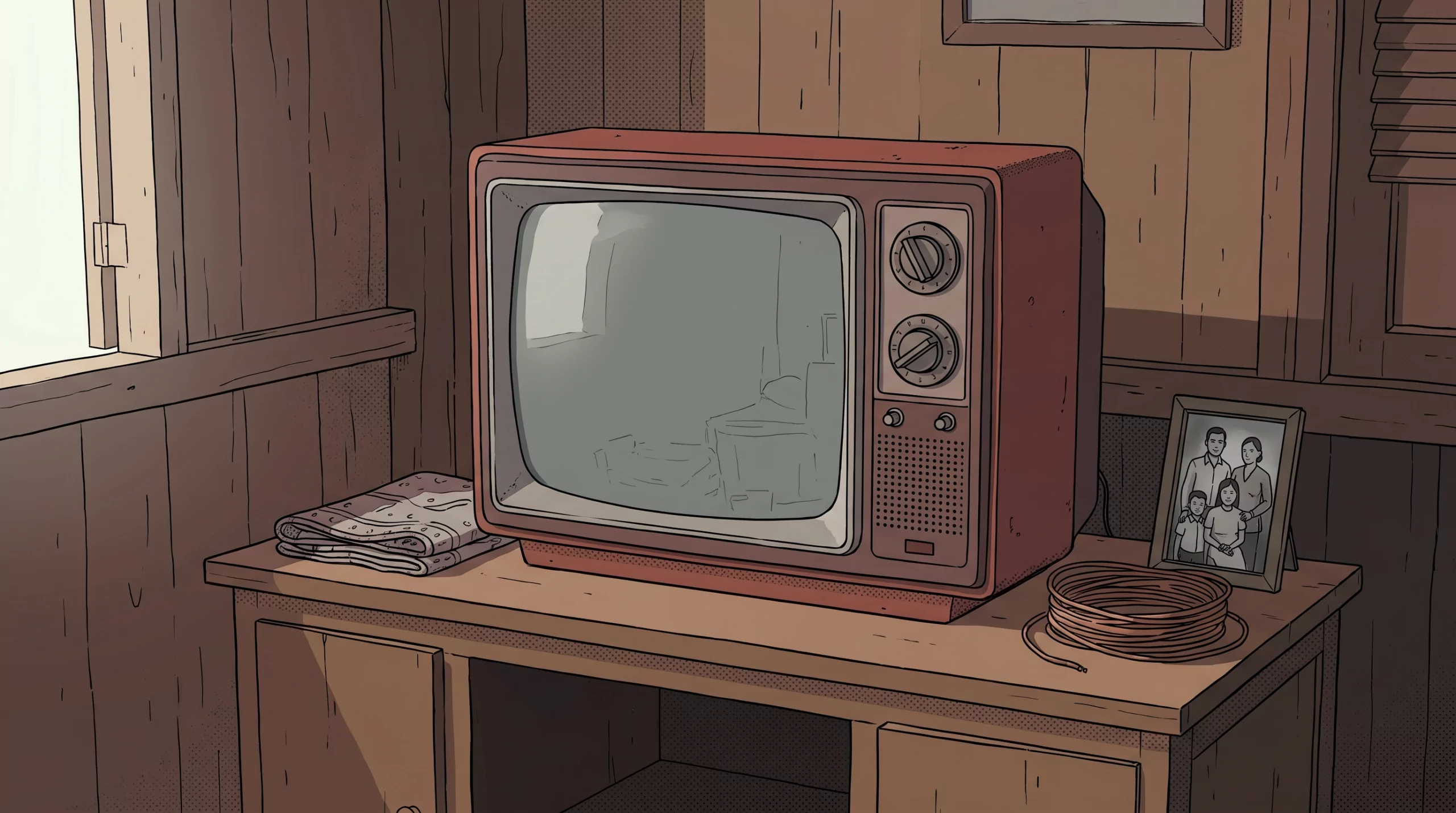
The first television lives on too – a Viettronics black-and-white set, red casing, VHF dial, a knob proudly labeled “10 Portable De Luxe”. De luxe. The brand started as a Japanese joint venture and got nationalized in 1977, which dates the set to the late seventies or early eighties: a television built by the Vietnamese state, for Vietnamese households, in the years when owning one made your house the place the whole neighborhood came to at night. The family aquired it when it was already considered antique, but it did its job. Sadly, it doesn’t work now. Jayden photographed it anyway and caught his own reflection in the dead grey screen – the present looking back into the past through a piece of glass that used to show the future.
The cabinet that has stood in the main room since before he can remember is still there too – dark lacquered hardwood, glass fronts, turned legs, an ancestor portrait kept behind the upper pane and a gold prosperity tree perched on top. In a house that never had much, the glass-fronted cabinet is where the things worth seeing live: the good dishes, the documents, the dead. It’s the family’s archive with legs.
I should say, because it would be dishonest not to: this isn’t all safely in the past tense for everyone. A family near Jayden’s, today, still measures out a hard life in money they don’t have – kids who go without, a child this year whose small body simply stopped and had to be carried hospital to hospital before it started again. The grid arrived. The struggle didn’t fully leave. Some doors out of that world are narrower than others, and not everyone gets through.
The walls he left behind
Here’s the thing I keep coming back to:
Somewhere around 2014, a teenager in that house – no art school, no studio, no private room, a kid whose home had gotten its first light bulb only a few years before he was old enough to remember wanting one – started painting on the walls. Not graffiti. The full inheritance.
On one wall, Quan Âm on her lotus, the bodhisattva of compassion, rendered so softly she could pass for a Madonna – which is not a mistake, it’s exactly how the sacred blurs and overlaps in this country, Buddhist and Catholic and folk all bleeding into one gentle figure. On another, Ông Thọ, the white-bearded god of longevity, dragon-headed staff in hand, robes and peonies and clouds, painted floor to ceiling with a confidence no one taught him. And a slender thiếu nữ in áo dài, the old ideal of feminine grace, watching the room from beside the cabinet.
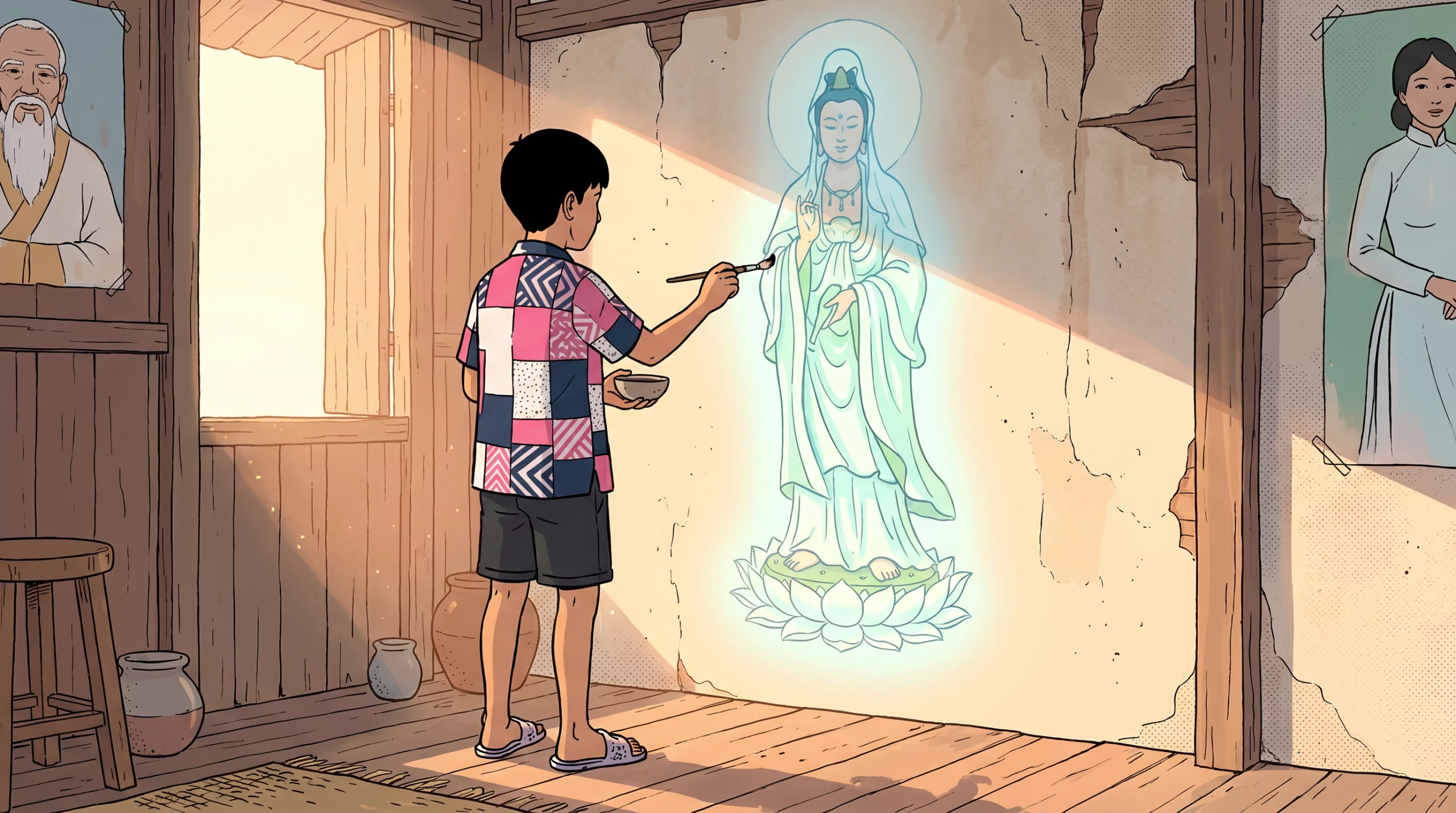
A boy with no room of his own painted his family’s entire spiritual and aesthetic world onto the only surface he was given. Compassion, longevity, beauty – the three things the culture holds highest, put up by hand in a house at the end of the water where the roads don’t reach.
Then he grew up, and he left, and he became a fashion designer in Sài Gòn.
The tape measure, the pencil, the book. The thôi nôi got it right the whole time.
The walls are still there.
Hero image: Generated with google/nano-banana-pro on July 1, 2026, at 6:20 PM.


