One Letter Apart We made boredom boring

The taxi hasn’t moved in four minutes. Green light, red light, green again, and the intersection just sits there full of motorbikes doing that slow shuffle where nobody is stopped and nobody is getting anywhere either. District 4, half past nine in the morning, aircon on full, the windshield already going soft at the edges from the heat coming off the road. It’s a GreenSM, so the car is electric and silent, which somehow makes the standing still worse; there isn’t even an engine to be annoyed at.
My phone was in my pocket and, for no particular reason, stayed there. Four minutes of nothing. And somewhere in the third one, watching a woman in a floral face mask balance a tower of egg trays on her lap while steering with the other hand, my brain handed me an entire blog post about boredom – unasked, more or less finished, like a cat dropping a dead bird on the doorstep.
That’s the whole origin story, and it’s why I’m bothering to write any of it down: four empty minutes are the last piece of machinery in my day that still works like that.
Everyone is looking down
Eight people in the elevator this morning, seven phones out; the eighth was a toddler leaning sideways into her mother’s screen for a better angle. Ground floor to the 21st takes about 40 seconds in my building in Phú Mỹ Hưng. When did 40 seconds become something a person has to survive?
It’s every age, all day. The cà phê sữa đá place on the corner at eight in the morning: four men at one metal table, four screens, no talking. The security guard downstairs playing TikTok on speaker, because headphones are for people who care what you think. Kids in school uniforms at the crossing, thumbs going while the light is red. Grandmothers on plastic stools with the phone leaned against the teapot like a tiny television.
And it isn’t a Vietnamese thing, before anyone starts – it looks identical in Munich, Sài Gòn just has better weather for watching it happen.
There’s no gap left anywhere. The line at the bank, the elevator, the ten minutes before the dentist says your name, the four minutes at a red light: all of it filled in, permanently, by something built specifically to fill it. And when the gaps go, the thing that used to grow in the gaps goes with them.
The flood, counted
Music is the extreme case. Luminate counted roughly 106,000 new tracks delivered to streaming platforms every single day in 2025, up from about 99,000 a day the year before – call it 38.7 million tracks a year, from a species that also holds down jobs. There are now 253,000,000 [253 million] tracks sitting on the platforms, of which 88% got fewer than 1,000 streams last year and 120,500,000 [120.5 million] got ten streams or fewer. Ten streams is one song, one upload, one cover image and eight strangers.
Deezer says about 90,000 fully AI-generated tracks now land on its servers daily – more than half of everything uploaded on the busiest days, up from around 10,000 a day in January 2025. They make up 1% to 3% of actual listening, and roughly 85% of those streams get flagged as fraudulent and demonetized. Machines making music for machines to pretend to listen to, with a payout button at the end: a closed loop of bullshit, and somebody inside it is getting paid.
Games are no better: Steam took 19,112 new titles in 2025, 9,327 of them finished the year with fewer than ten reviews, and 2,229 got zero. Zero reviews – nobody said a word about them, good or bad, NOTHING, not once, in a year. The first half of 2026 shipped 11,979 more, about 66 a day. American ISBN registrations jumped 32.5% in 2025 to roughly 4.17 million titles, some 3.5 million of them self-published. On YouTube around 500 hours of video go up every minute – Google’s own number, unrefreshed since 2019 and surely low by now – which is 720,000 hours a day, which is 82 years of footage manufactured every 24 hours – an absurd number that I have read four times and still can’t hold in my head.
The one category that isn’t exploding is scripted television. US series orders peaked at 759 in 2021 and have sat between 478 and 493 for three years, with streamer commissions down about 24% in the first half of 2025. Which fits the pattern rather than breaking it: the flood is worst exactly where production got cheapest.
Demand is a wall
The average person online spends 6 hours 38 minutes a day there as of April 2026, across 6.12 billion internet users, with 2 hours 21 minutes of that inside social feeds; 5.79 billion social media identities, 69.9% of everybody alive. And the number that actually matters is that it has barely moved in three years. US adults sit above 8 hours a day with digital media, and total media time grew by two minutes in 2025 with another minute forecast for 2026 – two minutes of growth, in a year. (The 13-hour media-day figures you see quoted count an hour of phone-while-TV as an hour of each, which is how a day of media gets longer than a day).
So supply is going vertical and demand is a wall, and every ugly thing downstream follows from that one collision: if the hours can’t grow, the only way to grow is to take hours off somebody else, and the only way to do that is to be more optimized than they are.
The arithmetic below is mine, done on the published numbers above, and it isn’t a statistic anyone reports. 6.12 billion people times 6.633 hours is about 40,600,000,000 [40.6 billion] hours online per day, near enough 14.8 trillion hours a year. One human life at the global life expectancy of 73 years runs to about 640,000 hours. Divide one by the other and humanity spends roughly 63,000 human lifetimes online per day. EVERY DAY. Around 23 million lifetimes a year, of which social feeds alone eat 21,300 lifetimes daily and gaming takes some 2.5 million a year; I ran that division three times because it looked wrong, and it isn’t.
Gloria Mark at UC Irvine has been measuring how long people hold a single screen before switching, and it fell from around 2.5 minutes in 2004 to about 47 seconds today, median 40. She puts two caveats on her own finding, and both matter: it measures screen-switching rather than some biological ceiling on thought, and it has been sitting at that level for five or six years. So the collapse already happened; what we’re living in is the after.
Optimized, not shorter
The average Spotify-charting song ran about three minutes flat in 2024, some 15 seconds shorter than 2023 and 30 shorter than 2019, and intros went from over 20 seconds in the eighties to roughly five. Not because taste evolved, but Spotify only pays past the 30-second mark and TikTok decides in three, so a slow atmospheric build is now a measurable financial mistake.
Hit singles averaged around three and a half minutes in the first half of 2025, and a good year for slightly longer songs doesn’t touch any of this, because length was never the claim worth defending; optimization was. The songs are still built backward from the retention curve; they just got a few seconds of runway back.
Television seasons come in tens now, cut so that episode nine ends on a cliff you can only survive by pressing the button. Games want you back tomorrow for the daily, and back Thursday for the weekly, and back before the 14th for the battle pass you already paid for, and back before the season ends for a cosmetic you’ll never look at twice – and if you skip a day the streak resets, and the game makes a small sad noise so you feel it.
None of which is a new complaint, and pretending otherwise would be embarrassing. Adorno and Horkheimer named the Kulturindustrie in 1944: standardized cultural goods, manufactured to a market, sold back as culture. So what’s actually different in 2026? The loop closed: the old culture industry guessed what would hold you and found out months later at the box office; this one measures per second per user and adjusts overnight, and it isn’t aiming at an audience, it’s aiming at you.
Many media, not all – I want that qualifier bolted on, because there’s more good work being made right now than any of us can get through. It just mostly lives outside the optimized mainstream, where nobody is A/B testing the first three seconds.
Fruchtbare Langeweile
German has two words sitting one letter apart. Fruchtbar is fruitful; furchtbar is terrible. Hang either one in front of Langeweile and you get the two kinds of boredom, separated by a single consonant, and I think that’s funny in a way only German gets to be funny.
The fruitful one I know from the inside. German countryside, about 1,200 people, where my family were the atheist transplants speaking Standard German at neighbors who had no use for either after moving there from Munich. Summer vacation, six weeks of it: school gone, friends off at the Adriatic with their parents, the comics read empty for the third time, nothing on TV until late afternoon, and outside ≈30 °C of hay-smelling nothing.
So I’d lie on the carpet in the living room and do absolutely nothing, and after a while – and this is the part nobody can sell you – the nothing would start producing: stories, terrible jokes I laughed at alone on the floor like a lunatic, whole drawings planned out before a pencil ever came near paper, elaborate plans for future-me, who was going to be extremely cool. Six weeks of nothing was a gift, and I had no idea.
I still love the pool for exactly the same reason. Up and down the lane, no display, no music, no podcast, only the blue line on the floor going past, the taste of chlorine, the sound of my own breathing, counting laps until I lose the count and stop caring about the count. That is still where half my ideas come from, and it’s where this one came from, in a car, at a red light.
The philosophers got there considerably earlier. Pascal said all of humanity’s problems come from being unable to sit quietly in a room alone, and named our escape from it divertissement. Schopenhauer had life swinging between pain and boredom like a pendulum with only two stops. Heidegger burned an entire lecture course in 1929/30 on tiefe Langeweile, deep boredom, as the mood in which being itself finally shows up – and Walter Benjamin called deep boredom the dream bird that hatches the egg of experience. Bertrand Russell wrote In Praise of Idleness in 1932. Every one of them predates television, and most predate radio.
The lab evidence is thinner than the internet version of it. The famous study is Mann and Cadman, 2014: people made to copy phone-book entries afterward produced more and stranger ideas than a control group, and the group handed the more boring task beat everybody. A later study went looking for the same effect and found no relationship at all between boredom and creativity. So the phone book is a good story on weak legs, and I’d rather rest the case on Byung-Chul Han, who comes at it from the other end: hyperattention, that rash switching between tasks and sources, has no tolerance for boredom and therefore no room for the deep idleness creative work actually runs on. Deep boredom is to the mind what sleep is to the body. We stopped sleeping.
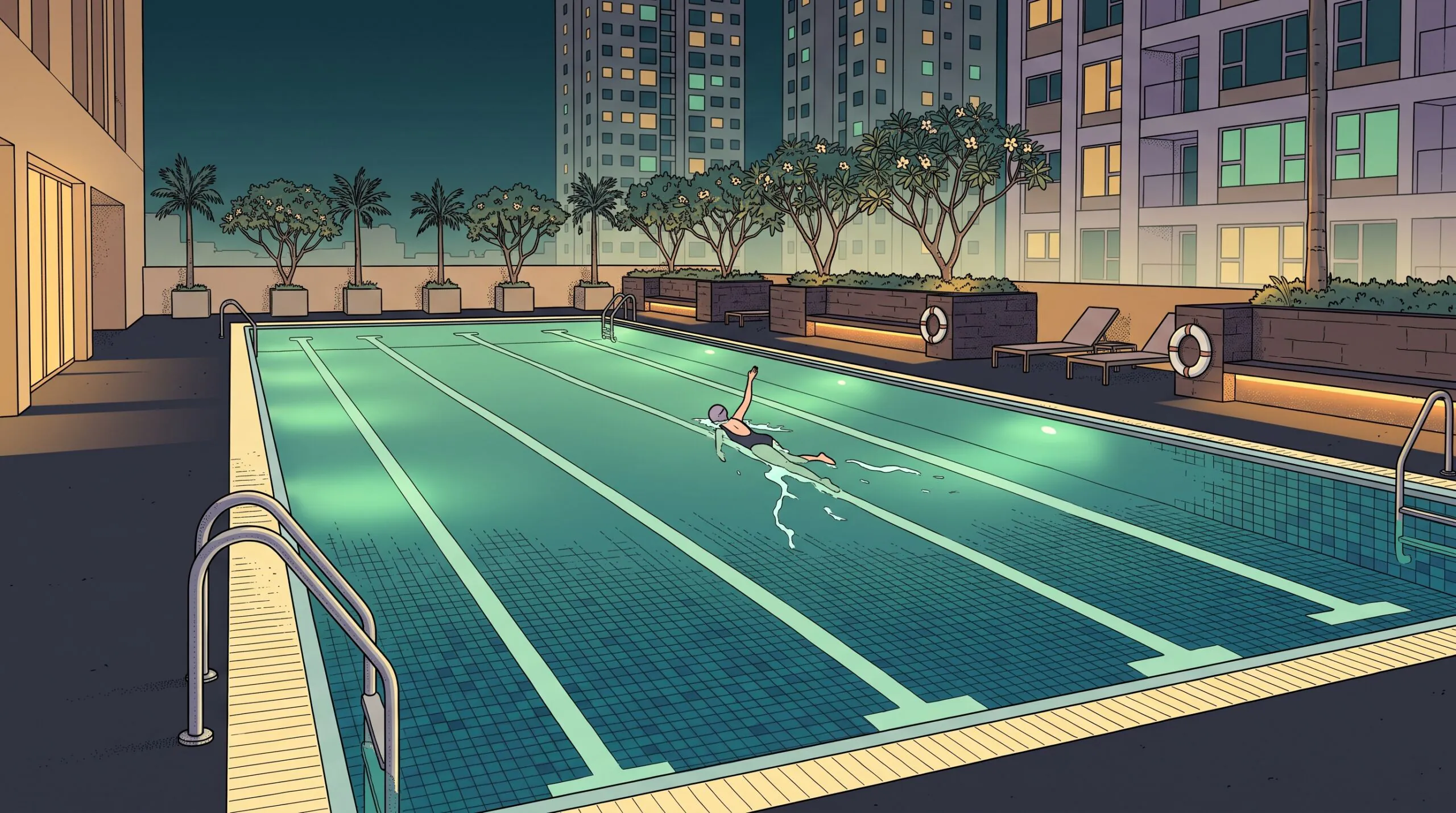
Furchtbare Langeweile
Then there’s the other one, and the trade we made was one for the other.
You’re standing in line at Circle K with four minutes to kill and nothing to do, and your brain starts making something out of the nothing. You’re standing in line at Circle K with four minutes to kill and nothing to do, and your thumb is already three swipes deep into a stranger’s kitchen renovation.
Same four minutes. The second version is where boredom stops being an empty room and turns into a treadmill: endless streams of thin, easy, over-optimized stuff, algorithmic music that all sounds like the same song wearing different clothes, a series running in binge mode on the big screen while the small screen runs TikTok, because the series on its own wasn’t enough. Boredom that never lets the mind rest and wander, and exhausts it instead. You get up from two hours of that more tired than you sat down.
Here’s what nearly killed my thesis. Reported boredom among American middle and high school students rose between 2008 and 2017 – precisely the smartphone-saturation window – and rose fastest among girls. A meta-analysis of Chinese college students found boredom proneness climbing over roughly the same stretch. So much for the death of boredom, right?
Well – no. That only lands if the claim is that boredom disappeared, and it didn’t; boredom is doing fine, it’s the metabolism that broke. What we lost is the tolerance for sitting inside it long enough for something to come out the other side, and the unfilled time it used to live in. Rising measured boredom is the loop working as designed: fill every gap, lose the capacity to sit in a gap, feel worse, reach for the thing that fills gaps.
And someone put a meter on that loop. The feed doesn’t end your boredom, it holds it at exactly the temperature where you keep scrolling, because a satisfied user closes the app – that’s the business model, stated plainly. We took the one part of the day that was free and unmetered and installed a turnstile on it, then optimized the turnstile.
I’m not standing outside this, by the way. I’ve burned entire evenings on absolute shit content while fully aware I was doing it, at 11 p.m., in bed, thumb going, brain flat. I don’t hate the feed; I’d have an easier time with all of this if I did. We feel it’s wrong and we do it anyway, because FOMO and a dozen other biases are being played like an instrument by people with much better data than we have.
Romanticizing boredom would be its own dumb move, though. In adolescents it also correlates with problematic phone use, substance use and risk-taking, so it’s a signal rather than a virtue – and the signal used to point somewhere; now it points at an app.
Where the hours came from
I assumed the time was cannibalized from other media – and some of it was. The American Time Use Survey has been asking since 2003, though, and it says the rest came from somewhere else entirely.
In-person socializing fell from 45 to 35 minutes a day over twenty years. Among 15-to-24s it went from about 60 to about 35 – the lowest in the survey’s 21-year run, some 26 minutes a day less than 2003, which one analysis converts into 158 hours a year of not seeing anybody. Only 30% of Americans did any face-to-face socializing on an average day in 2024, down from 38% in 2014. Between 2003 and 2020, time with friends fell 20 hours a month, companionship fell 14, and time alone rose 24. Time spent at home went up 1 hour 39 minutes a day between 2003 and 2022, and the researcher notes that shifts in what people actually do explain only a small slice of it.
So some of it came out of television, and some came out of the pub, the walk, the friend’s kitchen – and some out of the waiting room with nothing in it, which nobody mourns.
The shimmer, and what it costs
There’s a counter-movement: 47% of under-30s in the US say they’re trying to cut screen time against 32% of everyone older, 68% of Gen Z have taken a social media break for their mental health, and 81% of Gen Z adults wish they could disconnect more easily. Phone-free bars, pouches at schools and weddings, Month Offline, Dumb.co selling flip phones to people who could afford any phone on earth, r/nosurf past 250,000 members – a support group the size of a mid-sized city.
The counterweight is that wanting it isn’t doing it. 76% of Gen Z say they spend too much time on their phones, the highest of any generation, while US phone use climbed to 5 hours 16 minutes a day, up 14% on 2024. CDC survey data puts 50.4% of teens over four hours of daily screen time with schoolwork excluded.
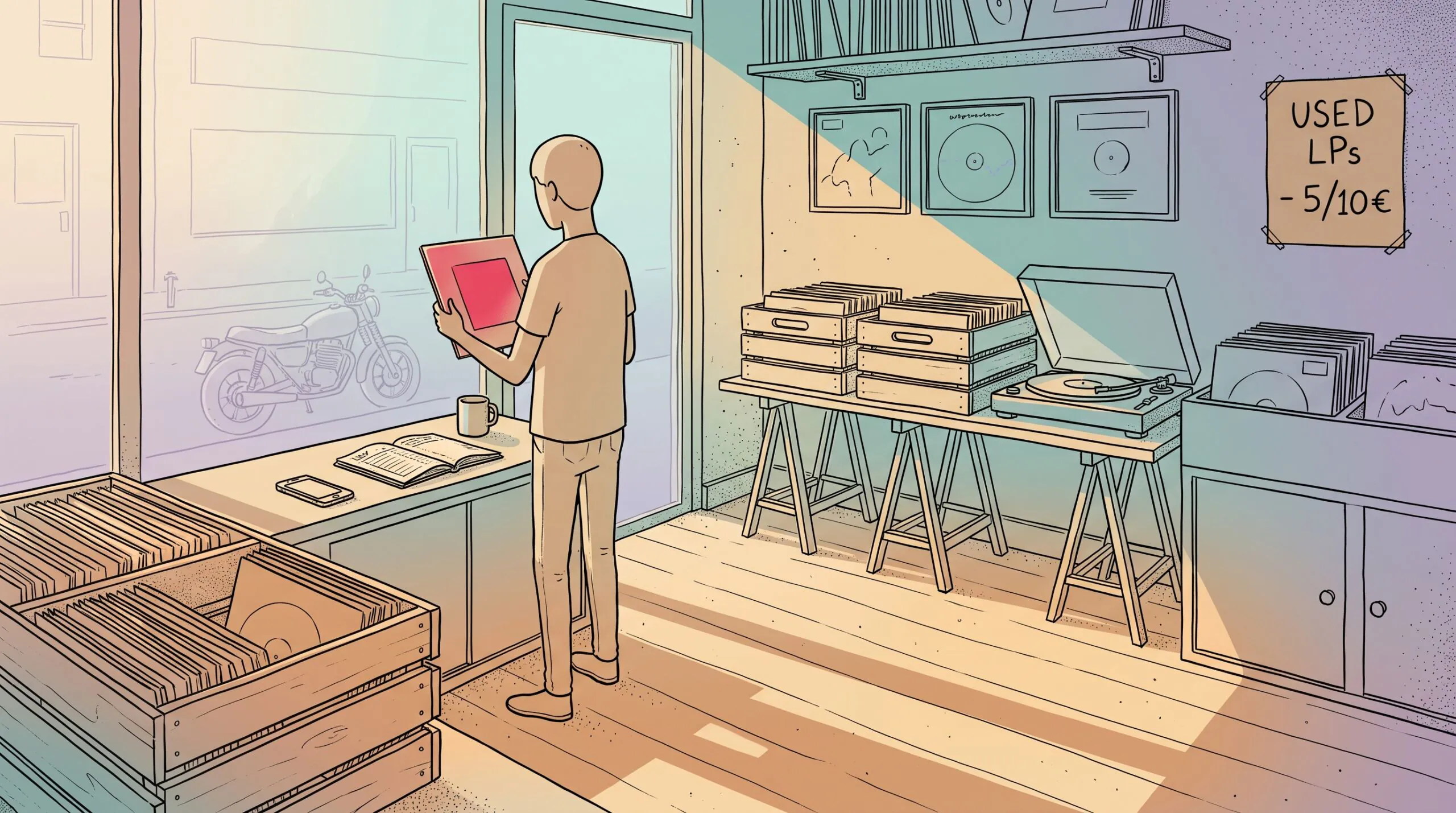
Physical media is the strongest piece of the shimmer, and the most beautiful to watch. US recorded music revenue hit 6 billion USD in the first half of 2026, up 6.9%; physical formats grew 25.9%, vinyl 17.7%, and CDs – CDs! – jumped 58.6% in dollars to 171.1 million USD on 17.5 million units against 12 million a year earlier, after shrinking 22% the year before that. Vinyl booked its 19th consecutive year of growth in 2025, 4K Blu-ray sales rose 12%, and total US physical spend fell only 9.3% after a 23.4% collapse the previous year. Two things keep it honest, though: the RIAA is explicit that every category grew, streaming included, so this is addition rather than defection – and a good share of the vinyl going to young collectors never gets played. The object is the point.
Then there’s the certification business, which got big faster than I expected. The Authors Guild opened its Human Authored registry to all US authors in March 2026, 10 USD per title if you’re not a member, identity check included. iHeartMedia has its DJs say “Guaranteed Human” during the hourly call-sign announcement, after finding that 90% of their audience wants human-made media. Spotify shipped its own verification badges. The EU AI Act’s labeling obligations land this year. In a survey of 144 music supervisors and filmmakers, 97% want to know whether music is AI-generated and 49% will only work with human-made tracks. Sony asked platforms to pull more than 135,000 AI tracks impersonating its artists, and the Velvet Sundown ran all the way to a million monthly Spotify listeners before admitting what it was.
And then the punchline: across three studies, people prefer AI-generated music – right up until they’re told it’s AI. Listeners also engage less deeply with music labeled AI even when a human made it, because they read less intention into it, and Deezer’s own survey found 97% of listeners can’t tell the difference blind. So the premium isn’t on anything audible, it’s on the label; the same reason supermarket jam tastes better out of a jar with a gingham lid and handwriting on the front.
The antidote arrived as a product category, sold by the same logic that built the problem and priced accordingly. Buying your way out of the flood is not the same act as being bored. It’s a good sign, it’s for sale, and both of those are true at once.
I’m in the flood too
I orchestrate AI models for a living. The images on the page above came out of a prompt I wrote and a model I don’t own. And I’ve just added several thousand more words to a pile I spent several thousand words calling a pile, which nobody was waiting for. The only clean part is the beginning: the idea showed up because I was stuck in traffic with nothing to do, and everything after that was work.
The light went green eventually. The driver took the right, I got to the office late, and yes, at some point in the second half of that ride I took the phone out like everybody else – the egg-tray woman was long gone and I’d run out of things to look at.
So at the next red light the phone stays in my pocket. No pouch, no retreat, no 10 USD seal of humanity, just me and the egg trays and a brain doing whatever it wants with the gap; the only media I still get for free.
We made boredom boring. I’d like the fruitful kind back, please.