
A Pearl Resurfaces The $137 Million Game I Couldn’t Play

Somewhere around 2002 or 2003, I hauled 15 kilograms of PC tower, ack-breaking CRT monitor, keyboard + mouse, and bags full of ripped games across town to a friend’s house. LAN party. The kind that lasted three to five days, where friendships were forged between rounds of CS 1.6, Age of Empires 2, Stronghold Crusader, UT 2003, and Warcraft 3 – and where the actual LAN part was a pain in the ass that ate the first hours of every gathering. This was the hub era, before switches made networking smooth(er). Windows XP. Manual IP configuration. Retry, restart, bluescreen, frustration, retry, restart, it works (for some minutes), someone else’s doesn’t, restart. Every prejudice about LAN parties was true: too much Coke, piles of self-made pizza from my friend’s pizzeria, chip bags everywhere, the ambient hum of eight PCs turning a living room into a sauna-like server rack with, well, decent body odor.
But LAN parties weren’t just about gaming. They were data exchange events. Hundreds of Gigabytes of ripped games, ripped movies, ripped music, por…adult entertainment, wallpapers – everything migrated from hard drive to hard drive through crossed ethernet cables. And at some point during one of these raids through a friend’s file system, I found it: Final Fantasy: The Spirits Within. Copied it. Burned it to CD-ROM (thanks, Nero Burning ROM). It joined an private collection of hundreds of movies, most of them questionable quality – cam recordings where you could hear the cinema audience coughing, people walking through the frame. But nobody gave a fuck – the currency was quantity, not quality.
I heard about the movie from gaming magazine CDs and DVDs already. GameStar, Computer Bild Spiele, sometimes PC Games and Bravo Screenfun. Those bundled discs were your trailer delivery system in an era before YouTube existed and before I had internet (which, for the record, didn’t happen until 2004, and even then it was dial-up until 2008 because the infrastructure in my hometown couldn’t support anything better). So Final Fantasy – a famous game franchise name, computer graphics that looked like pre-rendered in-game AAA cutscenes but somehow more, science fiction, mystery. I needed to see this.
I brought the burned CD to another friend’s house. He had a huge, bulky plasma TV in their living room, connected to a Xbox – the perfect stage. We bought a couple of Berentzen alcopops bottles at the local gas station and started the movie well after midnight, already having burned through several other films including Blade. No light except the moody TV screen. A good friend, cheap alcohol, late-night hype, and a new movie. What an experience.
Well, we didn’t fully understand the story. Partly the alcohol. Partly the hour. Partly because the movie was in English and we were German teenagers whose language skills were still mostly built from gaming and song lyrics. We were excited regardless. Completely, unreservedly satisfied.
The Spirits Within felt like a game I wanted to play. Not a movie I wanted to watch – a game. An impossibly beautiful, unplayable game.
In the days that followed, I returned to it repeatedly, studying its graphics as if they were important homework. The faces. The hair. The textures. The light on skin. The shaders. I wanted more movies like this back then, but I could never find them. Unfortunately, most of my friends had never heard of it and weren’t interested. There was nobody to talk about it with in this prehistoric offline world. Slowly and inevitably, I forgot about it entirely.
Twenty-Five Years Later, on a Couch in Phú Mỹ Hưng
Fast forward to 2026. I’m scrolling Netflix at home in Sài Gòn. Jayden’s next to me, along with a pile of self-made orange cake and another pile… mountain of spaghetti carbonara. And there she is again – Aki Ross, staring from the thumbnail with those almost-real, not-quite-right eyes. Final Fantasy: The Spirits Within. The “wait, I know this movie” moment hit like a sensory flashback: the plasma TV, the alcopops, and even the blue glow of a flickering CRT monitor in a LAN party room full of zombying or sleeping friends with their heads hanging backward over chair backs.
This time, though, I had context. I knew what went into making this thing. I knew the history, the technology, the financial catastrophe, the human cost. And watching it now, with all of that, made it a different experience. Not because the film changed, but because I did.
The irony is thick enough to render in 4K: what was once mind-blowing CGI now looks like real-time game graphics from about 2014. Maybe 2019 on a bad day. And yet there’s something in its heart that doesn’t come from the quality of its polygons. A certain brilliance that you only see when you understand the context of what these movie guys were trying to do and what it cost them.
What a time to be alive. Both then and now.
Final Fantasy: The Spirits Within Trailer
What This Movie Actually Is (and Isn’t)
Let’s start at the beginning, because the end is a long way off: The Spirits Within released July 11, 2001. Directed by Hironobu Sakaguchi – the creator of the Final Fantasy game series – and co-directed by Motonori Sakakibara, who’d previously directed the cutscenes for Final Fantasy 7. The voice cast reads like that of a mid-budget action thriller: Ming-Na Wen as Aki Ross, Alec Baldwin, Donald Sutherland, James Woods, Steve Buscemi, Ving Rhames, Peri Gilpin. The kind of cast you’d put in a live-action movie, not an animated film – Square was making serious cinema.
That cast detail matters more than it seems. Ming-Na Wen had just voiced Mulan three years earlier. She’d go on to become Fennec Shand in The Mandalorian and The Book of Boba Fett. Disney princess, virtual actress, Star Wars bounty hunter – that’s a career arc nobody could’ve predicted from a 2001 CGI film. And here’s the weird part: she only voiced Aki, the movies’ main protagonist. The motion capture was performed by sombody else – Tori Eldridge, an actress and martial artist. Voice and body, split between two people. In 2001, that split was a technical challenge – by the time Andy Serkis played Gollum, the whole point of performance capture was unifying them. The Spirits Within was stuck in the gap between two eras of filmmaking; the future and the past.
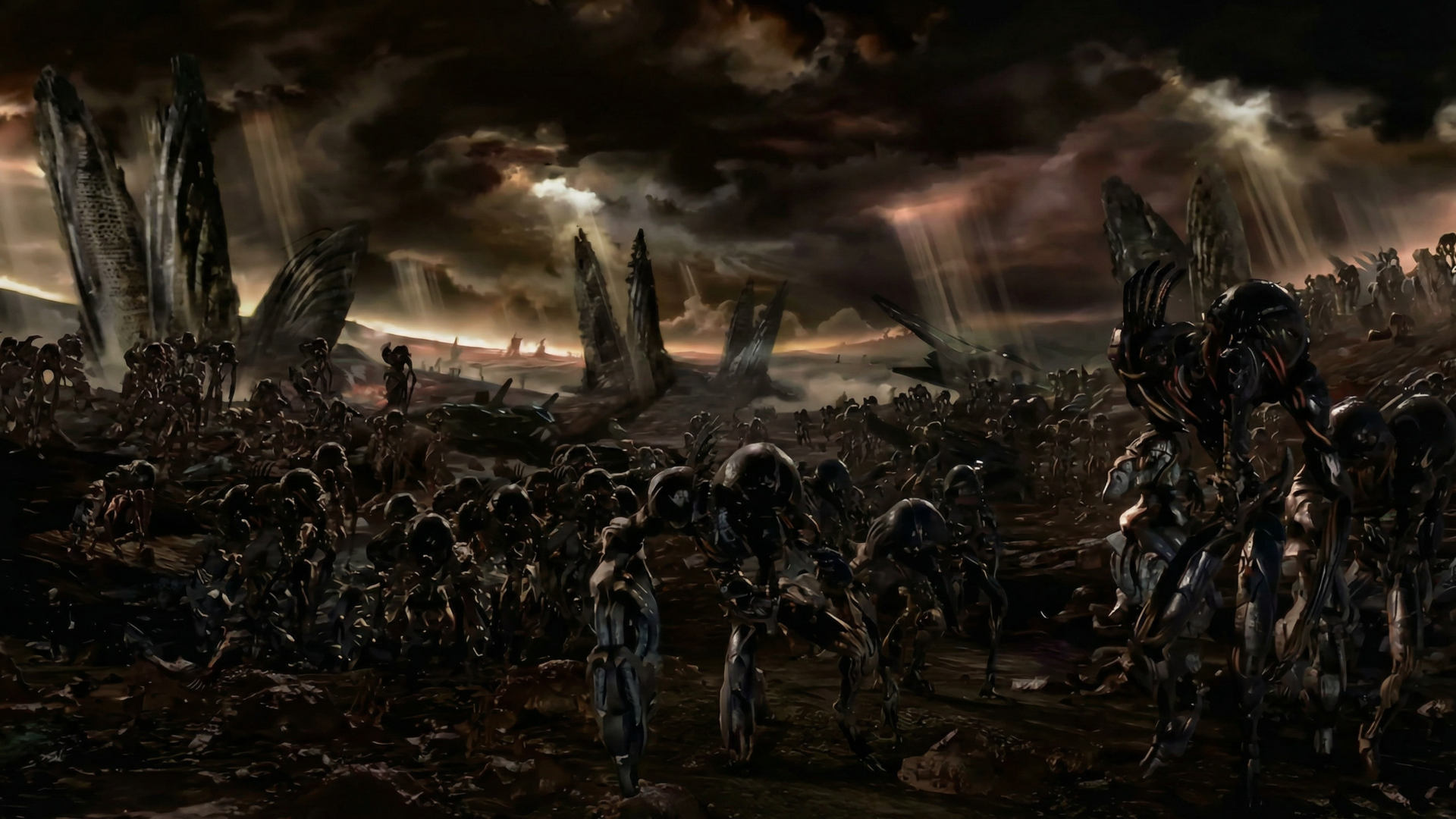
Speaking of future: the plot is set in 2065. Earth has been invaded by Phantoms, transparent alien spirits that consume Gaia – the life force of living beings – on contact. The remaining survivors live in densly populated barrier cities. Scientist Dr. Aki Ross and her mentor Dr. Sid believe they can neutralize the Phantoms by collecting eight spirit wavelengths that, when combined, cancel out the Phantom frequency – minus and minus equals plus. General Hein, who looks 150% mean on purpose, wants to use the Zeus Space Cannon instead to kick the Phantoms’ asses, which would risk annihilating Earth’s own Gaia. It’s standard save-the-world fare, elevated by a philosophical underpinning that most viewers lacked the patience to appreciate… the plot is not exactly Oscar-worthy in terms of creativity.
And it’s not really Final Fantasy. Not in the way fans expected: no swords, no magic, no medieval fantasy, no steampunk airships. The connection is thematic, not narrative: the Gaia concept is a direct descendant of Final Fantasy 7’s Lifestream. There’s a character named Sid (spelled with an S, not a C, but every FF has a Cid – it’s tradition). General Hein is named after an antagonist from Final Fantasy 3. Aki wears a chocobo-print pajama shirt in one scene – the most direct easter egg in the entire film. Consequently, Sakaguchi’s working title was simply Gaia. He saw the movie as another entry in an anthology franchise where each installment tells a standalone story in a new world. But the Final Fantasy branding brought valuable attention – and expectations the film was never designed to meet. It was a double-edged sword forged in marketing rather than narrative.
Composed by Elliot Goldenthal and performed by the London Symphony Orchestra, the score is worthy of a Hollywood blockbuster – because it was intended for one. Sakaguchi chose Goldenthal over Nobuo Uematsu, the composer who’d scored every Final Fantasy game up to that point. Controversial with fans who’d never heard of Goldenthal, but it was another signal: this was a MOVIE, not a game. The credits song, The Dream Within – composed by Goldenthal, performed by Lara Fabian – ended up on my playlist after the rewatch. Twenty-five years late, but it got there. Pretty neat.
The Technical Insanity
The Spirits Within holds a Guinness World Record for being the first photorealistic computer-animated film. No real template existed. No one had done this before. Every other CGI animated film of the era – Toy Story, Shrek, Monsters, Inc., A Bug’s Life – deliberately avoided photorealistic humans. The industry wisdom was simple: if you can’t make something not look like plastic, use characters that are actually made of plastic (or fur, or scales, or anything non-human). Sakaguchi looked at that wisdom and said no.
Square set up Square Pictures in Honolulu, Hawaii – a neutral ground between Japanese and American talent pools, far from the creative interference of Los Angeles. Creating the studio cost 46 million USD, and running it roughly 1.5 million USD per month. The motion capture stage sat at the Hawaii Film Studio at the foot of Diamond Head – the same stage used for Hawaii Five-O, Magnum PI, and Jurassic Park. About 200 people worked on the film for four years, totaling to about 120 person-years of combined labor.
The first 18 months of production were spent building software before any real animation could begin. SQFlesh, a proprietary system that integrated with Autodesk Maya and Pixar’s RenderMan, was designed for one purpose: to make digital skin look real. The render farm consisted of 960 Pentium III 933 MHz workstations running Linux. 960. For context, the Xbox – which launched four months after this movie hit theaters – used a single Pentium III. The Spirits Within’s render farm was essentially 960 Xboxes, crunching and melting for months, to produce what a modern GPU handles in real-time.
They stored 15 terabytes of data. In 2001. The first 1 TB consumer HDD didn’t ship until 2007. Back then, consumer drives measured in single-digit gigabytes (and games in the lower hundreds of MB). Let those numbers sink in for a moment.
The rendering stats are staggering. 141,964 total frames. Render time per frame ranged from 15 minutes to over 7 hours, with an average of about 90 minutes. 1,327 shots, each composed of 9 to 498 composite layers. In the early production phase – around 1998 – the team produced approximately one second of finished film per day (1 FPD). Aki Ross’s character model bore 60,000 individually animated and rendered strands of hair. Rendering each frame of her took about 1.5 hours. Her base model ran at roughly 400,000 polygons. For comparison, Final Fantasy X characters, which ran on the PlayStation 2 – the most powerful console in the world at the time and considered one the best-looking game ever made – had maybe a few thousand polygons per character.
The same company released both. In the same year. And Sakaguchi himself said that there was no point in making a game adaptation of The Spirits Within because the visual downgrade would be too extreme.
The Uncanny Valley – and How We Got Better at Seeing It
During the rewatch, I noticed something I couldn’t have named in 2002: the faces are off. Not in a bad way. Not ugly. Just… wrong in a way that’s hard to pinpoint until you know what you’re looking for.
In 2001, this sensation wasn’t part of the mainstream vocabulary. Masahiro Mori coined the term uncanny valley in 1970 for robotics, but it hadn’t become part of everyday film criticism yet. The Spirits Within is arguably the movie that dragged the concept into pop culture consciousness: critics and audiences could articulate that something felt just wrong about the characters’ expressions, but they didn’t have the words for it. The closer Square got to realism without quite achieving it, the more unsettling the gap became.
What’s fascinating is that the uncanny valley hits harder now than it did then. It’s counterintuitive; you’d expect old CGI to simply appear dated, like the early humans in Toy Story, who appear quaint rather than creepy (okay, bad example – they appear both ways). But our radar for detecting the uncanny has been sharpened by 25 years of Photoshop Philipp’s creations, deepfakes, AI-generated faces, virtual influencers, and increasingly photorealistic NPCs. We’re trained to spot the almost-human in a way 2001 audiences weren’t. The same faces that felt revolutionary then now feel subtly unsettling – not because the rendering has worsened, but because our eyes have become more discerning.
But back in 2002/2003, as a gamer, I perceived it differently than the average moviegoer would have. A film critic walked in calibrating against real human actors and found the faces lacking. I, on the other hand, walked in calibrating against all sorts of game cutscenes and found the faces incredible. Same faces, different reference frame, completely different experience. The “game I wanted to play” feeling wasn’t an anomaly – it was my brain processing the movie through the only visual framework I had for this level of CGI.
(Sidenote on uncanny valleys and our brilliant ability to make things worse by trying to improve them – a concept the Germans call Verschlimmbesserung, and yes, that’s a real word and no, English doesn’t have a proper equivalent. NVIDIA just announced DLSS 5, which uses generative AI to “improve” game environments and characters’ faces in real-time. The result? Faces that were intentionally designed to look tired, worn, and human are transformed into smooth, poreless, instagramy versions of themselves. Within minutes, gamers called it an “AI slop filter”. 25 years after Square spent 137 million USD trying to bridge the uncanny valley from one direction, NVIDIA has managed to create a whole new uncanny valley from the opposite direction. Full circle).
This is also why Pixar and DreamWorks stuck to cartoon aesthetics and why, four years later, Final Fantasy 7: Advent Children chose a stylized look over photorealism. Square’s Visual Works team learned from Square Pictures’ mistakes and emphasized the art as well as the technology. The Spirits Within proved the thesis that photorealism is a trap – not because it’s impossible, but because the final 5% is where all the horror lies, and there’s always another 5% around the corner.
The People Behind the Pixels
The technical story is already impressive – and the human story behind it is even better: Hironobu Sakaguchi named the protagonist Aki after his mother, who passed away in a house fire while he was working on Final Fantasy 3 around 1989 or 1990. Sakaguchi was in his mid-twenties at the time. After hearing about the fire over the phone, he drove through the night, and arrived to find his family home already reduced to a smoldering ruin. His grief not only informed The Spirits Within, but also reshaped the entire Final Fantasy franchise. His reflections on what happens to the spirit after death became the Lifestream in Final Fantasy 7. They became the Gaia hypothesis in The Spirits Within. He spent a decade of turning the same loss over and over in his mind and processing it through game after game, until he finally tried to make a movie about it. It cost 137 million USD to express what he’d been trying to say since he was in his twenties and stood in front of ashes. That’s the actual spirit within.
Then there’s Remington Scott, the motion capture director. His oorigin story sounds like it was written for a movie itself: He was playing Final Fantasy 7 at home when producer Jun Aida called him. He paused the game to pick up the phone, and flew to Hawaii for what he thought was a consulting gig shortly after. It wasn’t. On his first day, the team captured only about 10 seconds of usable motion because there was so much discussion – the motion mocap team was recording raw point clouds and handing them to animators, who had to manually keyframe puppets in Maya. Months of work per scene! Scott saw this, and rattled off a list of improvements. Aida said “You’re hired!” Scott didn’t even know the salary, but the decision was made: “Go home, pack your bags, and be here in two days”. That’s the lore.
He completely overhauled the pipeline by building a biomechanical solver inside Maya. This new solver could apply captured motion data in hours instead of the 1.5 months it had previously taken. He didn’t just improve the workflow; he laid the technical groundwork that would transform cinema. But we’ll get to that…
The Bomb, the Actress, and the Aftermath
Opening weekend: 11.4 million USD. Far below expectations. The Spirits Within got beaten by Cats & Dogs, The Score, and Legally Blonde. With production costs of 137 million USD, four years of work, and 960 Pentium IIIs, not to mention 60,000 individually rendered hair strands, you lose to a movie about talking pets. Remington Scott found out on the beach on opening Sunday – the following Monday must have been a terrible day indeed. Total worldwide gross: 85.1 million USD. Estimated actual loss: 80-95 million USD when factoring in marketing and theater splits.
Part of the problem was the marketing. Columbia Pictures was in charge of distribution, but they didn’t know what to do with a movie that didn’t star any real people. “Who’s starring in this movie?” “Umm, no one! It’s… computer-generated humans.” “So how do we market this?”. Their response? They put it on… Cartoon Network. Yepp. And they also made vague posters of NPC-like faces nobody recognized. As Scott put it: “There was not an awareness when the movie came out of what this was.”
But before the bomb, though, there was Aki Ross – the world’s first photorealistic virtual actress. She wasn’t just a character in one movie; she was intended to be a reusable digital performer for multiple films in different roles. Her story is a bit similar to Lara Croft’s, but with more polygons. In 2001, American men’s magazine Maxim ranked Aki #87 on their Hot 100 list – the first fictional woman ever to be included on such a list (sorry, Ms. Croft). She appeared on the cover wearing a purple bikini (in June 1997, British magazine The Face featured Lara Croft on its cover too, making her the first virtual celebrity to appear on a magazine). Entertainment Weekly named her an “It Girl” (would have been even more meta to call her an “IT Girl”). The DVD extras included bikini photos – because, of course, they did. In 2001, sexism was an everyday occurrence, and even reputable media websites had cringe-worthy “babe of the week” galleries (looking at you, GameStar).
Hollywood was spooked. Tom Hanks publicly criticized the film for threatening working actors. Steven Spielberg also voiced his concerns. The irony? Within a few years, Hanks starred in The Polar Express as five different digital characters, in what was marketed as “the first performance capture movie ever”. He went from critic to convert in under three years. Hollywood’s relationship with virtual characters has always been more about control of the technology than principles – same story, different technology today.
In October 2001, Square Pictures announced its shutdown, citing extraordinary losses of approximately 115 million USD. The studio officially closed on March 31, 2002, putting 125 employees out of work. Recruiters from ILM and Weta Digital descended on Honolulu like vultures looking for talent. Sakaguchi and other senior executives resigned from Square; and the company suffered its first-ever financial loss. The planned merger with Enix, which had been in talks since 2000, was delayed because Enix hesitated to merge with a company that had just burned that much money. Final Fantasy 10 and Kingdom Hearts kept Square alive long enough for the merger to finally go through on April 1, 2003. Square as an independent entity ceased to exist.
Sakaguchi spent the next three years at his home in Hawaii, which he described as “doing nothing”, and he felt guilty about his lack of contributions to the industry. He eventually found the motivation to return to game development through conversations with two old collaborators: Akira Toriyama, the creator of Dragon Ball with whom he’d worked on Chrono Trigger, and manga artist Takehiko Inoue, known for Slam Dunk and Vagabond. It wasn’t an intervention. Just creative conversations with friends that reminded him why he started creating immersive things in the first place. Those talks resulted in Blue Dragon and Lost Odyssey at Mistwalker, the studio Sakaguchi founded in 2004. Tragically, Toriyama passed away in March 2024 – the man who helped pull Sakaguchi back into creation is now gone. These things don’t wrap up neatly.
The Legacy That Outlived the Failure
Is there a happy Ending? Well… when Square Pictures closed, Remington Scott went directly from Honolulu to New Zealand. Peter Jackson had personally called him to bring Gollum to life in The Lord of the Rings: The Two Towers. At Weta, Scott encountered the same problem he had faced before: animators weren’t using Andy Serkis’s actual movements, but rather, they were animating Gollum based on their own ideas of how he should look and feel. Scott fixed the pipeline, again. The Two Towers won the Academy Award for Best Visual Effects. Scott then worked on Spider-Man 2 and 3, Superman Returns, and Watchmen. The pipeline that Square built in Hawaii – the one that bankrupted the company – became the foundation of modern performance capture. The Spirits Within → Gollum → The Polar Express → Avatar → basically EVERY modern MCU movie with digital characters. It’s a straight line from failure to industry standard. It was a success, but behind the curtain.
In 2011, BioWare art director Derek Watts confirmed that The Spirits Within was a major design influence on Mass Effect. This includes the GUIs, the ship designs (early Normandy concepts were pulled directly from the film), attack helicopters, and holographic interfaces. Once you know, you can’t unsee it – the entire military sci-fi aesthetic of one of gaming’s most beloved franchises traces back to a movie most gamers have never seen.
And then there’s the meta joke that only Square Enix could pull off: In 2015’s Life is Strange, protagonist Max Caulfield calls The Spirits Within “one of the best sci-fi films ever made”. The company that nearly destroyed itself making the film released a game in which a character defends it. I don’t know if that’s corporate self-awareness or cosmic irony, but either way – I agree with her (Life is Strange is a superb game btw, I implore you to give it a shot!).
Final Fantasy: The Spirits Within – CGI making of (2001)
What a Time to Be Alive
As the credits rolled and Lara Fabian sang “The Dream Within” over Jayden’s body while we lay on the couch in Phú Mỹ Hưng, I thought about the German teenager who watched this movie on a plasma TV after midnight with Berentzen, only vaguely understanding what he was seeing. He thought it was a game. In a sense, he was right – just not in the way he meant.
The Spirits Within was a game. It was a 137 million USD gamble by a grieving man who had spent a decade trying to understand death through the only medium he knew. He bet his company, his career, and his reputation on a new medium with which he was unfamiliar. The gamble failed. The technology survived. And the pipeline he funded became the invisible infrastructure of modern cinema. The movie his company nearly died for quietly shaped the visual language of franchises worth billions to trillions.
American film critic and author Roger Ebert gave the movie 3.5 out of 4 stars, calling it a technical milestone. He wasn’t wrong. He just didn’t know how DAMN RIGHT he was.
It’s on Netflix rn. If you haven’t seen it yet, now’s the time – it’s turning 25 this July. And if you have seen it, watch it again! Not for the story, which is fine. Not for the graphics, which are slightly dated. Watch it for the ambition. Watch it for the sheer, unreasonable, beautiful insanity of 200 people in Hawaii spending four years trying to convince you that a polygonal woman was real. Technically, they failed due to hardware limitations. Yet they succeeded – and changed everything.
And if you find yourself thinking that it looks like a game you want to play – congratulations! You’re seeing it correctly.
Hero image: Captured frame from Final Fantasy: The Spirit Within. It was visually extended on April 11, 2026, at 11:11 PM with the help of google/nano-banana-pro.