
Living Inside the Game $100 billion and an excavator for an alarm clock
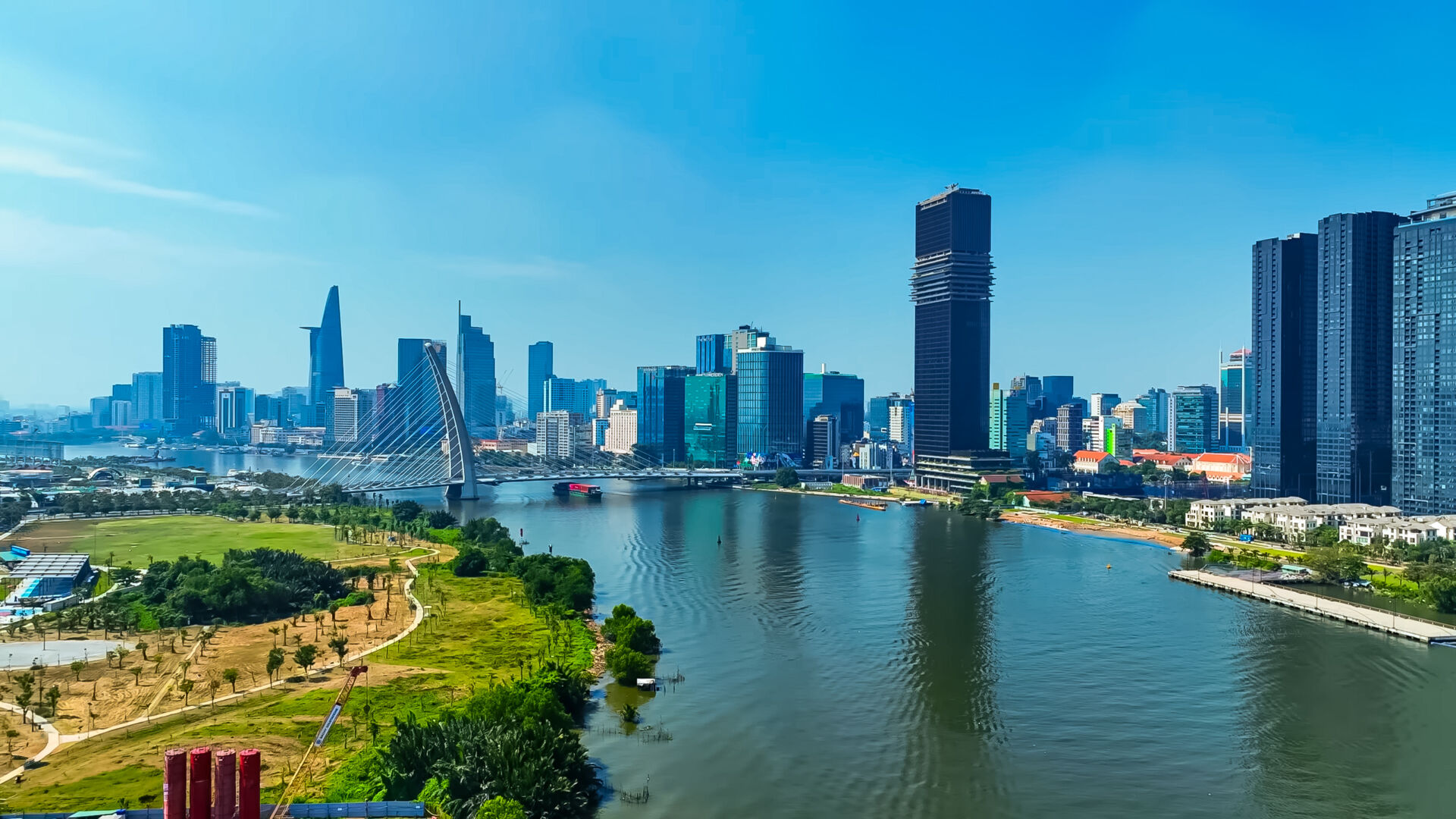

It’s 5:47 in the morning. I haven’t set an alarm in years – I don’t need one. The excavator parked roughly 200 meters from my bedroom window handles that. It starts every day around the same time, joined shortly after by the rhythmic hammering of pile drivers, the beeping of trucks reversing, and the low hum of concrete mixers that has become the ambient soundtrack of life in Phú Mỹ Hưng. Not one construction site. Several. All running simultaneously, all day, all night, all weekend long. And that’s just what I can see from my balcony.
The thing is – I love it.
The SimCity pipeline
I’ve been fascinated with cities and infrastructure for as long as I can remember. Some kids had dinosaur phases. I had a how does this city work and what would I do differently phase that never ended. It started with a DOS prompt and a game called SimCity – the original, the one where you couldn’t rotate the map, power lines were a genuine logistical headache, and every once in a while you unleashed a Godzilla-like monster on the city. Then came SimCity 2000, SimCity 3000, SimCity 4, Cities: Skylines. Then the city builders that care about the humans inside the city: The Settlers II in 1996 (at least somehoe), every Anno title, Caesar III, Pharaoh, Banished, Farthest Frontier, Ostriv, Foundation. Basically every city builder ever released has been at least evaluated, if not played for dozens or hundreds of hours by me. And let’s not even start on Minecraft, where I literally built entire metropolises – above the clouds, on the ground, below the ground – complete with highway interchanges, metro systems, and bridges that didn’t need to exist but felt damn right.
When I was about to finish school, I seriously considered becoming an architect. I played around with professional CAD tools for interior and exterior design, building floor plans and facades, trying to create a foundation for what I thought would be my career. That turned out differently – I became a software engineer instead. But the fascination never left. It just found different outlets: creating hundreds of detailed levels for shooters and strategy games, obsessing over SkyscraperCity forums, and following YouTube channels like The B1M, MegaBuilds, and – since moving to Sài Gòn – local channels like Hà Viễn Phương TV that document what’s happening on the ground here.
And what’s happening on the ground here is, frankly, insane.
(One of the) biggest construction sites on Earth
Ho Chi Minh City – the city I’ve called home since 2018 – is currently attempting to compress roughly 15 years of infrastructure catch-up into a 5-year sprint. Metro lines, highways, bridges, a brand new international airport, an entire new CBD built from scratch, a $10 billion artificial island city, a 70,000-seat stadium, a national high-speed rail network, a deep-sea transshipment port competing with Singapore – all of it breaking ground within months of each other. The combined investment of major projects currently active or breaking ground exceeds $100 billion. For a city of 14+ million people (22.5+ million in the metropolitan area).
If you come from an industrialized Western country – Germany, the US, France, the UK, Japan, pick one – that number might not immediately register. So let me provide context from my home country: Berlin’s new airport (BER) took 14 years to build, went roughly €4 billion over budget, and became a national punchline. Stuttgart’s train station renovation (Stuttgart 21) has been under construction since 2010, is still not operational in 2026, and has quadrupled its original budget. But this isn’t just a German problem. The same pattern plays out across the industrialized world: the US can’t build high-speed rail despite decades of talk, France’s Grand Paris Express is years behind schedule, the UK’s HS2 has been descoped to near-irrelevance while tripling in cost. The pattern is consistent: mature democracies with complex regulatory frameworks, extensive environmental reviews, individual participation rights (I want $infrastructure, but not in front of my garden!), high labor and material costs, and multi-layered approval processes produce infrastructure at a pace that is, to put it diplomatically, deliberate.
Growing economies operate differently. Lower labor and material costs, streamlined approvals, centralized decision-making, and a political system oriented toward rapid development create an environment where things simply happen faster. Vietnam is not unique in this – China, India, Indonesia, Saudi Arabia all share variations of this dynamic. But Vietnam right now, and Ho Chi Minh City specifically, is operating at a pace and scale that stands out even in that company.
Why everything is happening at once
To understand why the city looks like SimCity with fund cheats enabled, you need to understand that this didn’t happen gradually. Multiple legal and political logjams broke simultaneously.
Vietnam’s real estate and infrastructure sectors were largely frozen between 2022 and 2024. A series of high-profile corruption cases in the real estate sector – most notably the Vạn Thịnh Phát case involving the embezzlement of $12.5 billion from Saigon Commercial Bank, equivalent to roughly 3% of Vietnam’s GDP – triggered a bond market crisis, a collapse in investor confidence, and a regulatory freeze that stalled projects across the country. The anti-corruption campaign, described officially as the “blazing furnace” (đốt lò), was sweeping and consequential. For the real estate sector specifically, it meant that projects queued for 3 to 10 years simply could not move forward.
Then, in rapid succession, the logjams cleared. Resolution 188/2025/QH15, passed by the National Assembly in February 2025, created special fast-track mechanisms for metro rail development in Hanoi and Ho Chi Minh City – allowing projects to skip entire stages of the investment approval process, appoint contractors directly, and implement TOD (transit-oriented development) zoning that overrides national technical standards. Amendments to the Investment Law and Railway Law cleared additional bureaucratic obstacles. The PPP (public-private partnership) and BT (build-transfer) contract frameworks became viable again, unlocking private capital. And this was just the beginning.
Resolution 202/2025/QH15, passed on June 12, 2025 with 461 of 465 votes, redrew the entire administrative map of Vietnam – merging the country from 63 provinces into 34. Ho Chi Minh City absorbed the provinces of Bình Dương and Bà Rịa-Vũng Tàu, more than tripling its surface area from roughly 2,000 km² to 6,773 km² and creating a mega-city of 14 million registered residents. In the process, the city inherited both provinces’ infrastructure backlogs, their industrial zones, their coastline, and a powerful political mandate to demonstrate that the merger was worth it. The new HCMC officially began operations on July 1, 2025. It’s been same-same but different ever since.
The result: every project that had been waiting in a queue – some for years, some for a decade – broke ground within the same 12-month window. Private capital from Vingroup, Sun Group, Thaco, Masterise, and Hongfu converged simultaneously. And city leadership, facing the symbolically loaded deadline of April 30, 2026 (the 51st anniversary of reunification, coinciding with the first Party Congress of the new mega-HCMC), explicitly ordered departments to target groundbreakings before that date.
The metro explosion
Let’s start with the one that most cities in the world struggle with: urban rail.
On December 22, 2024, Ho Chi Minh City opened its first-ever metro line – Line 1, running 19.7 km from Bến Thành to Suối Tiên with 14 stations, at fares of VNĐ 7,000-20,000 ($0.28-$0.80). By May 2025, it was already carrying nearly 56,000 passengers per day – 143% above target.
That was the overture. What followed is an entire symphony of rail construction starting almost simultaneously:
Metro Line 2 Phase 1 (Bến Thành to Tham Lương) broke ground on January 15, 2026: 11.3 km, 11 stations, ~$1.9 billion, targeting 2030 completion. A separate Bến Thành-Thủ Thiêm segment (6.2 km, fully underground, ~$1.3 billion) is targeting groundbreaking before April 20, 2026, funded through a PPP model with Thaco and Đại Quang Minh. The Thủ Thiêm-Long Thành Railway (42 km, 20 stations, ~$3.4 billion) targets a June 2026 groundbreaking as the primary fixed-rail link to the new Long Thành Airport. Metro Line 6 Phase 1 (~22.85 km, mostly underground) will connect Tân Sơn Nhất Airport to the Thủ Thiêm-Long Thành corridor, also targeting 2026. The Line 1 extension into former Bình Dương province (Suối Tiên to Thủ Dầu Một) has its feasibility plan due this month.
And then there’s the wildcard: VinSpeed. Vingroup’s privately-funded metro line from Bến Thành to Cần Giờ broke ground on December 19, 2025. The numbers are staggering: 54+ km of elevated track, a design speed of up to 350 km/h (that’s inter-city rail speed applied to an urban corridor), with Siemens Mobility as technology partner, a price tag of ~$3.89 billion, and a completion target of 2028 that is widely considered extremely optimistic. The route turns at Nguyễn Lương Bằng intersection in Phú Mỹ Hưng – which means a station less than 500 meters from my apartment building.
The full ambition of the post-merger HCMC metro network? 1,024 km across 27 lines. Currently operational: 19.7 km. The target is ~200 km by 2030 and ~450 km by 2035. More on whether that’s realistic later…
Meanwhile, at the national level, the North-South High-Speed Rail – 1,541 km from Hanoi to Ho Chi Minh City, 23 stations, 350 km/h, $67 billion, the single most expensive infrastructure project in Vietnamese history – was approved in November 2024 and targets a groundbreaking by end of 2026, with the southern terminus at Thủ Thiêm station. The HCMC-Nha Trang section is set to begin construction in late 2027, full completion targeted for 2035.

Long Thành airport
While Ho Chi Minh City builds its rail network, it has also opened an entirely new international airport.
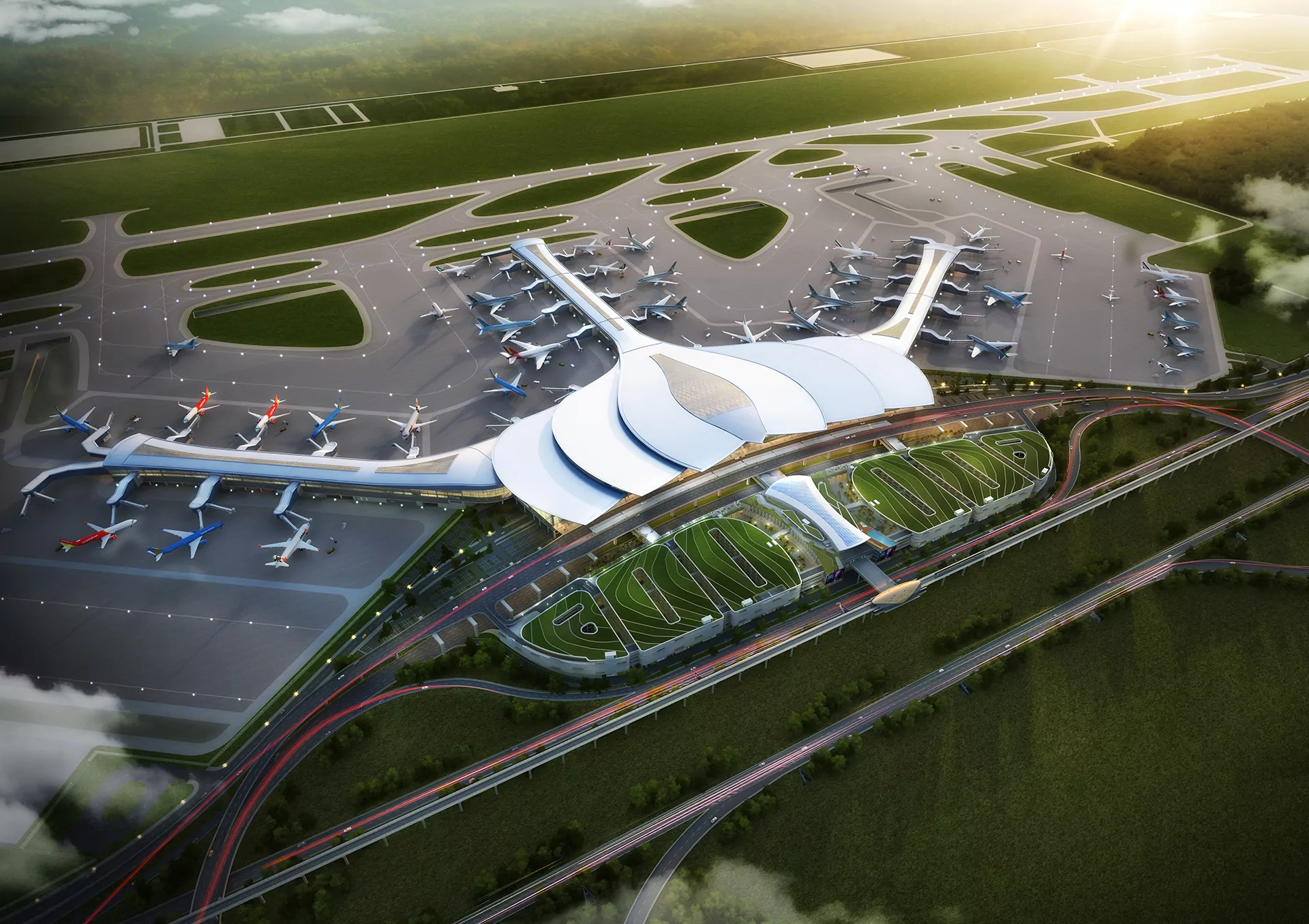
Long Thành International Airport received its first test flight (a Boeing 787) on December 15, 2025, and its first commercial test flight four days later. Phase 1, at a cost of ~$4.6 billion, provides capacity for 25 million passengers per year with one terminal and two runways. Phase 2 (feasibility study underway, ~$3.8 billion) doubles that to 50 million passengers. The full build-out envisions 100 million passengers per year, 4 terminals, 4 runways, and over 10,000 hectares – targeted for completion in the 2040s to 2050s.
For comparison: Berlin’s BER handles about 25 million passengers per year and took 14 years to build. Long Thành Phase 1 matches that capacity and went from construction start to first flight in roughly 4 years. Phase 2 would put it on par with Singapore Changi. Full build-out would place it among the largest airports on earth.
The B1M: Why Asia is getting another mega airport
Highways, bridges, and connectivity
The metro and airport projects are the headline acts, but what’s happening on the road network is equally relentless.
Ring Road 3 (76.3 km main section, ~$3 billion) is approximately 70% complete and targeting key interchange completion by June 2026. Ring Road 4 (159 km, ~$4.8 billion) was approved in June 2025 and targets groundbreaking in September 2026. The Bến Lức-Long Thành Expressway (58 km) is 88%+ complete and targeting full operations by Q3 2026. The HCMC-Long Thành Expressway is being emergency-expanded from 4 to 8-10 lanes. The HCMC-Mộc Bài Expressway (51 km, ~$780 million) begins main construction in April 2026.
Then there are the bridges. Cát Lai Bridge (4.7 km, 8 lanes, ~$760 million) replaces the Cát Lai ferry crossing, one of the most notoriously congested bottlenecks connecting HCMC to the former Đồng Nai province. The Thủ Thiêm 4 Bridge (2+ km, 6 lanes, ~$240 million) is a lifting bridge with 45-meter clearance for river vessels – something I’m personally waiting for to reduce the daily time wasted in District 4 congestion. A palm-leaf-design pedestrian bridge (720 m, ~$40 million, 100% privately funded) will connect Bến Bạch Đằng to Thủ Thiêm, targeting September 2026.
And possibly the most ambitious of all: Vingroup has proposed a Cần Giờ-Vũng Tàu sea crossing – 14 km total, combining an 8-km bridge, a 3.1-km immersed tube tunnel, two artificial islands, and 3 km of approach roads. Cost: ~$3.54 billion. This single piece of infrastructure would cut travel time between Cần Giờ and Vũng Tàu from 90-120 minutes to 15-20. It received approval-in-principle from the HCMC Party Committee in January 2026, with Vingroup given 12 months to prepare the investment report.
Thủ Thiêm – a new CBD from scratch
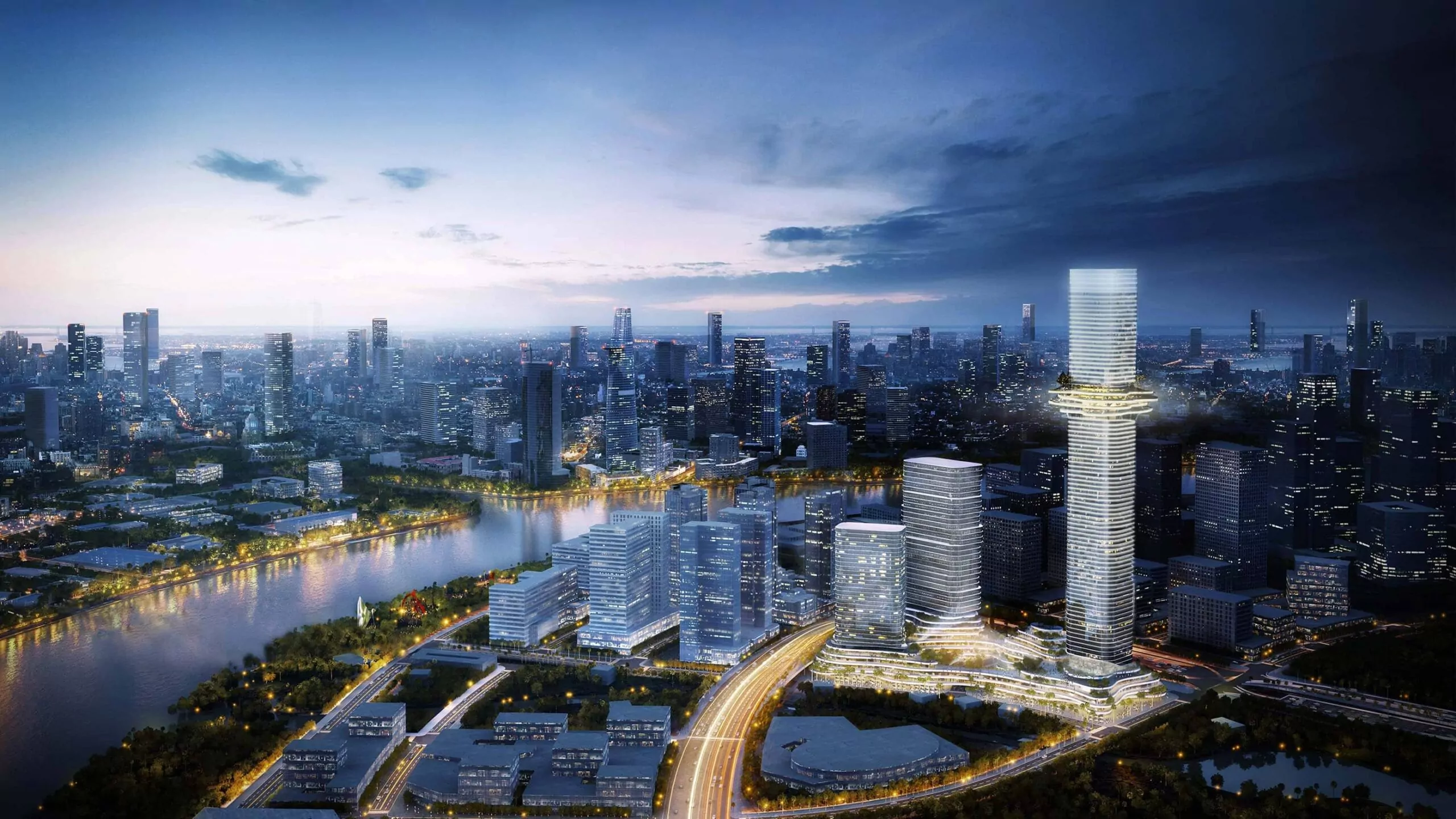
Across the Sài Gòn River from District 1, the old city center, Thủ Thiêm is being built as the new financial, political, and cultural heart of HCMC. This is not an expansion or renovation – it is an entirely new central business district rising from what was, until recently, marshland.
The Political-Administrative Center (7.84 ha, max 30 floors, arc-shaped, facing a 12-ha central lake) breaks ground in Q2 2026, designed to host 6,000 officials and 1,500-2,000 public visitors daily. Adjacent to it: a relocated Symphony/Opera/Ballet Theatre (3.18 ha) and a 10-ha wetland park. The entire complex exceeds 33 hectares.
The Vietnam International Financial Center (VIFC) was officially launched on February 11, 2026, with the Prime Minister presiding. Capital commitments at launch: ~$10 billion. Founding members include Sovico, MB Bank, TPBank, VinaCapital, and Nasdaq. The VIFC HQ currently operates from 8 Nguyễn Huệ in District 1 but will move to Thủ Thiêm after 2027.
The skyline ambitions match the financial ones. Empire City Tower (88 floors, 333 m, designed by Büro Ole Scheeren and KPF) is advancing through its residential phases, with the tower itself yet to break ground. A 99-floor tower (~500 m, which would surpass Landmark 81’s 461.3 m as Vietnam’s tallest) is in public consultation for rezoning at plot 1.K1.8.HH – no investor named yet, but the zoning proposal signals intent. The Saigon Marina IFC Tower (55 floors, 240 m, LEED Gold) opened in August 2025 on the District 1 side and serves as the first anchor project of the VIFC. And One Central HCM (twin towers, 240 m + 218 m, Ritz-Carlton hotel and residences, designed by Arquitectonica) has resumed construction after a decade of stalling, with a 48-month extension approved in November 2025.
Vinhomes Green Paradise – building a city from the sea
If Thủ Thiêm is ambitious, Vinhomes Green Paradise in Cần Giờ is something else entirely.
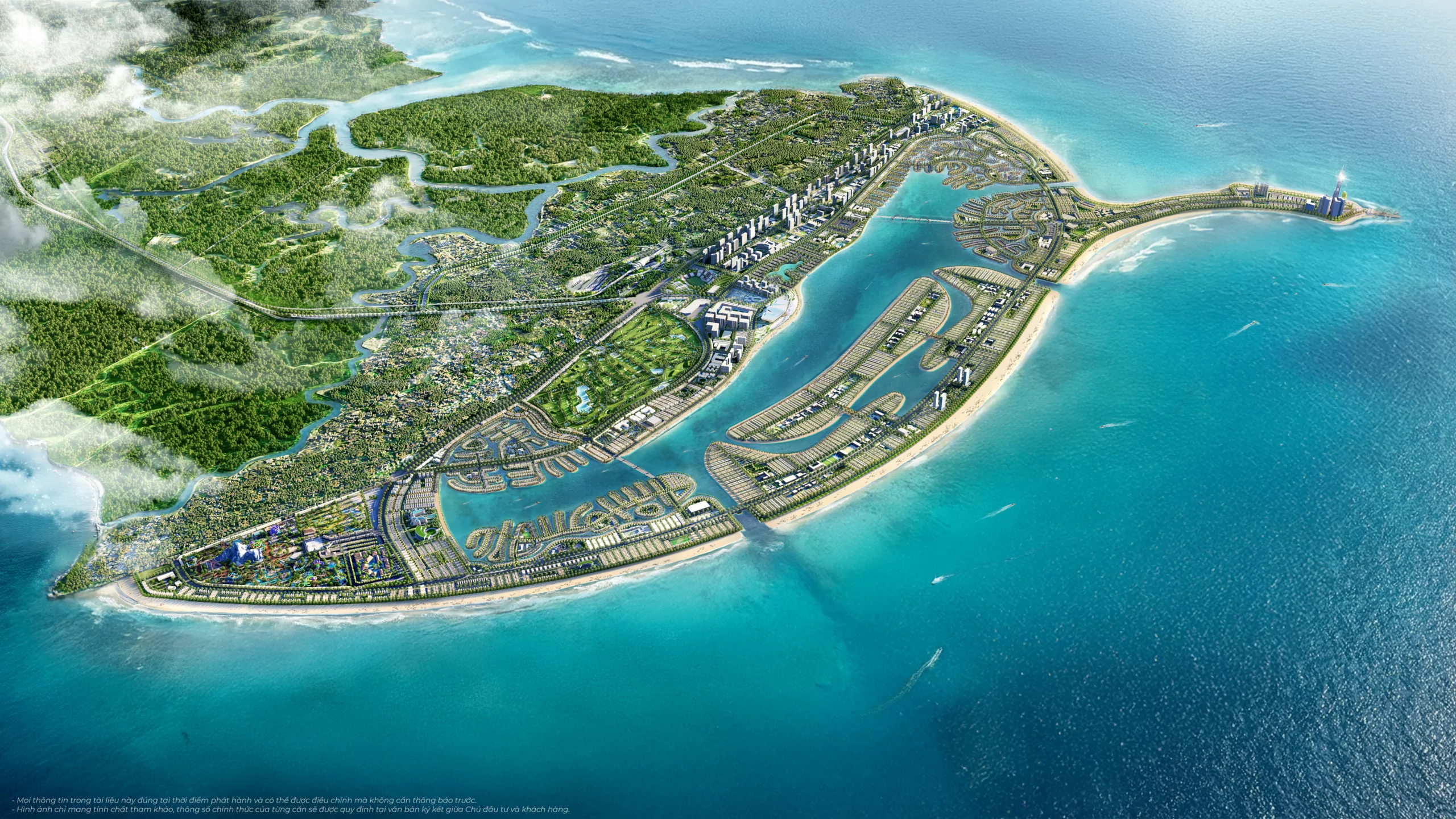
Vinhomes Green Paradise is a land reclamation project adjacent to the UNESCO Cần Giờ Mangrove Biosphere Reserve. Total area: 2,870 hectares. Total investment: more than $10 billion – the largest land reclamation in Vietnam’s history. Construction broke ground in June 2025 with heavy machinery working 24/7.
The numbers read like they were generated by me playing SimCity with infinite money: 121 km of coastline (53 km of public beach), an 800-hectare saltwater lagoon, a 5,000-seat theater, two 18-hole golf courses, a VinWonders theme park, a Safari park, a marina, a premium private hospital, and a planned 108-floor tower. Construction density: 16%. The energy target is 100% clean electricity from offshore wind and solar, with 100% net-zero transport. The tourism target is 40 million visitors per year. In March 2026, the project launched its ISO 37122 smart city certification roadmap, becoming the first participant in the “7 Wonders of Future Cities” campaign.
This is the project that the VinSpeed metro line is being built to serve. And the proposed Cần Giờ-Vũng Tàu sea crossing. Vingroup is not just building a city – it’s also building the infrastructure to reach it.
Rạch Chiếc – a sports complex for the region
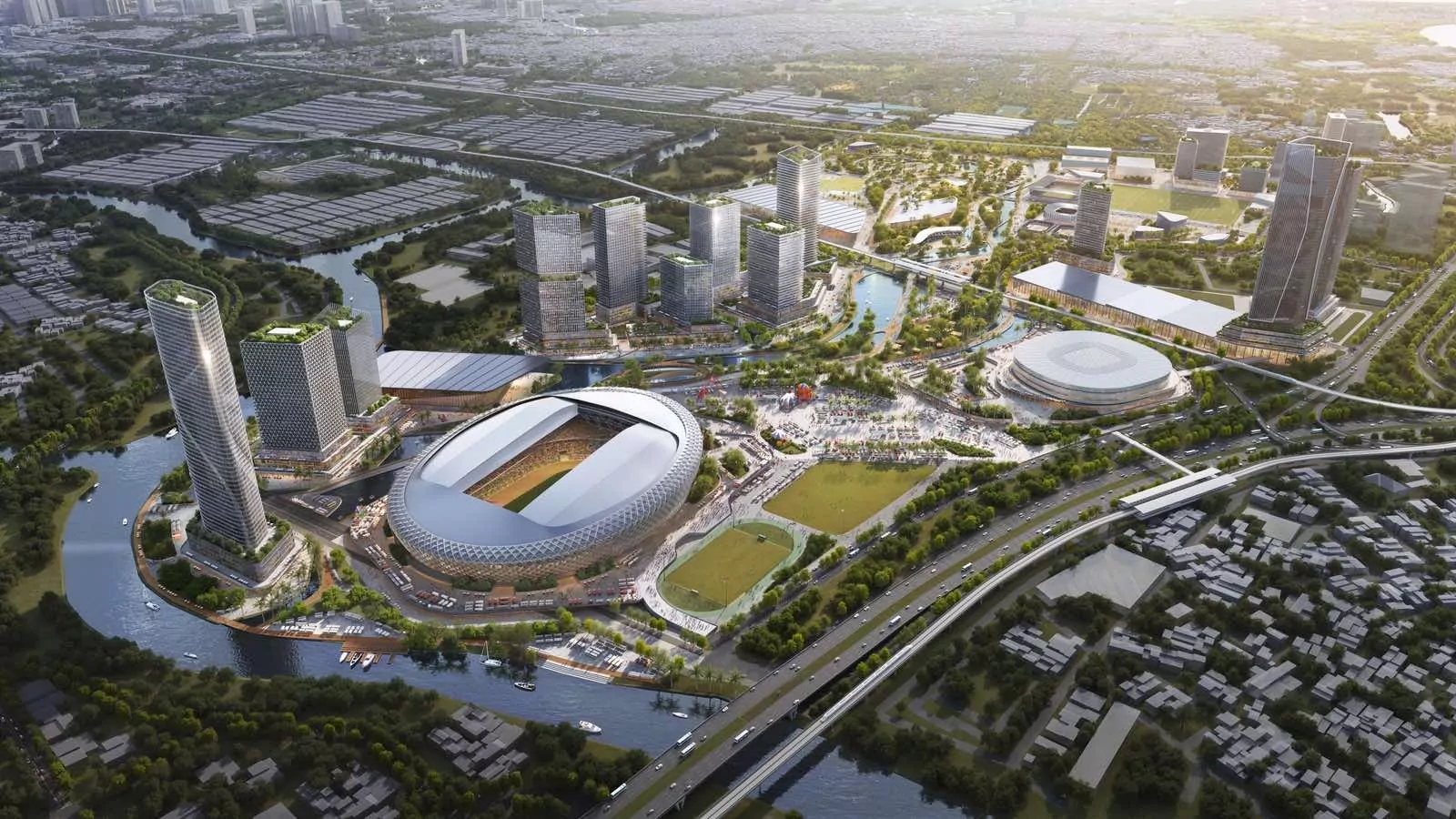
The Rạch Chiếc National Sports Complex broke ground on January 15, 2026. Area: 186.78 hectares. Cost: ~$5.5 billion. Investor: Sun Group (BT model). Architect: Populous, a Melbourne-based studio experienced in building stadiums for multiple Olympics and World Cups.
The centerpiece is a 70,000-seat stadium with a retractable roof and zone-controlled air conditioning – exceeding both Hong Kong’s Kai Tak Stadium (50,000 seats) and Singapore’s National Stadium (55,000 seats). The complex also includes an 18,000-seat arena, an Olympic aquatic center, a tennis center, and a 10,000-seat convention center. Completion target: 2030–2031. The complex sits near Rạch Chiếc station on Metro Line 1.
Seaports – competing with Singapore
The post-merger HCMC now controls a significant stretch of Vietnam’s coastline and some of its most strategically important port infrastructure.
The Cái Mép-Thị Vải port complex (formerly in Bà Rịa-Vũng Tàu, now HCMC) already handles roughly 34% of Vietnam’s container volume. It is the only port in southern Vietnam capable of receiving 250,000 DWT vessels. With extensions underway, the berth area is projected to reach 22 km – which would exceed Singapore’s total berth length.
But the flagship is the Cần Giờ International Transshipment Port: 571 hectares on Gò Con Chó islet, 7 construction phases, ~$5.1 billion investment, with the initial consortium led by Saigon Port JSC and TIL (linked to MSC, the world’s largest container shipping line). Phase 1 targets operations in 2027, with projected capacity of 4.8 million TEU by 2030 and 16.9 million TEU by 2047. Full completion is targeted before 2045. The post-merger HCMC seaport system is explicitly targeting a top-10 global ranking by container volume.
Flood control and the unglamorous essentials
Not everything that matters makes for a dramatic headline. Sài Gòn floods. Anyone who has lived here through a rainy season knows this intimately – and those of us in the southern districts near Phú Mỹ Hưng know it from tidal flooding that has nothing to do with rain.
Six tidal sluice gates (~$400 million total) are being completed across the city, with the Bến Nghé gate (between District 1 and District 4) entering trial operation in February 2026. The full 6-gate system targets mid-2026 completion and will protect 570 km² and 6.5 million residents. Two of these gates – Bến Nghé and Tân Thuận – directly affect tidal flooding on Nguyễn Lương Bằng and the surrounding Phú Mỹ Hưng area. The Tham Lương-Bến Cát-Nước Lên Canal (32 km, ~$360 million) is 65% complete. The Xuyên Tâm Canal (8.9 km, ~$690 million) is in land clearance phase with a 2028 completion target.
And that’s not even everything
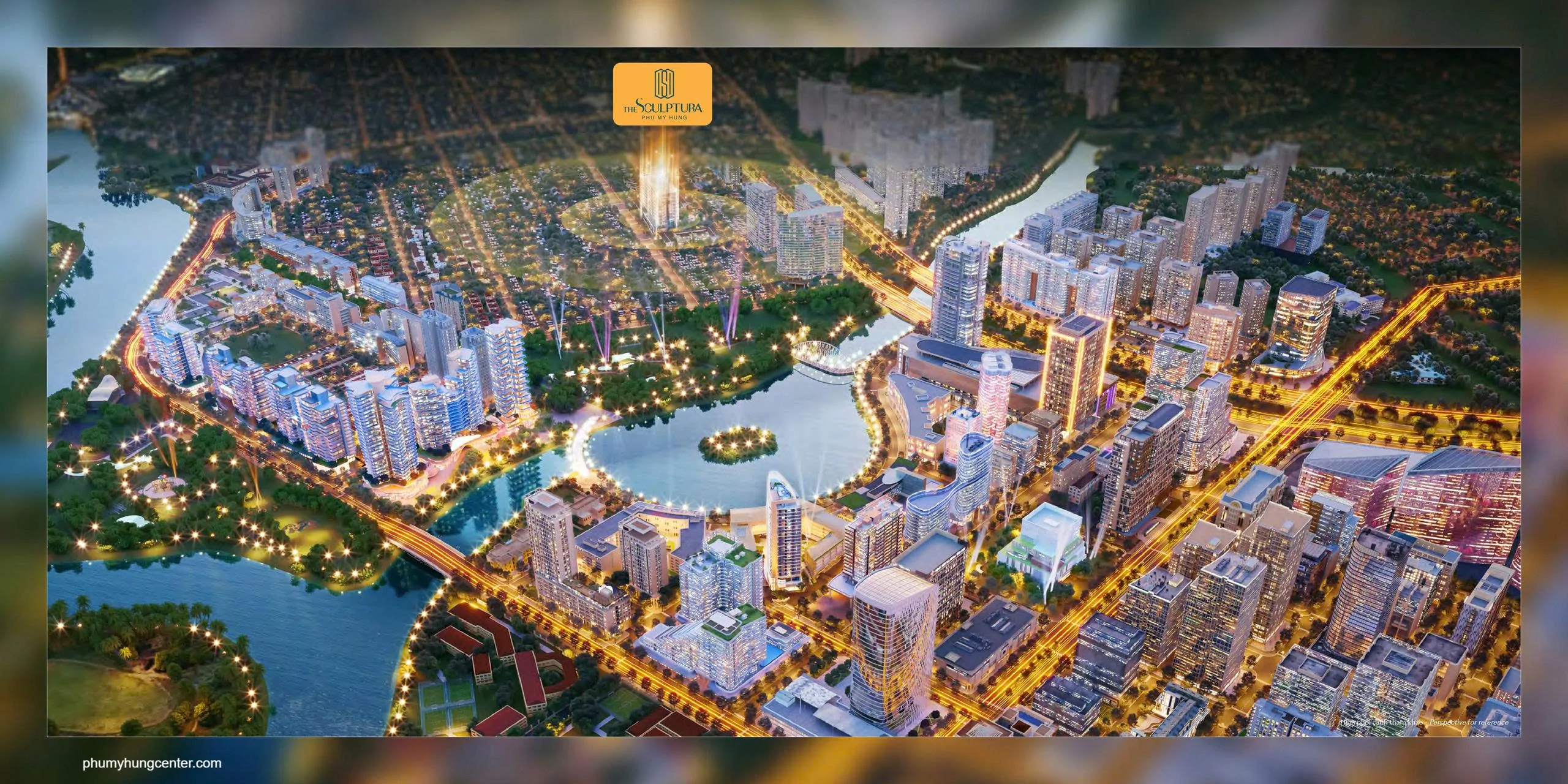
I’ve focused on the game-changers, but the list of secondary projects that would be a headline act in most cities is absurd: new public parks created from former government land (the 32-hectare Nhà Rồng Wharf conversion in District 4, the Thủ Thiêm Riverside Park that opened in December 2025), the widening of major arterials, Phú Mỹ Hưng’s own $500 million+ “PMH 2.0” reinvestment program bringing new residential & office towers, a $30 million art center, and a $300 million hospital to my neighborhood. The construction sites outside my window aren’t even the biggest ones in the city. They’re just the closest.
A reality check
I’m excited. Genuinely, deeply excited. I wake up to the sound of a city building itself and I feel lucky to witness it. But I’m also not naive.
Vietnam’s track record with mega-infrastructure is mixed. Metro Line 1 – the same line that now carries 56,000 passengers daily and is being celebrated as a triumph – took roughly 15 years from groundbreaking to operation, through multiple delays, contractor changes, and budget overruns. The target of 200 km of operational metro by 2030 – from the current 19.7 km – is, mathematically, nearly impossible. VinSpeed’s 2028 completion date for a 54-km elevated rail line is, by any global standard, aspirational at best. The 99-floor Thủ Thiêm tower doesn’t even have an investor yet. The Bến Lức-Long Thành Expressway has been under construction since 2014 with a Japanese contractor abandoning the critical bridge section. Several high-profile projects in Thủ Thiêm have already stalled or been terminated – Lotte’s Eco Smart City collapsed under its land fee burden, and IFC One Saigon has been 80% complete since 2012, sitting vacant as a consequence of the Vạn Thịnh Phát collapse.
Ambition and execution are not the same thing.
But here’s what’s different this time, or at least what appears to be different: the institutional awareness of past failures seems genuine. Resolution 188 didn’t just throw money at metro projects – it specifically dismantled the procedural bottlenecks that made Line 1 take 15 years. The province merger isn’t just administrative reshuffling – it consolidated decision-making authority so that a highway crossing from the old HCMC into the old Bình Dương no longer requires coordination between two separate provincial governments. The PPP frameworks have been redesigned after the failures that froze them. Private capital from Vingroup, Sun Group, and others is not waiting for government permits to begin work – they’re breaking ground under new BT models with land-repayment mechanisms that didn’t exist two years ago.
Living inside the game
I spent my childhood building cities on a screen. Laying roads, zoning districts, placing transit lines, managing budgets, watching a city grow from a few houses to a skyline. The thing that always fascinated me wasn’t the destination – it was the process. The moment a highway interchange connected two districts that used to be isolated. The first train running on a new line. The population counter ticking up because you built something that made people’s lives better.
Now I live inside the game.
The metro that will run less than 500 meters from my apartment doesn’t exist yet – it’s an emerging construction trench and a forest of orange safety barriers. The Cần Giờ it’s heading toward is still mostly mangroves and fishing villages. The 70,000-seat stadium is a plot of cleared land near a metro station. The high-speed rail to Hanoi is an approved resolution and a lot of engineering studies. The tallest office building in Thủ Thiêm is still shorter than the tallest residential one in my district.
But the cranes are turning. The pile drivers are hammering. The concrete is being poured.
And every morning at 5:47, my alarm goes off. Thank goodness for earplugs.
Hero image: Frame capture from Cầu Đi Bộ Thủ Thiêm Thi Công Trụ Trên Sông, Grand Marina Triển Khai GĐ2, The Metropole Quá Nhanh by Hà Viễn Phương TV.